
I wrote and presented At Home With The Georgians at the suggestion of Janice Hadlow, controller of BBC Two. She'd heard me give some public lectures on 18th Century private lives and read my new book about homes in Georgian England.
Janice reckoned the combination of characters, stories and interiors would make appealing TV. Or "sex, scandal and soft furnishings" as the trailer promises.
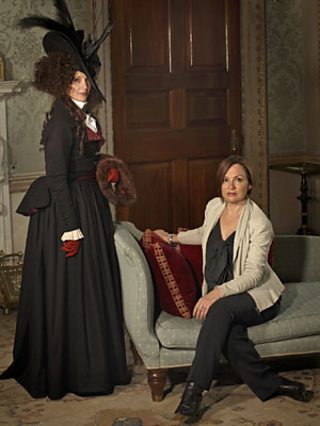
The recognisably modern middle class home was taking shape in the 18th Century when Britannia ruled the waves and became the world's leading manufacturing power.
The Gorgeous Georgians thought of themselves as 'a polite and commercial people', a nation of shop-keepers, consumers, and home-makers who loved to socialise and keep up with the Joneses.
Our towns and cities were rebuilt in the 18th Century according to the geometrical rules of classical Rome - all careful proportion, symmetry and clean lines. The Georgian townhouse is still the estate agent's dream ticket.
But inside those immaculate terraces there was a riot of up to date consumer goods - flock wallpapers, chintz curtains, silver plate tableware, Axminster carpets, and Wedgwood vases.
The polite threw open their doors to visitors, inviting the world into their parlours to drink the new exotic hot drinks (tea, coffee, chocolate), to gossip, and to admire the shiny new fixtures and fittings. Home improvements and interior decoration were the craze of the age.
The Georgians had this revolutionary new obsession: good taste. It sounds so quaint and suburban today, something that Hyacinth Bucket or Margo Leadbettermight get steamed up about. But 'taste' was fresh as paint in the 18th Century.
For the first time, quite ordinary middling people saw their interiors as an expression of personality. Your character, your education, morals, even the state of your marriage could all be judged from look of your home. Would your front room stand up to scrutiny? Would your choices cut the mustard?
The whole subject is so visual and colourful it leant itself to TV. I spent the summer getting behind the scenes in National Trust and English Heritage mansions, as well as the store rooms of the Victoria and Albert Museum and the Museum of London.
I loved finding hidden closets, back stairs and servants' back kitchens and garrets (some of the best are at Erdigg in Wales).
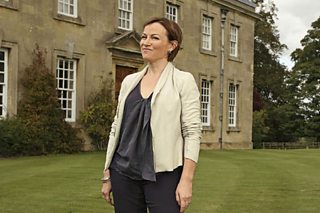
But there is plenty of full-on design glamour too - like the brilliant yellow Chinoiserie of Claydon House (Bucks), the Neoclassical Bling of Syon House (Middlesex), the magical honey colours of Parham (Sussex), the old-fashioned romance of Townend (Cumbria) and the profusion of Chippendale furniture at Nostell Priory (Yorkshire).
But I'm not just interested in the interior lives of the rich. The Georgians came up with clever ideas for keeping up appearances on a middle income.
Slapping up wallpaper was one way to transform the look of a room for a fraction of the cost of textile hangings, wood panelling or stucco.
And if you were strapped for space, why not invest in some ingenious metamorphic furniture (multi-purpose tables, wardrobes that turned into beds) to get the most out of your bedsit?
Temple Newsam in Leeds has a choice collection - the drop-down bed that folds out of a chest is a wicked spring-loaded contraption that nearly crushed me.
Historians are all natural voyeurs itching to know what really went on behind closed doors. I have spent the last six years toiling in deeply unglamorous local record offices reading diaries, letters, accounts books, criminal records and business papers.
I use them to unlock the secrets of home sweet home and peel back the façade of Georgian elegance.
At Home With The Georgians is the story of men as well as women, master of the house as well as domestic goddess.
Only when he married and set up home did a frustrated boy become a fully fledged man. I used the plaintive diaries of half-baked bachelors Dudley Ryder and John Courtney to show how men yearned for domesticity.
They are so artless in their romantic failures and frailties - I found myself blushing for them. Ryder worried that he had bad breath but was too embarrassed to ask his mother. He even fretted that nerves would make him impotent on his wedding night.
The letters of Mary Martin reveal the Georgian ideal wife, loyal, bossy and frisky - a sexy battle-axe. But the papers of Ann Dormer and Gertrude Savile are painful to read - both were victims behind closed doors. They show that a rich man's house could still be a prison.
Ann Dormer was married to a pathologically tyrannical husband, Robert Dormer of Rousham, in Oxfordshire, who censored her letters, watched her every move and even kicked in the nursery door on the hunt for her.
She enjoyed none of the prestige and power the mistress fully expected to enjoy indoors. So her marriage was a 'yoke', a 'net' and a 'cage'. Rousham was never 'her house'.
Gertrude Savile was a morbidly shy spinster clinging on in her brother's house Rufford Abbey, in Nottinghamshire, dependent on him for "every gown, sute of ribbins, pair of gloves, every pin and needle". Even the servants "treated [her] like a hanger on upon the family".
Constantly made to feel her inferiority, Rufford had no warmth for her "home! Why do I call it home? I have no home".
There were winners as well as losers at home.
It's our attitude to house and home which defines the British as a people. Let foreigners keep their apartments, most Brits want their own front door and a patch of garden.
An Englishman's house is his castle after all. This series gets to the bottom of this very British obsession and recreates the interior lives, hopes and dreams of women and men.
Professor Amanda Vickery is the presenter of At Home With The Georgians and author of Behind Closed Doors: At Home in Georgian England.
At Home With The Georgians is on BBC Two at 9pm on Thursday, 2 December.
For further programme times, please visit the upcoming episodes page.
Comments made by writers on the TV blog are their own opinions and not necessarily those of the BBC.

