
It's perhaps not surprising that I became a film curator.
I come from a family who documented their lives through home movies over a period of almost 60 years.
Every few years we hold a grand screening, projecting the films onto a sheet at the bottom of the garden.
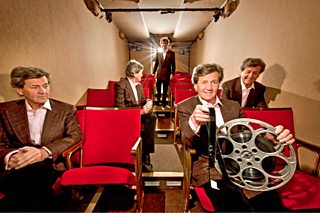
Melvyn Bragg inside the mobile cinema
When I watch them now, the pleasure is not just about seeing my parents when they were young, but the way the films connect our lives so potently to the times in which they were shot.
That's what I love so much about Reel History of Britain.
It uses film to tell very personal, individual stories, but connects us all to the monumental history of the last 100 plus years.
The series came into being through a happy coincidence.
BBC Entertainment Manchester were looking to develop a people's history of Britain.
At the same time the BFI - working with Britain's other national and regional film archives - was completing work on an epic undertaking to safeguard our film heritage and to make it available to people no matter where they live.
Reel History of Britain, commissioned by BBC Two daytime controller Liam Keelan, is one of the first steps towards ensuring that this access happens.
The BFI looks after the national collection of film and TV.
It's a remarkable collection of almost 1,000,000 titles - from the original negatives of Alfred Hitchcock's silent films made in the 1920s to The King's Speech.
But many of the stars of the collection are not the famous features, but the non-fiction films - the newsreels, documentaries, travelogues and home movies that capture life in Britain over the last 116 years.
Melvyn Bragg looks at films of the World War Two evacuation.
I work with the BFI's team of curators and, led by my colleagues Jan Faull and Simon McCallum, we selected hundreds of films that were shortlisted for use in the series.
Among my favourites that made it to the final cut is the brief, but evocative footage of the 1895 Derby (the oldest surviving British film); SS Olympic (1910), a spectacular film about the building of the Titanic's sister ship and We Are the Lambeth Boys (1959), a groundbreaking documentary focusing on the lives of a group of working class teenagers in south east London.
Seeing the boys reunited for the series 52 years later is remarkable and emotional - their lives having moved in directions that their teenage selves could never have guessed.
It is this connection between the films and the original participants that makes the series so compelling for me.
The sequence that I enjoyed the most was from the episode celebrating the British seaside holiday.
Here we see extracts from Holiday (1957), an exuberant portrait of ordinary people enjoying the kiss-me-quick pleasures of Blackpool.
On board the rollercoaster at the beginning of the film and screaming for all she's worth is a teenage girl, clearly making the most of her 15 seconds of fame.
I've seen the film a number of times over the years and for some reason the young woman's face stuck in my memory.
Remarkably, the production team managed to track her down.
The screaming girl is Sandra Burslem (now Dame Sandra) who grew up to become Vice Chancellor of Manchester Metropolitan University and even has a building named after her.
Sandra was not planning to ride the rollercoaster that day.
She was out for a walk in Blackpool, spotted by the director and asked if she'd pose on the rollercoaster for the camera.
You get the impression that screaming was really not Sandra's style, but that was what the director wanted, so that was what Sandra did.
And very convincing she was, too.
It's only a brief and seemingly insignificant moment, but it tells us a lot about filmmaking: don't believe everything you see.
Even if a film purports to be factual, it will be riddled with little fictions.
Robin Baker is the head curator of the BFI National Archive.
Reel History of Britain started on BBC Two on Thursday 5th September at 6.30pm and continues at the same time every weekday.
For further details, please visit the upcoming episodes page.
Comments made by writers on the BBC TV blog are their own opinions and not necessarily those of the BBC.

