
I'm really interested in making documentaries that go into worlds we seldom get to see, so I was thrilled to be asked to work with producer Lucy Cohen on an observational film made inside a psychiatric hospital.
I'd also had an old mate who'd been in and out of psychiatric hospital many times and felt strongly that people in that situation should be given a chance to share what it feels like.
Sectioned was in development for nine months before anything was filmed. Lucy scoured the country for a mental health trust who'd grant us the necessary level of access to their psychiatric services.
She found that Nottinghamshire Healthcare NHS Trust, one of the largest in country, shared her strong belief that the documentary was a real chance to help break down stigma around mental illness.
Once we started looking for contributors for Sectioned, however, we soon discovered there were very few people both well enough and brave enough to appear in the film. But following the guidance of some of the Trust's consultant psychiatrists and nursing staff, we began to meet patients who had an unfolding story we could follow.
It was absolutely crucial that anyone who might take part was well enough to make a decision about being filmed. Before I shot a single frame, lawyers from the BBC and the NHS Trust drew up a rigorous protocol.
A key staff member treating each potential contributor would sign a form to confirm the patient had the mental capacity to consent to filming and that they understood what it would entail.
The contributors themselves had to give three levels of consent - in writing, on-camera (which you see in the programme) and then at the end once they'd seen the final film.
We checked in with staff every time we wanted to film and they had the power to stop us at any time. Once these safeguards were in place, we could begin to tell their stories.
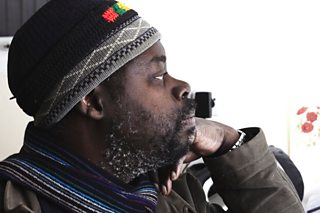
We met Anthony quite early on and it was obvious how deeply frustrated he was with the psychiatric system. He's been in and out of hospital for 26 years since a breakdown back in 1984, but rejects the label of schizophrenia he's been given and hates the medication he has to take when under section.
He feels trapped in a Catch 22-like situation - if he protests against taking medication, he's told that shows what little insight he has into his illness and proves how much he needs to take the medication.
But when Anthony's daughter Marcia described the level of self-neglect Anthony sinks to when not on his medication, it was clear his story was more complicated than it first appeared.
I met Andrew on one of Nottingham's treatment and therapy wards. A month earlier, during a paranoid episode, he'd been involved in a high-speed chase with three police cars and when he was finally caught, he was arrested and then sectioned.
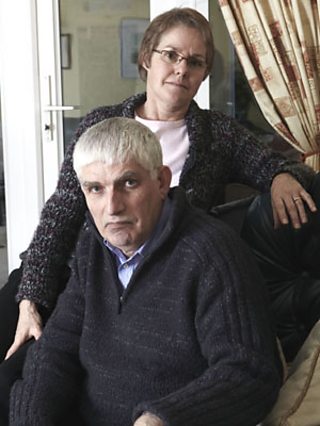
Andrew recently retired from a long and fulfilling career as a consultant pathologist despite enduring bouts of bipolar disorder for 30 years.
Even when unwell, Andrew seemed to have a real insight in to his illness and after our first conversation he was keen to take part in the film.
But he was still in the manic stage of a bipolar episode and it was a few weeks before his consultant was happy enough with his progress to allow any filming.
When Andrew's mood sunk into the depressive stage of the illness he found the filming very arduous and some days he couldn't face it. But such was his belief in the project, he admirably continued when he could.
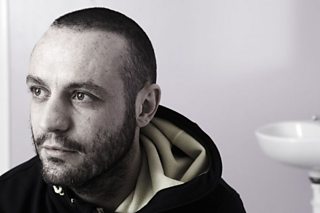
The day we met Richard on the intensive care ward, he was hearing voices and experiencing powerful suicidal thoughts.
Now 34, Richard had his first psychotic episode 15 years ago and was diagnosed with paranoid schizophrenia. Despite the delusions Richard was experiencing during our first meeting, his consultant was confident Richard still had the capacity to decide about being in the film.
Lucy and I were immediately struck by how charming and positive Richard is about life despite the huge challenges he faces.
The intensive care ward is an intimidating place for the uninitiated, but Richard soon made us feel comfortable and although it was hard at first to know how to react to the long pauses while Richard listened to 'the gods' in his head, we soon got used to it.
I set out to try and build relationships with Anthony, Richard and Andrew that were not based just on discussions about their mental health.
Perhaps the fact that that turned out to be so easy says something about my own prejudices going in to the project.
These men don't want to be defined by mental illness, although that is often how they feel others see them.
We wanted to make a film that gave a voice to those whose identity is often masked by a label and all three men have said making the film gave them that opportunity. That they found the experience of making Sectioned helpful is what I am most proud of.
Ben Anthony is the director of Sectioned, co-produced by the Open University, and is available on iPlayer until Thursday, 26 May.
Sectioned is part of the Out Of Mind season, a series of programmes which focuses on mental health issues.
For more information about Sectioned or for information on how to get help with the issues raised in this blog post, please visit the BBC Headroom website.
