Filming Gary Barlow: On Her Majesty's Service

Ben Winston
Director
Making a show like Gary Barlow: On Her Majesty's Service is a director's dream job.
To be able to travel all around the world, on a real mission of discovery, and be part of something as big as the Jubilee feels like a real honour.
Gary was asked some time ago to make a song for the Queen for her Diamond Jubilee celebrations.
I think at first he wondered if it was his kind of thing.
Sometimes these 'event songs' don't manage to capture the moment. But I could see from chatting to Gary, that he was tempted.
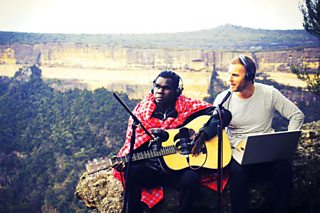
Aboriginal musician Gurrumul plays guitar with Gary in the Blue Mountains, Australia
It was when he thought of the idea of including the Commonwealth, we both felt he was on to something.
Choosing the countries was a real debate. Kenya was obvious to us both. Not only was it so important to capture the sound of Africa - but as the Queen became the Queen while she was there, where better for us to start?
After that we looked at the 16 realms, where the Queen is actually the monarch of the country - and tried to get variation in both the sounds of the place, and the look.
Jamaica is the home of so much music. Australia gave us orchestras and modernity. Solomon Islands gave us that middle-of-nowhere feel.
The thing that excited me about this, was how much was at stake for Gary. How real this all was.
He may be an acclaimed songwriter - the man is a hit factory - but this was a real challenge. Firstly creatively.
He had nothing more than a small piano melody when we left the UK. No lyrics, no clues as to what our song would end up sounding like.
Secondly, technically - travelling to the middle of nowhere with only minimal equipment is far from what he is used to.
Add that to the pressure of knowing the Royal Family were waiting for this song, and I was going to be on his shoulder filming the whole time - this was a big deal.
I approached this film looking at a few different angles. Overall it was of course the story of Gary making this song and the process behind that.
But this film had to be as much about the characters he meets, as it is Gary.
I feel we could have made a whole film about the slum drummers in Kenya. How can one not be moved when listening to their plight, and hearing them play their instruments made of rubbish?
Gary has a drum-off in a Nairobi slum
If you see where they come from, and hear what they all bring to the song, I feel the record means so much more.
And what a treat to be able in a one-hour film to have that many different backdrops, from rainforests to deserts to film in.
It was so important to me that this film looked beautiful. Everywhere we went had beauty - so the film needed to show that.
I was surprised to see how moved Gary was by the experience. I think he felt that music for him had become his business and he perhaps had lost a bit of what got him into music.
It was these characters, who play simply because they love it, that reignited his fire once more.
I think if the film had just been Gary meeting people - it could have dragged. The fact we see him going through something too allows the film to be richer.
It was of course a huge honour - and a rarity - to get so many members of the Royal Family in the documentary. But I think they were excited by the idea, and interested in the prospect of it all.
Working with Gary was a pleasure. He is so passionate - up early every day, eager to meet new people, determined to create this special song.
He is a joy to be around every day. There is no editing to make him look great - he is as natural and funny as he comes across on screen. I felt very honoured to be part of this whole journey.
Ben Winston is the director and executive producer of Gary Barlow: On Her Majesty's Service.
Gary Barlow: On Her Majesty's Service is on BBC One and BBC One HD at 7.30pm on Sunday, 3 June.
Comments made by writers on the BBC TV blog are their own opinions and not necessarily those of the BBC.

