
Lucian Freud: filming with the artist
At a meeting just before Christmas 2010 Lucian Freud, a small ancient figure at 88, sitting surrounded by fresh piles of newspapers, with their lurid headlines, suddenly stared, with characteristic bulging eyes, out of the window of Clarke's restaurant in Notting Hill, London.
He had noticed a pair of mounted police, heads down, battling through a sudden heavy snow storm.
The street scene erased in the white-out left just the foreground of chestnut horses and fluorescent riders, like a children's book illustration. Lucian was thrilled with the sight.
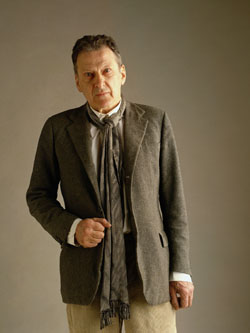
Lucian Freud
We met to discuss Lucian Freud: Painted Life - the BBC Two documentary I was to make.
My impression was of someone extremely alert, animal-like, relying for information to a great extent on what he saw.
The bliss of looking, to struggle to capture in paint something precious, the presence of a human being, were his activities 24/7, but as the newspapers and conversations indicated, he was interested in anything.
At the meeting he asked me a few questions about the nature of documentary films, which were sharp, tough, and funny.
"Is a documentary" (residue of German accent) "like a sign that says 'Toilet'? Is it not merely educational?"
He tolerated my fumbling answers, but he expected absolute honesty. Apparently, I was told later by a close friend of his, this was a mild reflection of the much more contrary and confrontational younger Freud.
His questions put a finger on essential issues.
The problem of 'documentary' is that it claims some sort of automatic or special truth, through photography's claim to truth, an idea that dominated Lucian during his lifetime.
Where does the truth about something or someone lie? How do you deal with it in a film? Stop pretending your medium has any built-in objectivity?
Why bother, Freud would say. For him, painting was the only medium adequate to the task of searching for truth.
In order to see this content you need to have both Javascript enabled and Flash installed. Visit BBC Webwise for full instructions
David Hockney on Lucian Freud's painting technique
Making a painting was the most important thing anyone could try to do, if they were to get close to the essence of things, to approach an absolute truth.
At another meeting, the sun was streaming in. By then Lucian knew I liked his regular food supplement: nougat. He cut me a slice without me asking.
At the end of the film, the art critic Sebastian Smee said that in the company of Lucian he did not feel the need to say anything clever, just to be with someone so intense and so alive was enough. I think that is so insightful.
I hardly said a thing - not that it would have been clever if I had.
Lucian started wiggling his fingers around to make interesting shadow patterns. The shadows were green by some accident of light reflecting from the leaves of flowers on the table.
He enjoyed the sight, and so did I.
We started production in the spring of 2011. Lucian said he would still be around for his exhibition at the National Portrait Gallery which started this month.
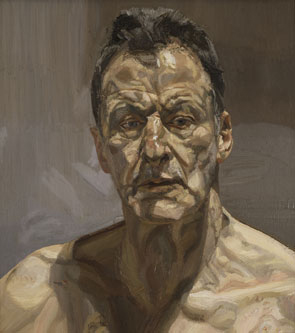
Reflection (self portrait) 1985
Many of his friends and family now felt free to take a bigger part in the film, and, in their grief, to articulate the feelings and insights that are so much in the foreground of the mind when someone you love dies.
The aim of the film is to look more closely, with an open mind, at the work. The editor, Paul Binns, and I tried to deploy the amazingly candid interviews from old friends and family to reveal themes in the painting.
At the moment I write this the composer and musician John Harle is performing a saxophone part for his intensely moving score.
I am sitting in a square room with red curtains on all sides, and a mass of sound mixing technology.
Thinking about Freud makes me look more closely and with greater fascination at the most ordinary of things - to realise what a strange place the world is, and how barely we understand it.
Randall Wright is the director of Lucian Freud: Painted Life.
Lucian Freud: Painted Life is on BBC Two and BBC HD on Saturday, 18 Feburary at 9pm.
For further programme times, please see the upcoming broadcasts page.
Comments made by writers on the BBC TV blog are their own opinions and not necessarily those of the BBC.


Comment number 1.
At 23:35 18th Feb 2012, Nicholas wrote:Thank you for this brilliant film; and to all those who helped put it together, and contributed. I, and likely many others, have been deeply moved seeing this.
The subtlety of the documentation and startling human insights into his genius and personality has left me mute.
I am sure I was not the only viewer who had to turn off the TV after the film given the need to cut off from further visual perception and mentally process the preceding ninety minutes again and again. Stunning. Thank you!
Complain about this comment (Comment number 1)
Comment number 2.
At 12:44 19th Feb 2012, Jane Elizabeth wrote:I agree it was a brilliant, albeit intense, film. I'm still not very fond of Freud's work, but now I understand it, and him, better. Paradoxically, his death allowed people to be more forthright and tender in talking about him which brought out both the light and the shade in his character - particularly revealing through the words of his daughters. Randall Wright's delicate touch in the design and production of this film were wonderful. Thank you BBC4 for bringing this to us and for allocating a sensible amount of time for a complex and demanding subject. It was a shining light in an otherwise dismal TV schedule and should become a classic documentary in the future.
Complain about this comment (Comment number 2)
Comment number 3.
At 14:53 19th Feb 2012, DPStL wrote:In a world of "fake" - celebtities with no talent, artists who prostitute their work for money & sharks profiting from it all - it is refreshing to see this honest & inspiring film.
Hope it will be repeated as I can't get the i-player in Belgium.
Complain about this comment (Comment number 3)
Comment number 4.
At 18:31 19th Feb 2012, Rebecca Child wrote:Thank you Randall for a fantastic film; subtle, moving, and it felt a great privilege to watch him working in his studio, surely the most private space for a painter. Wonderful, and I need to see it again.
Complain about this comment (Comment number 4)
Comment number 5.
At 21:40 19th Feb 2012, Nicola wrote:Congratulations and thank you for this brilliant, interesting, moving, inspiring film.
Complain about this comment (Comment number 5)
Comment number 6.
At 11:48 20th Feb 2012, Gordon Pullar wrote:Thank you for a wonderful programme,an in depth look into the artists life...beautiful!! Would you know the name of the music in the opening credits?? That set the mood for me.
Complain about this comment (Comment number 6)
Comment number 7.
At 13:28 20th Feb 2012, GARGLEBLASTER wrote:This was a very special documentary about a very special artist. It was a very special documentary because of the way it was made. This has had to be one of the best documentaries made about a 20th century British artist. Apart from a minimal use of music there was just the voice off of the narrator. No tricky camera work, no wretched presenter more interested in him/herself than the subject of the documentary and time to see some of the works.
The previous night I tried to watch the programme on BBC4 about Purcell and had to turn off because of the presenter and the constantly moving camera. Tonight's programme proves that it is possible to make a good documentary using an almost minimalist style and yet retain the viewer's interest 100%, or at least, mine.
Thanks BBC.
Complain about this comment (Comment number 7)
Comment number 8.
At 14:23 21st Feb 2012, Megan wrote:This video is full of interesting information. Learning about Freud's life allows us to relate to his work from a new aspect.
Complain about this comment (Comment number 8)
Comment number 9.
At 14:23 21st Feb 2012, alex wrote:I found this film quite interesting and has plenty of interesting information. I
enjoyed learining about this artist. i liked the normality and beautifulness of the bodys he painted, he painted them how he saw them and not in a way that people would want to see them, edited and fake etc...
Complain about this comment (Comment number 9)
Comment number 10.
At 21:54 24th Feb 2012, MaryF wrote:Excellent film sensitively made, thank you. So interesting to see great artists at work. I think it should remain on iplayer for longer so that people who missed the programme can see it. I look forward to more films on artists from Randall Wright.
Complain about this comment (Comment number 10)
Comment number 11.
At 11:20 26th Feb 2012, YannickTreboul wrote:I thought the interviews were insightful and excellent, and you got a great sense of the way he used paint - interesting that John Richardson reprised his Picasso comments on the link between sex and art. Some of Freud's sources would have been welcome, hardly a mention of another painter except Bacon (German 'New Objectivity', Chardin, Craxton etc.) And no mention of the feud with brother Clement?
Complain about this comment (Comment number 11)
Comment number 12.
At 15:30 28th Feb 2012, Randall Wright wrote:Thank you for these comments. I have been completely overwhelmed by the reaction to this film.
By the way if you liked the music you can find the tracks at JohnHarle.com. They are 'listen only'.
I agree with Yannick above that the art historical connections are really interesting, especially Courbet and Cezanne, Hals, Gericault, Titian, Van Eyck and so on, to add to his list. I felt that in the end a discussion of these connections belonged to a different kind of film. Martin Gayford discusses many of them eloquently in his book Man With a Blue Scarf.
Complain about this comment (Comment number 12)
Comment number 13.
At 10:29 18th May 2012, carmen valerio wrote:This was the first work of the director, Randall Wright that I had come across. It's a beautiful film which I return to again and again. Congratulations on realising such a special and insightful portrait of the artist, Lucian Freud.
Complain about this comment (Comment number 13)