
Roger: Genocide Baby
Post categories: bbc three, director, documentary
 |13:13 UK time, Tuesday, 12 July 2011
The idea for Roger: Genocide Baby sparked to life as I sat watching BBC Breakfast, munching on some oats.
A young British actor, Roger Nsengiyumva, was promoting his new film Africa United and I heard him say something like, "Yes, I was born in 1994 during the Rwandan genocide."
I put my bowl down and picked up the phone. "Roger's agent please..."
Days later I was at Roger's family home in Norwich asking them to let me tell their story.
And the story is rather extraordinary.
In order to see this content you need to have both Javascript enabled and Flash installed. Visit BBC Webwise for full instructions
Roger visits Nyakabanda, where his father was killed
Roger was born only days into the Rwandan genocide. He only survived thanks to the raw courage of his mother, Illuminee, who spent 100 days hiding herself and her newborn baby from the death squads.
They cowered in the family home and in a number of safe houses around the city.
His father, John, was tragically hacked to death by the neighbours.
Remarkably, Illuminee has come to forgive the men who killed her husband. Roger has not.
The BBC team who commission programmes asked me, as the director, to use Roger: Genocide Baby as a means of exploring forgiveness, a universal theme which we can all relate to in some way.
This was absolutely fine and would give the story added depth.
But for me, personally, this film would take me back to a harrowing chapter in my own life.
I grew up in Rwanda, my parents were Christian missionaries and we lived in the capital city Kigali.
I was 15 when the genocide began. It's odd looking back.
I remember 10 days of fear, and then whispered rumours of Tutsi friends being killed, the sounds of guns and grenades, the whiff of death. Eventual escape.
We had a Tutsi friend who was living with us. We had to leave him behind hiding in our attic. He survived, just.
Watching the archive from that time hasn't been easy. It brought back sad memories.
I travelled out to Kigali a few days before the crew. Rather than stay at a hotel, I crashed at my old house, slept in my old bed, in fact.
This was the room where my brothers and I hid from the gunfire - very strange.
Our old home is now used as a guest house in the heart of the city.
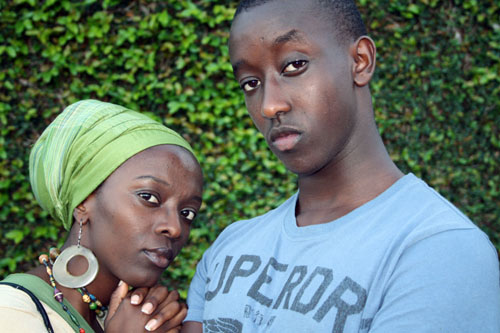
Rapper Miss Jojo and Roger
I wandered around the garden and saw the remnant of me and my brother's tree house - shattered by a mortar bomb during the conflict.
I felt melancholic and looked forward to the team arriving.
I hired a 4x4, bought litres of bottled water, grabbed a whole bunch of permission forms and met Ayuub, our translator.
My crew - Robe (camera) and Alistair (sound) - arrived safely with Roger and we filmed the scene at his uncle's house that same evening. We were up and running.
So, I found myself with Roger (only a year older than I was during the genocide) wandering the killing fields of Rwanda, telling the grim tale of one tribe attempting to eradicate another.
A killing frenzy of ferocious efficiency: 800,000 Tutsi dead in 100 days. That's six people every minute of every hour of every day.
We met survivors and killers; rappers (The Brain, Miss Jojo, Ryderman) who dreamed of a tribe-less Rwanda.
Roger attended a memorial which became a mass outpouring of grief at the national stadium. It was awful to witness. I wanted to run away.
The cacophony of 30,000 people wailing was hideous. You'll know what I mean when you watch the scene.
Not long after my own family's escape from Rwanda I remember watching an episode of BBC Panorama, presented by Fergal Keane, and called Journey into Darkness.
Fergal discovers a terrible massacre at a place called Nyarubuye.
We travel to Nyarubuye in the film. It's an eerie place. I never want to go back.
In order to see this content you need to have both Javascript enabled and Flash installed. Visit BBC Webwise for full instructions
Roger visits the site of the Nyarubuye massacre
I asked Panorama for permission to use the footage they shot in 1994. It's unbelievable.
Like the footage of Auschwitz or Belsen, none of us like watching it but it's important that we do.
It's only 17 years ago, but watch five seconds of the footage and the sheer horror of genocide, any genocide, comes screaming back.
I remember watching the footage at the age of 16 and it has stayed with me ever since.
As well as the horror, we met inspiring men and women - Tutsi and Hutu - involved in the reconciliation process.
There is hope here. And Roger felt it too. It challenged his reticence to forgive. It challenged me.
Roger's mum wrote a diary about her harrowing experience. It's an extraordinary document - an insider's guide to the horror of genocide.
I decided to punctuate the film with these diary extracts. And we've animated them to bring her terrifying memories to life.
I'm so proud of this film.
It was wonderful to be back in Rwanda. It was a privilege to make a film about forgiveness. And Roger bravely shouldered the responsibility.
Nick Andrews is the director and producer of Roger: Genocide Baby.
Roger: Genocide Baby is on BBC Three at 9pm on Wednesday, 13 July, and is part of BBC Three's Extraordinary Me season.
Comments made by writers on the BBC TV blog are their own opinions and not necessarily those of the BBC.


Comments Post your comment