BBC TV blog - BBC TV blog

Archives for May 2011

Prince Charles and Jerusalem's composer Hubert Parry

Blog comments are currently unavailable. Find out more.

Post categories:

John BridcutJohn Bridcut|14:20 UK time, Thursday, 26 May 2011

Jerusalem is perhaps the greatest of England's national songs - familiar at rugby matches and meetings of the Women's Institute, as well as royal weddings and the Last Night Of The Proms.

But, unlike Edward Elgar's Land of Hope and Glory, its composer has languished in the shadows, an almost forgotten figure in our musical history.

The royal wedding came almost exactly two years after Prince Charles had suggested Hubert Parry as a suitable subject for my next composer documentary.

Organist and Master Of Choirs at Westminster Abbey, James O'Donnell, with the Prince Of Wales.

He felt Parry was a neglected figure who had written five marvellous symphonies, which hardly anyone has ever heard, with a quintessentially English flavour.

Across a 12-month period, we made The Prince And The Composer, a film for BBC Four, which was an opportunity for the Prince (and for me as director) to explore Parry's life and music in greater detail.

The twenty ninth of April may have raised Parry's profile because the roof of Westminster Abbey was raised at least three times by his music during the royal wedding.

First came the stentorian trumpets launching the anthem I Was Glad, as the bride prepared to walk up the aisle on the arm of her father.

It was the unmistakable signal that at last the hype was over and the real deal, the wedding service itself, had begun.

As the majestic flourishes of choir, organ and orchestra reached their climax a few minutes later, the new Duke of Cambridge turned to his bride for the first time and said, "You look beautiful."

Later, during the signing of the register, the congregation were regaled with the rich, romantic harmonies of the anthem Blest Pair Of Sirens.

And somewhere in between came Jerusalem, with not just choir and orchestra, but the whole congregation inside the Abbey and outside on the streets vigorously joining in.

As his music echoed round the world, thanks to radio and television, it was hard not to feel that its composer had at last emerged from the shadows into the sunlight, to the great personal delight of the father of the bridegroom, the Prince of Wales.

What emerges in The Prince And The Composer is a portrait of a man far removed from the impression his photographs give of a hearty imperialist.

Instead, Parry turns out to have been an insecure man, full of self-doubt, who nonetheless nurtured the prolific generation of British composers that came after him, such as Vaughan Williams, Gustav Holst and Herbert Howells.

He fought hard to win the hand of his bride, Maude, whose mother was brutally frank in her opposition, but the marriage was far from being a success.

And, quite apart from the unforgettable Jerusalem, he was a composer of real talent, who was unfortunate enough to be followed immediately by Elgar.

Elgar admired Parry, but his music eclipsed him. Only now, almost a century after his death, is Parry's music coming into its own. He has few more ardent advocates than the Prince of Wales.

John Bridcut is the director of The Prince And The Composer.

The Prince And The Composer is on BBC Two at 3.10pm on Sunday, 25 December.

It was first broadcast on BBC Four at 7.30pm on Friday, 27 May and on BBC HD at 1.25am on Saturday, 28 May.

You can listen to Radio 3's profile of Hubert Parry on the Composer Of The Week site.

Comments made by writers on the BBC TV blog are their own opinions and not necessarily those of the BBC.


Windfarm Wars: Filming the renewable energy debate in Devon

Blog comments are currently unavailable. Find out more.

Post categories:

Jeremy GibsonJeremy Gibson|12:32 UK time, Tuesday, 24 May 2011

When I convinced the BBC to commission Windfarm Wars, call me naive, but I had no idea it would take seven years of my life to deliver. And doubtless most of the people we've followed with the camera over all those years didn't figure their lives would evolve this way either.

And, over that time, the whole question of how the country best provides for its burgeoning energy needs in a sustainable way has, quite simply, become more and more tortuous. Toxic even.

Windfarms divide opinion like few other topics. They are beautiful to some, eyesores to others.

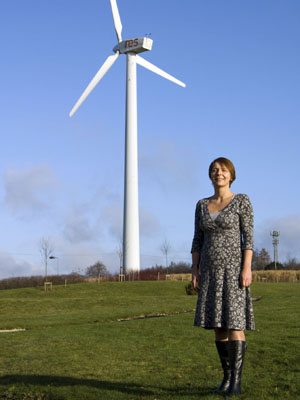
Rachel Ruffle from Renewable Energy Systems, standing by a wind turbine.

They are free sustainable energy or expensively inefficient. They desecrate the landscape, or they protect its future existence.

For a filmmaker treading into this minefield, the antagonism between incoming developers and the local residents they seek to convince can be most difficult to negotiate.

Renewable Energy Systems, or RES, first put forward their plans for a windfarm in Devon in 2004.

It would be sited four-and-a-half miles from the northern edge of Dartmoor National Park, in the shallow valley of Den Brook.

I started as the film's executive producer, largely office-based, but with a director and small team on location.

But, seven years later, I had become the sole production member the budget could still afford to have on location, shooting on my own to see the story through - and the windfarm had still not been built

Early on, we were lucky enough to gain access to all sides of the Den Brook dispute, from developers RES, to landowners and protestors alike, and to the council and council planning committee.

As the story went on, and on, over the years, this access widened to include lawyers and barristers, expert witnesses, and the planning inspectors involved in public inquiries.

Maintaining everyone's commitment and involvement over the long years of the process demanded confidentiality and tact.

Each side had to trust that we would not tell the other things that only we knew.

Windfarm Wars was originally commissioned as a single film - an observational documentary. We would follow whatever happened, wherever developments took us.

By the time the commission fell into place and the director of the first film, Olly Lambert, arrived in Devon, RES had already held their introductory exhibitions, where they showed the residents of the nearby villages what the windfarm might look like and where it would be situated, and answered their interests and concerns.

Feelings for and against the windfarm were already running high.

It's difficult to gauge the true feelings of a whole community. One of the ways is to go by those who have bothered to write letters to the council.

When the closing date came, the council had 402 letters and 3,000 questionnaires in objection and 31 letters in support.

We roughly assembled the material as we went along but each time a viewing with the BBC had come due, it was apparent that a chapter may have finished - but the big story was still unresolved.

Luckily they had the vision to keep running with it. Eventually it became a four-part series. BBC channel controllers have come and gone while waiting for it to materialise.

At times, as long waits for the next part of the planning or legal process had to be endured, it was tempting to wrap up the project, but I wanted everyone involved in the whole process to know it was being documented very publicly, and that it would be seen through to the end.

Bash and Mike Hulme, who were campaigning against the wind farm, outside their cottage in Devon.

And, as concerns about global warming, reduction of carbon dioxide emissions and the security of energy supplies became more and more acute over the years, the project gained in significance, and just had to be seen through.

What emerged is what I hope some people will see as a unique social record of how one of the nation's key dilemmas has unfolded in the early 21st century.

The four films unravel as a narrative story, and while viewers think they may know where they stand initially, a fair few may well change along the way.

Windfarm Wars will no doubt raise tempers, and for some of the many people who've taken part it will be difficult viewing - not least to see how we've all aged through the process.

Perhaps it will be difficult too, because all sides may need to confront and acknowledge mistakes, to review how they could have done things better.

For many, it's clearly been a journey that's taken courage, commitment and faith in the search for what each perceive to be the truth - the best way forward for the good of all. There may be regrets.

I hope, though, that the end product of the process of documentation has been usefully revealing and thought provoking, and that it will, in time, repay the commitment that many gave to the project. We'll see - soon enough.

Jeremy Gibson started as executive producer and also worked as series producer of Windfarm Wars.

Windfarm Wars is on BBC Two on Fridays at 7pm until Friday, 3 June. The first two episodes are available in iPlayer until Friday, 10 June.

For further programme times, please visit the upcoming episodes page.

Comments made by writers on the BBC TV blog are their own opinions and not necessarily those of the BBC.

Driving the A303: Highway To The Sun

Blog comments are currently unavailable. Find out more.

Post categories:

Tom FortTom Fort|14:16 UK time, Thursday, 19 May 2011

"Why a road?" people asked when I told them I was presenting this documentary, then, "Why the A303?"

Actually it took a while for the questions to occur to me. About 20 years in fact, which is how long I've been driving the road on a regular basis.

Like most others I drove it and didn't think about it. It goes from just west of Basingstoke to just east of Honiton in Devon - 92 miles, give or take a few yards.

In order to see this content you need to have both Javascript enabled and Flash installed. Visit BBC Webwise for full instructions

On the way it goes over three of my favourite rivers for fishing - the Test, the Avon, and the Wylye.

From my point of view, that was what the A303 was for - to get me to the riverbank.

Between the Avon and the Wylye it went past Stonehenge. Like everyone else, I wondered about Stonehenge.

Then I started wondering about other aspects of the landscape that flashed past the window.

Like Andover and the big slab of forest before it. Like Amesbury and the weird metal bloke on his knees by the turn-off. Like the burial mounds.

The shape of a story formed. A book, I thought. Then someone came along and said, "What about a film?"

So a film it became first - A303: Highway To The Sun. The book is having to wait.

I spent 20 years with BBC radio news, never having anything to do with TV. I was a words man, didn't understand pictures. Still don't, really.

The experience was gruelling, far more so than I'd expected.

For one thing, filming was in February and it was marrow-freezingly cold. For another, I had to drive a 1968 Morris Traveller.

The Morris is the real star of the show. It took me right back, because it was the first car I ever drove on a regular basis.

Tom Fort standing by the 1968 Morris Traveller on a bridge above the A303.

It's happiest at 50 miles per hour or under, which can be awkward on a dual carriageway, and the wing mirrors are at the far end of the bonnet, which means that the only way you can see anything in them is to stop and get out.

All in all, talking to a camera and driving wasn't the easiest thing.

Rather fun, though. As was singing in a pub with a pair of ram's horns on my head. And talking road-kill with the country's leading expert on the subject (if you ask me nicely I'll give you the recipe for fox casserole).

And I learned a lot, both about the mysterious world of television, and about the road. My road, as I've come to think of it.

Not my film, though. That belongs to John Holdsworth, who directed it. A man of heroic - almost inhuman - patience and dedication. I used to imagine documentary makers as precious, arty types. Not any more.

Tom Fort is the presenter of A303: Highway To The Sun.

A303: Highway To The Sun is on BBC Four at 9pm and BBC HD at 10.30pm on Thursday, 19 May.

Comments made by writers on the BBC TV blog are their own opinions and not necessarily those of the BBC.

Radio 1's Big Weekend: I directed the Introducing stage

Blog comments are currently unavailable. Find out more.

Post categories:

Will KinderWill Kinder|17:30 UK time, Tuesday, 17 May 2011

I'm on a train on the way home from Carlisle playing reserved seat roulette, hoping like crazy that the elderly couple heading toward me with a steely look in their eyes aren't booked into my seat. I do so hate tears on a train.

I'm the senior producer for Radio 1's visualisation team and this year I get to do a number of things.

This included directing the red button coverage of Chris Moyles and Greg James' capers in the country house leading up to Radio 1's Big Weekend in Carlisle, setting up our web coverage of the Big Weekend on site, and directing coverage of the BBC Introducing stage there.

Chris Moyles on the Outdoor Stage at Radio 1's Big Weekend 2001 in Carlisle

It's my debut working for the BBC's music entertainment department who, as well as covering most of the major music festivals for the BBC, also make the timeless Later... With Jools Holland, among many other productions.

All last week, Chris Moyles and Greg James did their shows from a country house near Carlisle, where we rigged a handful of robot cameras in the broadcast area to cover both shows on the red button.

We also got a posh graphics generator and an equally posh graphics operator (hello Charlie!) to make flashy clocks, captions and show photos, tweets and text messages on screen.

Biggest surprise of the week? Rolling up to the house at 5.30am to find Chris Moyles already hard at work doing the washing up.

From the outset we were told the country house was haunted and, as cynical radio and visual producers, were rather hoping the old spirit might show up at some point.

It/him/her resolutely failed to rattle a chain, bang a door or cause so much as a tepid draft. However some keen-eyed viewers spotted an anomaly on this video:

In order to see this content you need to have both Javascript enabled and Flash installed. Visit BBC Webwise for full instructions

After a week at the country house it was time to hotfoot it to the Big Weekend site in Carlisle - an airfield.

Here I worked with our teams to set up streaming the event on the Radio 1 website.

We provided four windows onscreen so viewers could watch the Main Stage, the In New Music We Trust Stage, total visual coverage of Radio 1's live output, and the choice picks of the other stages.

This is an incredibly complicated piece of work demanding collaboration between a number of departments across the BBC and an awful lot of wire.

I'll admit I don't have the first idea how it's really done, but the teams from the BBC and SIS Live (the company who provide all the technical facilities for the TV outside broadcast) pulled the proverbial rabbit from the hat and made it all work.

Finally, on Friday afternoon, I was ceremonially handed over to the music entertainment department, who were doing BBC Three's coverage for the Big Weekend, and sent on my way to the BBC Introducing tent.

If you've never heard of BBC Introducing, in their own words they support unsigned, undiscovered, and under the radar musicians.

You can upload your own music to the website, and a selection gets played on local and national radio. Some acts get to play live at events like Big Weekend.

The BBC Introducing stage is a modest affair, but attracts a lot of attention and is a huge deal for a select number of bands who get to play at an actual bona-fide festival and effectively appear on the same bill as the Foo Fighters and Lady Gaga.

The TV coverage on this stage is also modest, four cameras and four very hard working camera operators.

Lady Gaga performing on the Main Stage at Radio 1's Big weekend 2011 in Carlisle.

On the Sunday, however, the small gods of directing smiled down and the engineering manager (hello Donald!) showed up with a pole-cam.

The team was testing it out for use on a shoot later in the year, so I got to be guinea pig.

The pole-cam device is much akin to an extra large fishing rod mounted on a regular tripod, with a tiny HD camera at one end.

It gives the director all those nice high, wide sweeping shots without having to have a dirty great big jib camera (one of those ones on the end of a crane), which wouldn't have fitted in our tent anyway.

At the other end is a very skilled operator (hello Chris) who physically moves the pole and manipulates the camera head with a joystick arrangement whilst simultaneously avoiding taking out members of the crowd and bands.

After a hasty discussion with the health and safety bloke, we had to insulate some of the metal parts of pole in case it came into contact with the overhead lights.

Apparently it's no longer the done thing to frazzle your camera operators. They'll stop us sending kids up chimneys next.

At the other end of the cameras was me in a TV truck. I had monitors showing all of my cameras and a mixer allowing me to broadcast any of the cameras to complete the show that our viewers see.

The camera boys and girls could hear me in their headphones, using an unusual shorthand language that allows me to get the shots I want quickly.

Generally, this is largely made up but can sound impressive to visiting executives. "Four, dev off the drums and find the lead in an MCU. Three KEYS!! KEYS!! One, you're soft!"

On the bigger stages it's unusual for the director to have contact with the artists. After all we kind of expect that the Foo Fighters know what they're doing.

Sometimes they'll get requests from the artists via their management to avoid particular camera angles or shoot in a particular way.

It's up to the director as to how much this can be accommodated as sometimes this can conflict with what you want to show the viewers. (To be honest mate, you've always had a big nose and there's nothing I can do about that.)

In order to see this content you need to have both Javascript enabled and Flash installed. Visit BBC Webwise for full instructions

Over on the Introducing stage, no such concerns. I try to introduce myself to the bands, many of which will never have been filmed before. I'll let them know where the cameras are and maybe offer a few words of advice.

For instance, talking to a couple of hip hop artists I think it looks really good if they perform their rhymes directly down the camera lens. On the other hand it can look bad if a vocalist in a band performs down the camera.

As usual, the standard of the various Introducing artists was exceptionally high and there's no doubt we'll be seeing some of them on the bigger stages next year.

For me it'll be nice to say I shot the first ever festival performance of a new band who goes on to make it big.

Hey, maybe in years to come I'll be directing one of the main stages they're performing on. I'll be sure to remind them.

Well I've already written too much, the elderly gentleman on the train has painstakingly got out his glasses and is studying his ticket. I fear it won't be too long before I'm ejected and sat on my suitcase outside the toilets whilst the pesky highly-organised pensioners enjoy their booked seating.

And in a few short weeks we'll be doing it all again as we pack our barely-dry washing and head to Glastonbury.

Will Kinder directed coverage of the BBC Introducing stage for Radio 1's Big Weekend.

You can watch performances from Introducing acts on Radio 1's website, along with performances from the main acts.

Highlights of Radio 1's Big Weekend are on BBC Three at 7pm on Tuesday, 17 May and on the red button between 6am and 4am until Friday, 20 May. Other highlights from the weekend are available to watch and listen to in BBC iPlayer.

For future programme times, please see the upcoming episodes page.

Comments made by writers on the BBC TV blog are their own opinions and not necessarily those of the BBC.

Doctors: The joy (and pain) of creating characters

Blog comments are currently unavailable. Find out more.

Post categories:

Peter LloydPeter Lloyd|09:03 UK time, Friday, 13 May 2011

Damn - we've lost Simon Bond. Or more correctly, the wonderful David Sturzaker has decided not to stay with us for the next series of Doctors.

This has happened before and it will happen again, but as series producer, one can't help feeling frustrated at creating a successful character, only to have him snatched away from you because the artist concerned is keen to do other things with his career.

David Sturzaker in Doctors

Shouldn't be allowed.

Of course this is completely unfair. David is a talented young actor and has a lot of things he wants to do, we were probably lucky to have him for as long as we did and we got to tell some great stories with him.

Still - damn!

But life, and the Mill, goes on and eventually we all have to come to terms with such departures and try to see the huge gaping hole of their passing as some kind of opportunity.

Ironically, it's some six months later when we get to see the audience's reaction to a character's exit, and how annoyed they get - "Now George and Ronnie have left, I refuse to watch it any more" and "It's just not as good without Vivien".

Alright already! I know I know, but it's not my fault and much as I'd love to, I just don't have that kind of power over actors' lives and ambitions.

I truly wish I did, but sadly it's beyond my job description and I'd probably get fired if I tried.

So you learn to see this as an opportunity, a chance to refresh the cast and introduce some new faces to stir things up.

The editorial team always start with the characters we have already, draw a kind of map and then look at the types of characters we don't have.

Who will create conflict? Who's the absolute opposite of Zara? What's the last thing Julia needs? etc.

Characters don't just leap up, fully formed. If you're not careful you end up putting all kinds of ticks and tricks into a biography to make them interesting... 'supports the Villa', 'collects china pigs'... and it ends up like Top Trumps.

And the next time someone says 'has a dry sense of humour' in a story meeting, I'm going to make them leave the room and stick their head in a bucket.

Everyone likes to think they have a dry sense of humour!

There are all kinds of ways to create characters, there's a whole industry (based in Hollywood naturally) that's dedicated to systems and archetypes and templates for dramatic characters.

Great writers don't need them. In fact many top writers find them stultifying and needless.

But these are very talented men and women and stuff like this comes naturally to them. Then there's the rest of us...

In story meetings the editorial team often talk about people they've met/are related to who may provide inspiration for new regular characters.

Always interesting as examples of behaviour, but you'd never do a direct lift. Real people are never very useful dramatically.

They're less consistent and more chaotic than fictional characters - and the audience likes to know where they are with someone they're supposed to love/hate/sympathise with.

Of course our characters can be chaotic and inconsistent, but the audience likes to be in on the secret of why they are behaving like that.

Unless you know a person really well, you never have that kind of intimacy, and intimacy is the key to series drama.

If you've created your characters well, then the audience will be able to anticipate how their favourites are going to behave.

Of course sometimes you can subvert that and have even more fun with it.

But you need to know what your characters' flaws and strengths are. The writers have got to put them into all kinds of situations and they need to know what makes them tick and how to write them.

If I've got a good sense of a character's 'voice', I will write some sample scenes to give writers a clue and use at auditions.

Some writers really struggle to get these voices right. They may be more interested in plotting than they are in characters.

Or they may be brilliant at writing their own characters but less interested in writing someone else's.

But if you're going to write for series drama, you're going to have to get the knack of it, or you'll be rewritten somewhere down the line... and you probably won't be asked back.

So, after all this mapping and ticking and strategising and matching and mismatching, you produce a biography that hopefully makes things clear to the writers and the make up artists and the costume designers.

You've thought about what kind of car they'd drive for the art department, and you've supplied enough of a physical description to give the casting directors some idea of what you're looking for, but you're not so prescriptive that they laugh you out of the audition room.

But after all this, it comes down to casting the right actor. Cos however much prep work you do, if you pick the wrong actor, or worse, a bad actor, then you're screwed and all your hard work comes to nought.

In order to see this content you need to have both Javascript enabled and Flash installed. Visit BBC Webwise for full instructions

But we got it right with David Sturzaker and with Lu Corfield and Simon Rivers, I think we've got a couple of corkers.

So farewell Simon, and a great big welcome to Dr Kevin Tyler and Dr Freya Wilson!

Peter Lloyd is currently the series producer on Doctors. He has also worked as the script editor, producer and series editor on the show.

Doctors is on BBC One and BBC HD every weekday.

For programme times, please see the upcoming episodes page.

Comments made by writers on the BBC TV blog are their own opinions and not necessarily those of the BBC.

Wonderland: The Trouble With Love And Sex

Blog comments are currently unavailable. Find out more.

Post categories:

Zac BeattieZac Beattie|09:54 UK time, Wednesday, 11 May 2011

"So it's like Creature Comforts but with humans instead of animals?" is often what people ask when you say you've just made an animated documentary. It is and it isn't.

Yes, animated characters lip-synch the words of real people. But there's more talk of sex problems and extra-marital affairs in this.

The Trouble With Love And Sex is a hybrid of documentary and animation, which takes a look inside other people's real life relationships as they spill their troubles to relationship counsellors.

In order to see this content you need to have both Javascript enabled and Flash installed. Visit BBC Webwise for full instructions

There is certainly humour in it, but my ambition was to encourage understanding, not laughs. After all, we've all been there - heartache and rows.

I'd wanted to try a new way of making a documentary - to use animation to tell the stories of people who wouldn't normally agree to appear on screen.

Could animation help us get inside the counselling rooms of Relate and inside the normally private lives of its clients, if we only needed their voices?

Could animation make the storytelling more compelling?

I hope the answer to both of these is yes, but I'd be interested to know what you think.

We promised to design the participants' animated alter-egos so as not to look like them, but it still wasn't easy to find people to record with.

They had to agree to us using their real voices and, unsurprisingly, often felt like they had enough on their plate.

But for the brilliant and generous people who let me crouch in the corner of the counselling room to record their weekly sessions, being hidden behind the animation was critical.

It gave them enough privacy to feel able to talk freely about infidelity, erectile dysfunction, and their deepest family secrets in a way I don't think they would have in a traditional documentary.

In order to see this content you need to have both Javascript enabled and Flash installed. Visit BBC Webwise for full instructions

We wanted the animation to do more than just recreate what happened in the counselling room or at home. We wanted the animation to interpret the voices and their stories.

So sometimes the counselling room transforms into a frosty ice field or transports us 30 years back in time.

A fly buzzing against the window or an awkward glance act as a short hand for the emotional mood I witnessed whilst recording.

Jonathan, the animation director, was tirelessly patient with my obsessive commitment that, whatever the animation did, it had to be an honest and fair representation of the participants' experience.

These are the stories of just two couples and one single man struggling with relationships, but I hope viewers might find a tiny bit of themselves somewhere in the film.

Zac Beattie is the producer and director of Wonderland: The Trouble With Love And Sex.

Wonderland: The Trouble With Love And Sex is on BBC Two and BBC HD at 9pm on Wednesday, 11 May.

To find out times of future programmes in the Wonderland series please visit the upcoming episodes page.

Comments made by writers on the BBC TV blog are their own opinions and not necessarily those of the BBC.

Business Nightmares With Evan Davis

Blog comments are currently unavailable. Find out more.

Post categories:

Evan Davis|00:01 UK time, Monday, 9 May 2011

I have a secret concern about the Business Nightmares programme. I worry that you'll enjoy it too much.

I worry that you'll revel in the stupidity of the mistakes, laugh at the businesses involved and idly sit back, comfortable in the knowledge that you would never be as daft.

Of course, I can see why you might react that way and I'm not saying that I don't want you to enjoy the programme at all. And I certainly don't want to suggest that it doesn't have its laugh-out-loud moments.

Evan Davis

It's just that I don't want Business Nightmares to make you all feel smug about the failings of business.

If there is a reason why most of us would not make mistakes on the scale of the characters in the programme, it is simply that most of us don't make complex decisions like the people in the programme.

We don't create companies, launch new products or devise marketing campaigns.

When most of us make mistakes they tend to be rather routine. Whether we be journalists or dentists, filing clerks or mechanics, we err all the time and rectify (or ignore) our mistakes as we discover them.

But for those in business, it is different.

They live in a world governed by gods that are particularly creative.

Gods that hate to make life regular, that enjoy playing with the unpredictable and that like to challenge the brave.

So when we see people in business fail, we must always ask whether they deserve respect rather than derision.

For example, in the three-part series of Business Nightmares, some of the nightmares are simply genuinely difficult situations that no amount of clever handling could resolve.

What exactly would you have done if you were running Polaroid when digital cameras came along?

We feature gambles that were taken perfectly reasonably, but which didn't happen to pay off in the end. The Rabbit phone seemed like an awfully good idea when mobile phones were beyond the reach of ordinary people, but is easily ridiculed now.

In order to see this content you need to have both Javascript enabled and Flash installed. Visit BBC Webwise for full instructions

And we tell the stories of what I call "good" mistakes - those which result from trying to be ambitious and original. Boo.com was ambitiously ahead of its time but at least it wasn't stuck in the past.

Of course, there are a few straightforward bad mistakes too: the genuine howlers that prompt one to ask, "What were they thinking?"

Royal Bank of Scotland's takeover of ABN Amro as a banking crisis broke in 2007 comes to mind. But there are fewer of those than you would think.

So here's my tip in watching the programme. Laugh at the funny bits. Revel in the mistakes. But laugh with the protagonists not at them.

And be inspired by them to take a few risks of your own, to be ambitious and to move outside your comfort zone to the arenas of life where error is inevitable.

Business Nightmares with Evan Davis is on BBC Two at 8pm on Monday, 9 May.

Evan Davis is the presenter of Business Nightmares. He also a presenter on Radio 4's Today Programme, and BBC Two's Dragons' Den.

For further programme times, please visit the upcoming episodes page.

Comments made by writers on the BBC TV blog are their own opinions and not necessarily those of the BBC.

Why I want to share Britain's Secret Seas with you

Blog comments are currently unavailable. Find out more.

Post categories:

Paul RosePaul Rose|10:06 UK time, Friday, 6 May 2011

There's no denying it, most people really don't know how fabulous our seas are.

We tend to celebrate the coast and our great maritime history and yet we often overlook what's just under the surface in our coastal waters.

As a diver for over 40 years, you can imagine that Britain's Secret Seas feels like the ultimate way for me to share my love of British underwater adventures.

In order to see this content you need to have both Javascript enabled and Flash installed. Visit BBC Webwise for full instructions

My big hope was that we could make a great programme that revealed the true wonder of Britain's seas and make it look easy and attractive to explore.

I kept thinking about a family of non-divers watching, and hoping that our programme might inspire them to give it a try.

I would love to see that family experience basking sharks like we did.

We snorkelled with a shiver of about 12 huge basking sharks only 100 metres or so from the beach at Porthcurno in Cornwall.

They are shy of noise. Bubbles from scuba diving equipment or jumping in from the boat sends them away, so the snorkelling approach works well.

We found that if you just float motionless at the surface they come very close indeed.

It's exciting. Even though we know that basking sharks are not predatory there is something gripping about a 10-metre-long shark swimming towards you with that massive open mouth. How about that as part of a family day at the seaside?

There are four one-hour episodes from Britain's north, south, east and west, with each episode having a core theme.

My co-presenters Frank Pope, Tooni Mahto and I dived in whichever combination made the most sense for each particular story.

Frank was leading the history and ocean ecosystems stories, Tooni was leading the marine science, with me being the lead diver, presenter and expedition leader.

In order to see this content you need to have both Javascript enabled and Flash installed. Visit BBC Webwise for full instructions

But it's not just about diving. Being underwater is a great setting in which to bring important stories to life.

In this series, we talk about ecosystem's services by diving on the fluorescing sea squirts off the coast of St Abbs in Berwickshire that provide the protein for tracking cancer cells.

In the Wild North episode I report on some of our military activities by diving with the Royal Navy clearance divers to explode 1,000lb bombs.

And the Bustling South and the Giants Of The West episodes reveal exciting history and conservation stories when we dive some of our important shipwrecks.

Britain's Secret Seas is the realisation of a dream for me.

I remember the early 1960s when my life's heroes were in their prime - Hans Hass was using military diving gear to film his fabulous shark documentaries.

Jacques Cousteau had co-invented scuba diving, written The Silent World, and was exploring the world's seas on the ultimate diving expedition on Calypso.

And my big hero at the time, Mike Nelson, was up to his neck in Sea Hunt adventures.

Beautiful women were hiring Mike for diving lessons and at the end of each programme I would swear that he was talking directly to me with his words on diving safety.

I had just failed my 11-plus, hated school, loved the sea and knew nothing. Except that I wanted to be a diver.

Paul Rose is the co-presenter of Britain's Secret Seas.

Britain's Secret Seas is on BBC Two and BBC HD at 8pm on Sunday, 8 May.

You can read more from Paul about a dolphin autopsy he carried out on BBC News online.

For further programme times, please see the upcoming episodes page.

Comments made by writers on the BBC TV blog are their own opinions and not necessarily those of the BBC.

The Shadow Line: Getting the shot

Blog comments are currently unavailable. Find out more.

Post categories:

Johann KnobelJohann Knobel|11:13 UK time, Thursday, 5 May 2011

Scene 1:

Aerial shot of two lines of torchlight sweeping across the screen like searchlights. Then they both come together. On a stationary car.

CONSTABLE FELIX
So what are we looking at?


It's 8.07pm on Thursday, 2 September 2010 and we're about to start shooting the opening image of The Shadow Line. And with his usual economy and wit, our writer-director Hugo Blick has indicated in the script exactly what the shot should be.

But we have a problem.

For the shot to work, we need complete darkness and we need it soon.

It's the last day of the Isle of Man portion of the shoot and, having already shot the next scene the previous night, it's vital that we get this shot and this scene in this location - and before midnight, too.

But it's not working at the moment, due to the faint glow on the horizon behind the location, courtesy of the floodlights at the Isle of Man Airport, Douglas, about half a mile away.

In order to see this content you need to have both Javascript enabled and Flash installed. Visit BBC Webwise for full instructions

There's a hurried huddled conversation about different angles, black-out shades and other possible solutions but we quickly realise the best and speediest option is to ask the airport authority to dim the lights, or even better, turn them off.

All eyes turn to our intrepid location manager and with an imperceptible shrug, he sets off in the direction of the airport.

In so many ways, the scene embodies the spirit of the whole piece.

It orients the audience, tells them to pay close attention to even the smallest thing now, because it's likely to mean a great deal later on.

And the beautiful spare language that Hugo has given Sergeant Foley as he describes what exactly it is that they are looking at, tells us that the world we're entering is different from what we might be expecting - slightly heightened, elevated but hidden.

As Gotham is to New York, so is our world to London.

Thus far, we've managed to achieve it here on the Island, finding, amongst other hidden gems of locations, probably the only street in Douglas that could double for a street in London.

And it's all been conducted with good humour and in a spirit of camaraderie, whether it's scouting for locations while the Isle of Man TT Motorcycle Race takes place around us or cramming just over 15 cast and crew (and their equipment) for a whole day into a hermetically sealed hotel room on what turned out to be the hottest day of the year, without any of them passing out.

Or the day we (intentionally) caused an explosion that landed us on the front page of the Manx Independent and gave the people of Peel a night out to remember.

From left to right: DCI Gabriel (Chiwetel Ejiofor), Gatehouse (Stephen Rea), Joseph Bede (Christopher Ecclestone)

Or shooting a scene in a church graveyard, with Charles Kay (Pendleton in Edge Of Darkness) giving a brilliantly sinister, yet humorous performance, and just as the camera cranes upwards for the final shot, a sheep nonchalantly ambles out from behind a gravestone as if on cue, adding to the slight surrealism of it all (and it made the final cut).

Or the day when several cast and crew members hugged the ground behind a low wall out of sight while the cinematographer raced to the top of Snaefell Mountain to get the last panoramic shot.

Snaefell Mountain, from which local legend states that one can see six kingdoms: Man, Scotland, England, Wales, Ireland and the sixth, Heaven. But only if the fog stays away and that day, it had been threatening to roll in, all day.

But we got that shot with minutes to spare and now, we need to get this one.

Because, just as the two sides on either side of the line slowly converge in the narrative, so the two lines of flashlight should converge on Harvey's car.

The shot is the embodiment of the whole story, all seven episodes of the series. So, we really do need it to be dark.

The location manager returns. Yes! They'll do it, but only for an hour, there's yet one more flight coming in later on.

And as the camera turns over, I hear a crew member saying under his breath, "They'd better let that plane land, 'cause it'll be the one that we have to get in the morning to get to London to finish the shoot."

Well, we got the shot, we got the plane and we got to London.

Where we would get to the first day of shoot, only to discover it's the first of what will be several tube strikes that late summer and spend several days running around Victoria Park, with a camera buggy struggling to keep up with an actor who probably could've qualified for the British Olympic 100m squad.

But that's another story.

Johann Knobel is the producer of The Shadow Line.

The Shadow Line is on BBC Two and BBC HD at 9pm on Thursday, 5 May.

For further programme times, please see the upcoming episodes page.

Comments made by writers on the BBC TV blog are their own opinions and not necessarily those of the BBC.

Royal wedding: I was in the flypast over Buckingham Palace

Blog comments are currently unavailable. Find out more.

Post categories:

Jake Humphrey|14:11 UK time, Tuesday, 3 May 2011

"Lest we forget" is the motto of the RAF Battle of Britain Memorial Flight.

I have no doubt that after the royal wedding on Friday, tens of millions will forever remember the sight of three World War II planes roaring down the Mall in central London, as a sea of people became a sea of flash photography.

In some ways this is a difficult blog post to write as I would love to fill it by telling you how it felt to broadcast live to the nation from the cockpit of a plane older than my Dad.

However, despite the old lady doing her bit just perfectly, sadly modern technology let us down.

In order to see this content you need to have both Javascript enabled and Flash installed. Visit BBC Webwise for full instructions

The plan was that, as we approached London, I would leap into position and deliver 90 seconds of compelling and entertaining commentary about the plane, and then reaction afterwards relating to the flypast, and how proud the Royal Air Force were to be paying their respects to a current RAF pilot in the shape of Prince William.

Sadly, however, as we flew over the Olympic site, just minutes away from Buckingham Palace, I couldn't hear the BBC programme or see a monitor, so I was effectively 'working blind'.

Despite delivering my lines three times, things conspired against us and we weren't able to deliver what would have been an epic part of the BBC's royal wedding coverage, much to my frustration and sadness.

However, as the well known biblical phrase goes, "The Lord giveth, the Lord taketh away."

I think that line sums up exactly how I felt as I collapsed into my seat on the train home on Friday evening.

I was so frustrated that we weren't able to deliver our side of the bargain.

Yet, at the same time, I was on the crest of a wave after being privileged to spend 24 hours in the company of some incredible people and some equally impressive feats of British engineering.

Like many young boys I grew up with tales of Lancasters, Spitfires and Hurricanes, and just how much we owe to them.

As I sit here penning this blog post, aged 32, I think for the first time I've only just grasped quite how brave those boy-pilots were, 70 years ago.

I will never forget the moment I climbed aboard the Lancaster on Thursday afternoon to prepare for the flypast.

I felt immediately claustrophobic, with an instant, increased respect for what my forefathers achieved.

It was compact, lacking any sort of comfort, and with echoes of the past all around me.

Messages about bombs, ammunition and emergencies offered a regular reminder of the plane's glorious, if incredibly dangerous, past.

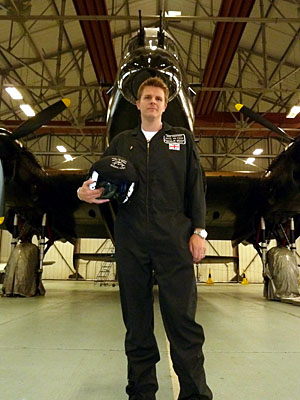
Jake Humphrey, with helmet in hand, standing in front of a RAF bomber

As well as the flight itself being something that will stay with me forever, I gained just as much enjoyment from chatting to the engineers who get these planes in the air, and the pilots who keep them there.

I had barely been there for five minutes and I had been encouraged to stand on the wing, sit in a Spitfire, and asked to imagine being a Battle of Britain pilot.

The RAF servicemen looking after the relics are experts, historians, and tour guides all rolled into one, and are brilliant at the lot.

Just imagine the facts. Most pilots were in their early 20s with very little flying experience and suddenly carrying out night-time sorties lasting hours.

Of the thousands of Lancasters that were built, only 30 managed to clock up over a century of missions, and the average life of one of the planes was just a couple of weeks. As scary as it is unbelievable.

And it is all those reasons and more that it's essential the Battle of Britain Memorial Flight retain the ability to keep these planes where they belong - in the air.

Taking off and seeing the Spitfire and Hurricane playing around just behind us, as responsive and athletic as they were all those years before.

The sound of the Merlin engines roaring into life, and the moment we joined the party being attended by millions.

All of them wonderful memories of the day the RAF paid their respects to Kate and her new husband, who is the patron of the Battle of Britain Memorial Flight.

However, despite all that, what really resonated with me was what we did after we'd flown over the capital.

As we headed back north we dropped in on fetes, garden gatherings and street parties across Britain.

At the sound of the engines the streets below us were full of frantic waving as we dipped our wings and made people's day with a low arc past them.

Whilst I will be forever grateful for what I experienced on Friday, the same applies to us all.

We all owe these planes and the pilots who flew them so much, and every day the Battle of Britain Memorial Flight makes sure that decades after these planes did their national duty, we shall never forget. I know I won't.

Jake Humphrey is a BBC Sport presenter and writes a blog about Formula One.

Highlights of The Royal Wedding are available in BBC iPlayer until Friday, 6 May.

Comments made by writers on the BBC TV blog are their own opinions and not necessarily those of the BBC.

Exile: I want the story to be more than a thriller

Blog comments are currently unavailable. Find out more.

Post categories:

Danny BrocklehurstDanny Brocklehurst|10:00 UK time, Sunday, 1 May 2011

Having worked with Paul Abbott on three successful series - Clocking Off, Linda Green and Shameless - we were keen to work together again.

I pitched him a modern-day Twilight Zone show, which he loved, but felt might be a tough sell.

Other ideas got banded around. A cop show. A romance. He smoked some fags, I drank some coffee until eventually Paul produced a short six or seven page document from deep inside a drawer.

It was entitled Exile and he said "Have a read".

Tom Ronstadt, played by John Simm, and Sam Ronstadt played by Jim Broadbent

It was a film pitch. It was set in America. It was about US politics. I liked it, but it was hard to see how it could fit onto a British TV screen.

However, at the heart of it was an intriguing father/son relationship. I am obsessed by father/son relationships and they are a recurring theme of my work. I was hooked.

The story needed a complete overhaul and, over the course of a few weeks, I set about storylining what would become the new version of Exile.

Storylining means working out the story, in acts and episodes. I tried to keep to the spirit of that original document whilst allowing it to take on a life of its own.


After leaving university, I'd worked as a journalist for a number of years, so Tom's world was one I knew and understood.

Draft one of the script included a 10 minute sequence where we saw Tom in the world of Ransom magazine: his lifestyle, his attitude and, ultimately, his downfall.

The BBC felt, quite rightly, that this was redundant. So now the story begins when he gets in his car and drives back north.

From day one, I wanted John Simm to play Tom. Partly because he was perfect for the role, but also because he is one of the best actors of our generation.

Whether it's The Lakes or Life On Mars or Never Never, if you see John Simm is attached, you know you are in for something brilliant.

As for Jim Broadbent, well, what can you say? The man's a star.

I remember watching him in Life Is Sweet when I was a student and loving his performance as a seemingly carefree father of problematic twins, and now here he is saying my words.

As for the supporting cast, we have been tremendously lucky to get such brilliant actors as Olivia Colman, Claire Goose, Timothy West and Shaun Dooley.

John Simm as Tom Ronstadt and Claire Goose as Mandy Eldridge.

The most difficult aspect of Exile, without question, was dealing with the Alzheimer's.

I've written about illness before so I understand the importance of getting it right.

I threw myself into research, as I wanted a realistic take on what it's like to live with someone who is in the middle stage of the disease - when their mind is deteriorating but at times, still accessible.

I think I got it right but, to help matters, our producer Karen Lewis, our brilliant director John Alexander, and Jim Broadbent himself, all have first hand experience, so collectively we have brought a breadth of knowledge to our depiction of the disease.

Despite dealing with huge themes, I always wanted Exile to be more than just a thriller. I wanted it to be funny and characterful and quirky.

All the shows I have loved over the years - Cracker, Our Friends In The North, State Of Play - have managed to combine serious themes with light relief.

So, for me, the scene where Tom hides from Mike in the supermarket and ends up having an argument with Spotty Shop Assistant is a very pleasing scene. It symbolises my ambitions for the drama.

My personal philosophy is to try and write entertaining, contemporary drama that speaks to people about their lives.


But more than that, I want to write drama that if I was a viewer, I'd want to watch too. So... modern day Twilight Zone anyone?

Danny Brocklehurst is the writer of Exile.

Exile is on BBC One and BBC One HD at 9pm on Sunday, 1 May.

For further programme times, please visit the upcoming episodes page.

Comments made by writers on the BBC TV blog are their own opinions and not necessarily those of the BBC.

More from this blog...