BBC TV blog - BBC TV blog

Archives for January 2011

Outside The Court: Filming the stories behind the court cases

Blog comments are currently unavailable. Find out more.

Post categories:

Fiona WickhamFiona Wickham|17:26 UK time, Monday, 31 January 2011

Film-maker Marc Isaacs spent three months on the steps outside Highbury and Islington Magistrates' Court in London, talking to the people who were coming in and out. The result is Outside The Court, a documentary that is part of BBC Four'sJustice season.

Marc told the BBC TV blog about how he filmed the stories of the people involved in the court cases.

Mark, on the steps of Highbury and Islington Magistrates' Court

How did you decide on the subject for this documentary?

The idea for this film came from the controller of BBC Four, Richard Klein. He wanted, as part of the Justice season, to have a film featuring ordinary people.

He asked me if I would be interested in this subject because he knows I am drawn to the lives of ordinary people. [Marc made All White In Barking, as part of the BBC's White season, and Calais: The Last Border.] The rest is history, or recent history.

Did you have any sort of security while on the steps or was that not necessary?

No, just my colleague Guy King, who was my researcher and second camera person. But he's soft too, so we were totally vulnerable, but that's the best way.

Did you feel intimidated by any of the people you needed to approach for the film?

No not at all. I run a mile from intimidating people. I go for the ones with soft centres. The ones who are willing to open their hearts and tell of the deeper reasons why they regularly find themselves in front of the judge.

The court deals with all of the usual cases that any magistrates' court would see on a day to day basis, from drug and drink-related offences to violence and motor offences.

Mark [who was in court for breaching bail conditions] and Michel, the Frenchman, were just two of the characters who were more than happy to share their lives with us.

Who were you most interested by, of all the people you met on the steps?

Each for different reasons but Michel stole my heart.

He was in court for carrying an offensive weapon because he wanted to exact revenge on a security guard who he claims had been violent towards him.

On the way to commit this crime, Michel changed his mind and called the police to hand.

The best moment in the film, for me, is when Michel opens his heart to us in the cafe. This is the centre of the film, in my view.

Michel, the Frenchman

Were people hostile to you at first? What did you say to open the conversations and bring them round?

I approach people in a non-threatening way and just try to treat them as an equal and then act instinctively from there.

Is there a culture of people like journalists and paparazzi waiting on court steps? Did you get friendly with any of the other people waiting outside?

Every time the paparazzi turned up we went home. I despise those people, they are like vultures and I didn't want to be associated with them.

Did the programme turn out how you expected?

Film-making is a discovery. There are always surprises and thank God for that.

Most TV today eliminates the element of discovery in documentary. I want to fight to keep this idea alive. These kinds of films thrive on freedom and spontaneity.

What was the worst moment?

Waiting in winter for hours with nobody interesting turning up at court. I am not good in the cold.

Did you make any friends in the process of the programme?

I will stay in touch with a few of the characters but our relationship will always be defined by the experience of filming together. It's a friendship of a particular kind.

What was the most interesting thing that happened, or that you learned?

I learn something new in every film but, for me, I am pleased that we managed to make a film like this without moving too far away from the court itself. We tread a fine line but pull it off hopefully.


Presumably the story would be ever-changing - would you like to do it again or was once enough?


There is no story until you as the film-makers create one. So yes, if I did it again it would be very different but once is enough of course. I am ready for the next film now.


Outside The Court is on BBC Four at 9pm on Monday, 31 January.

Outside The Court is part of the Justice season on BBC Four.

Fiona Wickham is editor of the BBC TV blog.


Comments made by writers on the BBC TV blog are their own opinions and not necessarily those of the BBC.

How we documented Laura Hall's battle with booze

Blog comments are currently unavailable. Find out more.

Post categories:

Meredith ChambersMeredith Chambers|11:32 UK time, Monday, 24 January 2011

I'm the executive producer of Laura Hall: My Battle With Booze. We read about Laura, like so many people, when she hit the headlines earlier this year.

Newspapers named her the "poster girl for binge Britain", while a judge even called her "despicable and rotten".

She'd become an overnight tabloid sensation for the worst possible reason - consistently getting drunk and offensive, mostly directing her drunken anger at the police, while out and about in her home town of Bromsgrove, and beyond.

Laura Hall

As so often is the case, we thought there might be more to Laura and the stories about her than the papers were saying.

We wanted to take a look at the girl behind the lurid headlines and find out whether there was more to Laura Hall, and reflect the problems that she was going through and drive discussion around them.

We felt that a documentary that did this properly would sit well on BBC Three, a channel that's proving to be a home for popular documentaries with real social purpose.

So we made contact with Laura. And true enough, when we met her, we found that she was articulate and clever, and from a good home.

Danni Davis, the director, struck up a relationship with her and was struck by the fact that Laura had real insight in to the depth of her problem with alcohol.

Laura felt the system had demonised and failed her rather than helped her. She didn't appear to be the epitome of the drunken lout.

We were fully aware she had 39 convictions, from drunk and disorderly to assaulting a constable, plus a range of public order offences - and that she could behave terribly.

But it quickly became clear that here was a girl that was vulnerable and needed help.

A magistrate even asked in court one time where the help was for Laura. Clearly Laura's was a young life that shouldn't be simply written off.

We told Laura that we wanted to film over a period of time to see if she could come good on her promise to stop drinking and go in to rehab.

She'd already sold her story for money in the past but we made it crystal clear that she would not benefit financially from making this documentary.

We told her that we would make a thoughtful film that examined the issues around her behaviour and alcoholism, which tried to show her attempts to stop and that ultimately gave a fair portrait of her.

We were clear that if she behaved badly we would show it, as this is the nature of an observational documentary, but that we would balance it.

However, throughout filming, the welfare of Laura was always of the utmost importance.

Laura saw that a film with the BBC might have the best chance of showing the other side to her. She turned down offers from other parties that had money attached.

We then went to BBC Three, where we knew that the Dangerous Pleasures season was gearing up for its second run.

This strand of documentaries, that already had broadcast films like Nicola Roberts: The Truth About Tanning and Sun, Sex And Holiday Madness, had built up a reputation for filming with young people who live life to the extreme.

These people are then prepared to share their experiences with a wider audience, and be frank about the detrimental effects their choices have on their lives.

Laura, who is very honest, and who wanted to show how destructive a force alcohol was on her life, would be an ideal part of this season.

BBC Three saw the potential in the film. Laura would speak directly to its core audience and give them a clear and stark warning of the dangers of alcohol abuse from a first person perspective, without preaching.

The programme was there to reflect real life and living in modern Britain. We set about making the film and it was a very up and down six months.

At one point we filmed her coming out of 55 hours of custody with nothing but a plastic bag, yet within weeks we saw her take the bold decision to go in to rehab.

We did work closely with Laura despite making her no promises about the shape or content of the film.

We had a thick set of protocols agreed with lawyers and editorial policy that governed our behaviour at all times.

One of the main points for us was that making this film didn't make her difficult life worse.

We took our duty of care to her very seriously and had plans drawn up if she hurt herself or others.

We were always ready to do the most responsible thing and it was clear we'd never incite her to do herself or others harm or break the law.

The film is now finished and I'm glad to say that Laura managed to get rehab therapy, and is now working towards recovering from her addiction.

Although the road has been tough and there has been obstacles to overcome, she's only 21. Her life will be hard from here on in but I hope she stays motivated.

She shows that no matter how bad an addiction seems, you can have the inner strength to fight it - but an addiction can be there for life. So I think our aims and ambitions for the film have come through.

I hope the people watching it will find that there's more to Laura Hall than we think.

I hope the film will also make people think about what more can be done to help people who harm themselves and how society treats young addicts.

Finally, I hope it makes people challenge their own behaviour and treat other people and themselves with more respect.

Meredith Chambers is the executive producer of Laura Hall: My Battle With Booze.

Laura Hall: My Battle With Booze is on BBC Three on Monday, 24 January at 9pm. The programme is part of BBC Three's Dangerous Pleasures season.

Comments made by writers on the BBC TV blog are their own opinions and not necessarily those of the BBC.

Making the new BBC One HD trailer

Blog comments are currently unavailable. Find out more.

Post categories:

Danielle NaglerDanielle Nagler|17:48 UK time, Thursday, 20 January 2011

How do you tell the story of BBC One HD in a short trail, which makes sense whether you are watching in Standard Definition (SD) or High Definition (HD), at the beginning of 2011?

The BBC likes to throw out challenges, and the wheel stopped on this one for me and the marketing team I work with.

The BBC One part was the easy bit. BBC One is the place that brings people together to watch an incredibly rich and diverse range of programmes.

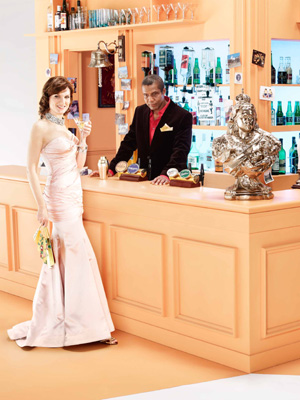
Fiona Bruce and Hugh Quarshie standing at a cream coloured Queen Vic bar.

It constantly seeks to bring its audience something different that can't be found elsewhere, and encourages the presenters, actors, and producers who work for it to push at the boundaries of what might be expected.

And it does this, though, with a warmth and welcome, which allows everyone to feel at home.

HD is harder. And, along with all the others in the UK trying to explain what HD actually brings to television, we've tried a number of different approaches in the years since we started making and broadcasting programmes in HD.

In the beginning we talked about pixels and picture resolution. That explained things to those who understand television technology, but was baffling to most.

So, at the BBC in recent years, we've focussed on the programmes you can watch in HD, trying to convey the kinds of things we're making in HD.

And, through the choice of shots (close ups, slow-motion sequences), showing what the new HD format brings in terms of picture detail and, therefore, emotional involvement, whether you are watching the trail in SD or in HD.

But BBC One HD is a different channel from BBC HD. It's an old and familiar friend in new, up-to-the-minute clothes. And by now we know that most of you know of HD's existence.

So the trail that has been made tries to be true to BBC One - staying warm and down to earth - and to convey a little of the magic that HD is bringing to the channel.

It features stars from across BBC One, though shows them to you as you've never seen them before.

And while the promo was, of course, produced in HD, we've tried to style it so that even if you are watching them on one of the BBC's SD channels you will get a sense of what HD can mean for the television you already know and love, using colour and storytelling to make up for those extra pixels.

We launched BBC One HD in November. Since then we've been working on ensuring it runs smoothly, and on bringing even more programmes into HD.

EastEnders moved to HD on Christmas Day and, over the coming months, other favourites will join the BBC One HD family, including Have I Got News for You, Formula One, The Boat Race, Songs of Praise, Watchdog, and coverage of the Chelsea Flower Show.

You can always check the programme description in the information bar if you want to know whether a programme is in HD or not. Lots of you have been trying out the channel already, especially over the Christmas holidays.

BBC One HD can be found at Freesat channel 108, Freeview channel 50, Sky channel 143, Virgin channel 108.


BBC HD continues to broadcast HD programmes from all the BBC's channels, and can be found at Freesat channel 109, Freeview channel 54, Sky channel 169, Virgin channel 187.

UPDATE: You can watch the trailer on YouTube.

Danielle Nagler is head of BBC HD.

For a list of frequently asked questions and answers please visit the BBC One HD FAQ page.

Comments made by writers on the BBC TV blog are their own opinions and not necessarily those of the BBC.
Hattie Jacques: How we filmed her bittersweet tale

Blog comments are currently unavailable. Find out more.

Post categories:

Seb BarwellSeb Barwell|11:03 UK time, Wednesday, 19 January 2011

The idea for a Hattie Jacques film was first hatched with Cheryl Taylor in BBC Comedy, following the excellent BBC Four dramas on Frankie Howerd, Tony Hancock and others.

We all felt it was time to look at a woman in comedy and it would be interesting to portray a comic whose life was more colourful off screen than her roles ever suggested.

Ruth Jones as Hattie Jacques.

Deeper research into her story suggested that we were dealing with a bittersweet tale - humorous moments, but tinged with sadness - and the project became a joint effort, with the support of Ben Stephenson and Anne Mensah in BBC Drama.

We were keen to avoid a cradle-to-grave treatment and instead find one episode in her life that captured her core dilemmas - her work, her personal life, loyalty and adventure.

Writer Stephen Russell grasped this brilliantly and forged a revealing, satisfying narrative around the love triangle with her husband, John Le Mesurier, and her driver, John Schofield, covering just a few years.

We resigned ourselves to the fact that Matron - Hattie's iconic Carry On role - wouldn't feature, but we were determined the story should work for any viewer, even if they'd never heard of Hattie Jacques.

In fact, the filming of Carry On Cabby coincided with our story. This was an unusual lead role for Hattie and her favourite in the series.

In order to see this content you need to have both Javascript enabled and Flash installed. Visit BBC Webwise for full instructions

With themes of sexy cab drivers, unfulfilled marriages and female empowerment, Cabby provided plenty of parallels with Hattie's personal narrative.

From talking to some of Hattie's friends and family, we were struck by the very civilised way in which the marriage break-up was handled and the conviction that, although Hattie's affair with Schofield ended badly, she would make the same gamble again.

We didn't want to create goodies and baddies in this story - there is always more to the end of a relationship than one person's actions - and this was the perfect story to explore that theme.

Director Dan Zeff made sure that moments of great strength and human weakness were revealed in each of the characters.

One of the most poignant aspects of the script is the irony that Hattie and her husband rediscover each other through the process of separating - and seem to fall in love again just as they are divorced.


Casting started with a shortlist of one for the main role. Luckily Ruth Jones was a fan of Hattie and, soon after reading an early draft of the script, she was on board.

In order to see this content you need to have both Javascript enabled and Flash installed. Visit BBC Webwise for full instructions

Casting for the two Johns was tougher. John Le Mesurier needed a passive, detached air, while exerting a powerful influence over the other characters.


John Schofield was the opposite - raw, intuitive, passionate and bristling with physical presence. Robert Bathurst and Aidan Turner fulfilled these criteria perfectly and make a fantastic combination.


With three weeks to shoot a 90-minute film, the schedule was tough - not least for Ruth, who appears in nearly every scene with detailed hair and make-up each morning.

To her great credit she threw herself into it, delivered a ravishing performance and, through her unflagging good cheer, helped make the frantic shoot a pleasure.

Seb Barwell jointly produced Hattie with Richard Osborne.

Hattie is on Wednesday, 19 January at 9pm on BBC Four and BBC HD.

Comments made by writers on the BBC TV blog are their own opinions and not necessarily those of the BBC.

Land Girls: My Tiger Moth adventure

Blog comments are currently unavailable. Find out more.

Post categories:

Becci GemmellBecci Gemmell|10:07 UK time, Monday, 17 January 2011

When I read the opening of episode one of the new series of Land Girls, I was chuffed to bits with all its action, suspense and romance.

The land girls are together working in the fields, a Tiger Moth flies in close over their heads and lands nearby, the pilot turns out to be John, the husband of my character Joyce.

He's on leave from RAF Bomber Command (and he's alive, phew).

In order to see this content you need to have both Javascript enabled and Flash installed. Visit BBC Webwise for full instructions

Cue movie-style kiss and swells of stirring music as he whisks her off for a romantic afternoon. Not a dry eye in the house. Plus I get to go up in a plane.

Kind of. Apparently the budget doesn't quite stretch to me actually taking to the skies, but I did have fun being taxied around a field for a bit.

I think 'plane day' was my favourite day of filming this year. It really was as exciting and as romantic to be a part of as I think the final product looks.

There had to be absolute silence when the pilot was gearing up to fly in so that he could talk to people on set via radio.

It's quite something standing with 30 people spread out across a field in total silence for a good 10 minutes, then hearing in the distance the rumble of a plane engine getting louder and louder.

I was thinking, "Here we go... Oh crap, what's my line? What am I doing? Beck, don't mess this up."

It was a cracking day, lots of jokes (courtesy of Sue Cookson who plays Esther), some running about, and a real team effort to make it come together.

And, I should say, particularly enormous kudos to the make-up department.

Open-topped plane, plus wig, could have equalled havoc. It was certainly no mean feat to stop it ending up on John's face behind me. Or in a bush somewhere.

Connie, played by Seline Hizli, Joyce, played by Becci Gemmell, and Bea, played by Jo Woodcock, stand in front of a Tiger Moth plane.

Joyce goes through the mill in this series. Her positivity, patriotism, and make-do-and-mend attitude (all things I loved about her when I first read the script for series one) are really put to the test.

To be quite honest, by the end of it, she's almost a different woman to the girl we first met. And that's not to say that she's lost those qualities, it's just that this series forces her to be far braver than she was and much more mature.

Where there was perhaps naïve optimism, there's now a more deep-seated hope and faith that things will be ok.

That's what I find most interesting about this series - we see the characters taken way out of their comfort zones and confronted with situations that push them to their limits.

And, more often than not, they respond in ways that surprise even themselves.

It was tough-going filming this series, particularly for those behind the scenes who put in long hours of intense, concentrated work.

But I think it's paid off - they do make it look absolutely beautiful. I'm really proud of the work that everyone involved has put in, and I hope you enjoy the show.


Becci Gemmell plays Joyce Fisher in Land Girls.

The second series of Land Girls starts at 2.15pm on Monday, 17 January on BBC One and BBC One HD, and is repeated on BBC HD on the same day.

For further programme times, please see the upcoming episodes page.

Comments made by writers on the BBC TV blog are their own opinions and not necessarily those of the BBC.

The all new BBC blogs homepage

Fiona WickhamFiona Wickham|15:57 UK time, Thursday, 13 January 2011

I knew the BBC had a very decent range of blogs coming from news, radio, TV and more - but it surprised me to know there's actually almost 300 of them from - from Zane Lowe to Formula 1 to The Archers.

The BBC blogs homepage has just been relaunched so that it showcases all the blogs all the better. To take you through the redesign, product manager Jessica Shiel has written this post on the BBC Internet blog.

As TV fans you may well have already seen the blogs from EastEnders, Comedy, Strictly, Watchdog and more... but just have a browse through the A to Z at the bottom of the new blogs homepage just to appreciate how varied the range is!

There's a short pop-up survey on the new homepage for feedback (more details in Jessica's post) and of course, you can leave any comments about the new homepage on her post.

Fiona Wickham is the editor of the BBC TV blog.

Lark Rise: I design the costumes and corsets

Blog comments are currently unavailable. Find out more.

Post categories:

Pam DownePam Downe|09:00 UK time, Sunday, 9 January 2011

For a costume designer, Lark Rise To Candleford is an interesting project to work on. The research beforehand means I get to spend hours looking at photographs and paintings of the period. It's a part of the job I particularly enjoy.

For this fourth series of Lark Rise To Candleford I spent four weeks designing and preparing the costumes and three months filming.

Laura Timmins (Olivia Hallinan),Gabriel Cochrane (Richard Harrington), Dorcas Lane (Julia Sawalha) and Minnie (Ruby Bentall)

This spanned from July to October in 2009 and thankfully the majority of this happens in the Bath and Bristol area, which is handy as I live in Bath and the commute is a doddle.

I have designed programmes set in the 1890s before - one called Uncle Silas comes to mind as it had a similar rural subject matter.

The difference with Lark Rise To Candleford is that now it is in its fourth series the characters are well defined. The Prattsisters, for instance, have very much evolved into the kind of WAGs of their day.

They pore over fashion plates from Paris (the fashion magazines of the time) and copy them but don't get them quite right - the fabrics are a bit too loud and their outfits verge on the tasteless.

This becomes more apparent when they stand alongside Dorcas, who tends to dress more elegantly and wears shapes that suit her, rather than what's the latest fashion.

For example, she has small proportions and the big leg of mutton sleeves that are fashionable would overwhelm her. The Pratts, on the other hand, don't give a damn - it's fashion, they will wear it.

Corsets are, of course, very much part of the female silhouette in this period and I love the way that the female actors shapes can radically change when they are in costume.

Julia Sawalha as Dorcas Lane

Julia Sawalha, who plays Dorcas, has a particularly malleable waist and I find it amazing how small a waist we managed to achieve with her.

Julia loved to wear her corset. Most of the cast found them uncomfortable and wanted to take them off at lunch time to have more freedom.

The only problem was that they then had to put them back on again and wear them for another five hours which they found even harder to take.

As much as I like designing around corsets, I also like to design more contemporary programmes.

I recently finished working on a 1940s project called The Night Watch for BBC Two, which involves doing as much research as for the 1890s and throws up different challenges such as the accuracy of Second World War uniforms.

This programme is based on a book by Sarah Waters and starts off post-war in 1947 and then moves backwards in time to 1944 and then 1941.

It is about the lives of four women and how they cope with the end of the war when suddenly they aren't needed in the work force anymore, and how their paths cross.

It was exciting to do, as there were blitz scenes and it was a nice change from Lark Rise To Candleford.

Luckily this was also shot in Bath and happened directly after Lark Rise To Candleford so it was relatively easy for my team and I to roll on to it (apart from being very tired).

My own style is pretty simple - I don't want to think about what I wear too much (I do enough of that for the actors).

The most important factor is comfort and, seeing as I spend 12 hours a day on my feet and am often dashing about picking up costumes that have been overlooked or added at the last minute, comfortable footwear is particularly important.

Also, much time is spent outside on exterior locations so warmth is an issue in winter especially. The Night Watch involved many night shoots in sub zero temperatures. I wear lots of layers and big padded jackets - oh, the glamour of it all!

Pam Downe is the costume designer for Lark Rise To Candleford.

Watch a clip of Pam and make up and hair designer, Lesley Faulkner talking about how they created Gabriel's look.

Series four of Lark Rise To Candleford begins on BBC One and BBC One HD at 8pm on Sunday, 9 January. Episode one is repeated on the BBC HD channel at 8pm on Monday, 10 January.

For further programme times, please see the upcoming episodes page.

Comments made by writers on the BBC TV blog are their own opinions and not necessarily those of the BBC.

Aurelio Zen: Michael Dibdin's Italian detective on TV

Blog comments are currently unavailable. Find out more.

Post categories:

Andy HarriesAndy Harries|09:47 UK time, Friday, 7 January 2011

Years ago my Dad gave me a Michael Dibdin book and told me to read it. What I most enjoyed about it was the loving detail and description of life in Italy - it's almost as if Italy is a huge character in the novels. I tucked it away in my memory.

The success of the first series of Wallander, made by my independent production company, Left Bank Pictures, made me think about what other 'foreign' detectives there might be around that we could develop.

In order to see this content you need to have both Javascript enabled and Flash installed. Visit BBC Webwise for full instructions

I liked the form of the 90 minute TV film - it feels special - and I liked the idea of developing a second upmarket detective franchise for the BBC that would sell potentially around the world.

There were a few existing Italian detective franchises that we could have picked on but it was the Michael Dibdin books which most intrigued me.

Dibdin died a few years ago and though he was not Italian, he lived there for years and clearly adored it.

All his stories are loosely based on real stories and he captures remarkable qualities of its culture and customs. We've tried to ensure that our series has similar insights and reflects the reality of life in Italy.

And since the British love Italy for the food, the beautiful scenery, the sense of style, the history of the country and its stories, I checked on the rights to the books.

They were available although there was another company - an Italian one - chasing the agents for them.

We made a quick decision and went for it. But it wasn't a slam dunk. I knew that the books had been 'optioned' several times before - that's when production companies buy the exclusive rights for a specific time period - usually 12-24 months.

If and when the series is successfully made there's a further payment to the author or, in this case, the author's estate. Despite quite a bit of investment in scripts Aurelio Zen had never made it to the screen.

Rufus Sewell as Aurelio Zen

So there was the challenge: to boldly go where others had tried unsuccessfully before. We had to get it right and we had to ensure that we could raise the money to get it right. They were going to be expensive films to make.

It is an ambitious series and it's my job to help create the series, pull the team together and help lay out the blueprint with the main writer.

But perhaps the most important part (along with Marigo Kehoe, Left Bank's managing director) is to raise the money.

We started with the BBC who loved the idea. After they had committed to about 40% of the potential budget, we set out to find the rest.

After several recces in Italy to work out where and how to make the series, we were able to convince three more media companies from Italy, Germany and the US (Mediaset, ZDF and WGBH respectively) to join us in making the programme.

Around the time I was thinking about this show, I went to see the Tom Stoppard play Rock'n'Roll. As soon as I saw Rufus Sewell on stage I knew he was the one to play the lead, Aurelio.

I didn't know him personally but I've always loved his work. He's very handsome, and rather hip, and has great range as an actor.

He also has tremendous warmth and humour and brings these great qualities to the role of Aurelio. He just seemed perfect in every way and his time is now.

In order to see this content you need to have both Javascript enabled and Flash installed. Visit BBC Webwise for full instructions

Caterina Murino

was our first choice as the female lead Tania and luckily she loved the project and was free to do it. The first director John Alexander, Rufus and I flew to Milan to meet her.

I felt very strongly that we should cast an Italian actress in the role of Tania if we could find the right one. She was it. She is hugely talented, very funny and gorgeous. So that was the casting.

It's always a huge move to decide on a writer for a series and I spent several weeks thinking about this at the start of 2009.

A friend had recommended Simon Burke to me and I knew he was a great adapter of books. What I didn't know was that he had abandoned his life in south London and moved to Umbria with his family.

So Simon shot to the top of my wish list. I rang him and told him of my ambitions. Brilliantly, he saw the same mix of drama and comedy in the books that had excited me.

As soon as I read his first draft of his first script I knew he was the right choice. I loved it and so did Rufus. We were all seeing the same show.

As with the Wallander novels, we've updated them to make a contemporary series. I think there is a real similarity between the writing of Henning Mankell and that of Michael Dibdin.

Just as Mankell's novels tell you a huge amount about life in Sweden, Dibdin's do the same for Italy.

Everyone who reads Dibdin will have an idea of how Zen is - how he looks, reacts etc.

Novels and TV films are very different forms of entertainment and we can't please everyone but I do think that Michael would have been very pleased with the choice of Rufus Sewell as the detective.

Some of the stories have been changed of course, but that's inevitable. Michael Dibdin's wife (novelist K K Beck) was very keen that we keep to the spirit of Michael's work and we have been very keen to do this. I think we've pulled this off.

I met his daughter recently, who is a journalist. She liked the first film very much and I was delighted.

Andy Harries is the executive producer of Zen.

Zen is on BBC One and BBC One HD on Sundays at 9pm. The first episode is available on iPlayer until Sunday, 23 January.

For further programme times, please visit the upcoming episodes page.

Comments made by writers on the TV blog are their own opinions and not necessarily those of the BBC.

The Laconia: Sinking an ocean-liner onscreen

Blog comments are currently unavailable. Find out more.

Post categories:

Knut LoeweKnut Loewe|11:32 UK time, Thursday, 6 January 2011

I was working as a production designer on a show in Lithuania when Nico Hoffman, the producer of The Sinking Of The Laconia, came to visit.

He told me about the idea for a new TV drama: the true story of the WWII English ocean-liner, RMS Laconia being bombed by a German submarine 600 miles off the West African coast.

Ken Duken as German U-boat commander, Werner Hartenstein

Once Werner Hartenstein, the commander of the German U-boat realised that the Laconia was carrying British civilians as well as Allied soldiers and Italian prisoners of war, he went against orders to organise the rescue of as many passengers as possible.

You can imagine that my imagination immediately went all over the place. Even though I was standing in the middle of 300 extras and some 100 horse-drawn carriages near the Baltic Sea, I said "Yes, yes, when do we start?"


When I first thought about design aspects on Laconia, nobody really had any idea how to do this.

I mean, in the beginning it seemed like Pearl Harbor meets Titanic with Das Boot as the icing on the cake.

The only difference was, we had much less money - a fraction of what those big American movies had.


Morven Christie as Laura Ferguson with Franka Potente as Hilda Smith, holding baby Ella

The entire project was a challenge. Just imagine, we needed to sink a 600-foot ocean-liner on screen and both the interior and exterior of a 200-foot submarine needed to be constructed from scratch as our primary filming location.

The exterior submarine used in the movie Das Boot no longer exists. The interior sits prettily in Munich as part of the Bavaria Film studio tour.

No way we would ever be able to shoot anything there, and besides, it was way too small.

The submarine required for this show was a type IX-C, which was the biggest German submarine at the time. I would say our biggest challenge was to be historically as accurate as possible.

The interior submarine set

The set I'm most proud of would be the Laconia exterior. Since it wasn't feasible to work with an existing ship, the producers asked me to come up with a proposal.

I took the script apart and allocated each scene to a specific area on board.

Then I proposed that we build at least five different sets for the Laconia exterior and make it look like one: The first class deck, the bridge, the aft deck, the straight hull in the harbour, a tilted hull for the sinking and a second class promenade for the sinking.

To build all these would cost less in the end than the towing of a real ship without mooring and insurance costs.

Only then did I get my budget approved for construction in South Africa. Please note that was four years after I started to think about possibilities! (Yes, I worked on other films in the meantime.)

The sinking hull section of the set

Over these four years I went through so many stages of the design as the script changed, as locations were found and debated and rejected.

I did feasibility studies - can you believe - for England, Germany, Malta, Spain, Australia and South Africa.

Truthfully, I have almost lost track of which design approach I liked best.


Once we'd decided to shoot everything in South Africa, I pretty much started from scratch. So what you see in the finished film are the designs I did in Cape Town at the beginning of 2009.

I had so many favourite moments making this film. The most exciting one of course, was the launch of the steel submarine we had constructed ourselves for the open-water scenes.

Other great moments are always when the actors appear on set for the first time in their period costumes (by costume designer Monika Jacobs).

It makes my heart beat faster to see Lindsay Duncan with her great outfits, along with the first class promenade we constructed with that horrible rust and patina.

Knut Loewe is the production designer on The Sinking Of The Laconia.

The Sinking Of The Laconia is on BBC Two at 9pm on Thursday, 6 January. It's repeated on BBC HD at 9pm on Thursday, 12 January.

For further programme times, please see the upcoming episodes page.

Eric & Ernie: A minute with Jim Moir

Blog comments are currently unavailable. Find out more.

Post categories:

Fiona WickhamFiona Wickham|09:00 UK time, Saturday, 1 January 2011

Jim Moir (aka Vic Reeves) and Victoria Wood star as Eric Morecambe's parents in the one off drama, Eric & Ernie.

Victoria Wood is also the executive producer of the programme. It was her idea to focus the story on the pair's boyhood friendship when they were child performers in variety shows, and their efforts to get established in the mainstream.

I got a quick chance to ask Jim about his part in the production.

How did you come to be involved in Eric & Ernie?

My agent rang me to go for a reading with Victoria Wood. I didn't feel nervous. I got called back, and then I got a phone call to say yes, you're doing it.

In order to see this content you need to have both Javascript enabled and Flash installed. Visit BBC Webwise for full instructions

Was it a laugh working with Victoria, or serious hard work?

It was pretty much work because things moved quite fast during filming, but we did go out a couple of nights. We did some people-watching which was quite good fun.

Which is your favourite Morecambe and Wise sketch?

I seem to remember seeing one years ago when they were watching Frank Sinatra from the side of the stage doing a song. It made me laugh a lot.

Did you like wearing the vintage outfits?

It was like a busman's holiday for me. I could have taken my own wardrobe! [laughs] I like doing period stuff, especially the 1930s.

What was the hardest bit of production?

Nothing really, because it's fun. I think if you like what you're doing, it's not hard. Don't know if acting is hard. I think if you think it is you're in the wrong profession.

What was your favourite moment?

Probably the first scene I filmed when it was torrential rain. Me and Sadie [Eric Morecambe's mum, as played by Victoria Wood], we had to do a tender scene on the bench and then sun suddenly came out. [See video above]. It was the most brilliant sunset. It heralded the rest of the production for me. It was just a great moment.

What touches you the most about this story?

I suppose it was three parts - the Eric and Ernie story and my part as George, he was having to put up with quite a bit with Sadie being away, but he got his life back in the end.

The scene where George and Sadie are sitting with all the people in the area at their house watching Eric and Ernie in their first TV show, Running Wild, and they weren't very good.

I'm not sure if you'd call it touching but it's poignant. It must have been difficult for the parents to have invited the whole neighbourhood round and the show turns out to be a flop.

The film is like a very moving ballad, there are high points and low points. So when you stop crying, you started laughing.

Victoria said she wanted a man to write the script, to capture the authenticity of the men's friendship. What was your first thought when you read the script?

When I first got the script I looked at my part first and I immediately liked him, and then I read the whole story and I thought it was quite gripping and it moves along at a pace. Every word was right, there wasn't any point where I questioned it.

Jim Moir plays George Bartholomew, father of Eric Morecambe, in Eric & Ernie.

Eric & Ernie is on BBC Two at 9pm in England, Scotland and Wales and at 10.35pm in Northern Ireland on Saturday, 1 January.

It's repeated on the BBC HD channel at 10.30pm on Thursday, 6 January.

You can watch classic Morecambe And Wise clips on the BBC Comedy website.

Fiona Wickham is the editor of the BBC TV blog.

Comments made by writers on the BBC TV blog are their own opinions and not necessarily those of the BBC.

More from this blog...