BBC TV blog - BBC TV blog

Archives for December 2010

Toast: The magic and humour in memoirs of my childhood suppers

Blog comments are currently unavailable. Find out more.
Post categories:

Nigel SlaterNigel Slater|09:00 UK time, Thursday, 30 December 2010

When I started writing Toast it never crossed my mind it might one day become a film, let alone one starring Helena Bonham Carter and Freddie Highmore.

The book had started life as a short story about the food of the 1960s and 1970s for my weekly Observer column, but I soon realised that the food I was writing about was impossible to separate from what was happening in my life at the time.

Helena Bonham Carter as Joan Potter in Toast

Whether I was writing about marshmallows or canned fruit, picnics or barley sugars, I couldn't help but tell the story that surrounded them. My short story soon escalated from a catalogue of childhood food into a childhood memoir.


When Alison Owen at Ruby Film and Television first suggested asking Lee Hall to turn my book into a film script I was thrilled, but nervous.

Lee had just enjoyed a huge success with Billy Elliot, but I was unsure about seeing what was an intimate and indeed personal sad story brought vividly to life.

As soon as I read the first draft I relaxed a little. Lee had captured not just the initial sadness of the story of a little boy who loses his mother at Christmas but had captured the humour of the book too.

I felt an immediate bond with the director SJ Clarkson too, partly because she had created or worked on so many of my favourite television programmes from Mistresses to Life On Mars, but also because we shared a vision for the film: neither of us wanted it to end up as a grey and gritty drama.

In order to see this content you need to have both Javascript enabled and Flash installed. Visit BBC Webwise for full instructions

She immediately recognised the magic of the story, the humour and fairy tale element. I knew at once my story was in safe hands.


It was SJ who first suggested Helena Bonham Carter for the role of my stepmother.

Helena is full of surprises as anyone who has seen her in Fight Club or Enid knows and I was excited at the prospect.

Casting Victoria Hamilton as mum was a little more straightforward. I immediately recognised mum's quiet elegance and gentle nature in her.

The casting continued in this original and spirited manner.

Ken Stott proved to be the perfect reincarnation of my father, and Oscar Kennedy and Freddie Highmore who both play me at different stages of my life, turned out to be an extraordinary piece of déjà vu for me, both of them showing the determination and vulnerability I had at that age.

The sexual element of Toast - it is, after all, a coming of age story - was an integral part of the book and I was concerned how it would translate onto the screen.


The film touches on the sexual thread of the book, but in a more subtle way. This may disappoint a few readers who are hoping for a visual romp through the book's more colourful and varied sex scenes but it makes it easier viewing.

The days I spent on set were enjoyable but emotional.

It is one thing to read the last words you ever said to your mother on paper, another thing altogether to hear them being shouted over and over again through headphones.

That said, it is extraordinarily comforting to turn around with tears in your eyes and find everyone else crying with you.

Nigel Slater is the author of Toast.

Toast is on BBC One at 9pm and on BBC HD at 11pm on Thursday, 30 December.

The producer of Nigel Slater's Simple Suppers, Jennifer Fazey, has written a post on the BBC Food blog about how Nigel takes classic recipes and gives them a new twist.

Comments made by writers on the BBC TV blog are their own opinions and not necessarily those of the BBC.
Upstairs Downstairs: Playing Mr Pritchard

Blog comments are currently unavailable. Find out more.

Post categories:

Adrian ScarboroughAdrian Scarborough|09:00 UK time, Sunday, 26 December 2010

I came to play the role of Mr Pritchard by a curious turn of events.

I had worked on Cranford with both Heidi Thomas (the writer of this revival) and Eileen Atkins. They'd also seen me in a play at the National Theatre.

And the part kind of landed in my lap from that really.

It was totally unexpected and extremely flattering. I read the scripts and just fell in love with Mr Pritchard and I completely bought the whole idea of 165 Eaton Place being re-imagined.

So rather suddenly, but delightedly I was in Upstairs Downstairs.

I think being a downstairs character suits me as a person - I'm not good with airs and graces.

But the great thing about Mr Pritchard is that he spans both worlds - and very efficiently at that. It's called 'having your cake and eating it'.

One minute he can be opening the front door for Wallis Simpson and the next minute arranging flowers in a vase.

I love the frantic nature of downstairs where we are constantly on the go - preparing food, cleaning clothing - contrasted with the smoothness of upstairs, which has to look utterly effortless and calm.

Being in both worlds also means I get to spend time with everyone in the cast, which is a real treat.

The new version differs from the original as the characters (with the exception of Rose Buck) are all new to Eaton Place.

Heidi has used genuine historical events around 1936 to colour and chart the storylines.

Because of the way the original series had to be made, the camera shots were dictated by the settings. With the new series, a single camera crew made it possible to shoot the scenes any way the director wanted.

The detail of the sets and costumes are astonishing.

By the time I'd put my tail coat, wing collar, bow tie and watch chain on and walked onto the magnificent hall and stairs set, or the low-ceilinged warm and chintzy downstairs set, no acting was required - it all felt so real and convincing.

In order to see this content you need to have both Javascript enabled and Flash installed. Visit BBC Webwise for full instructions

I have enormous admiration for what the art, costume and make-up departments all created. It was the perfect playground.

My favourite room was the kitchen pantry. There were shelves and shelves of provisions, boxes and jars from the period along with home-made preserves and chutneys, bottled beetroot and pickled onions.

You only catch little glimpses of it in the show, but the art and props departments worked tirelessly to make it historically accurate as well as beautifully evocative.

I loved the all cast but I simply adored Anne Reid who plays Mrs Thackeray, the cook.

I've admired her work for years. Let's face it, she's a national institution.

We hit it off the minute we met. She is something of a minx on set. She can make me laugh simply by raising an eyebrow.

Her anecdotes are comedy gold, and she's never afraid to take a difficult path in a scene.

We travelled back from Cardiff (where we shot the series) on the same train a couple of times. My sides ached from laughing by the time we reached Paddington.

She's also partial to a glass of red wine, like my good self, especially on trains, which endears her to me even more.

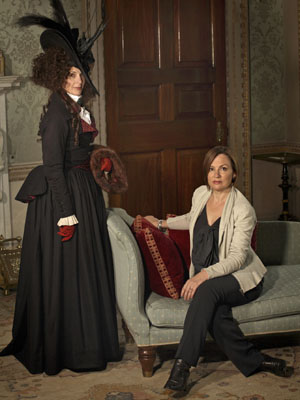
Emma Clifford as Mrs Simpson and Eileen Atkins as Lady Holland

Eileen's character, Maud, has a pet monkey, which was remarkably professional on set.

There was one occasion however when I was serving coffee by the breakfast table and it wouldn't do what was required.

If I poured the coffee once I must have poured it a thousand times. Every time we went for another take we had to reset the cups, the milk, the coffee, the spills I'd made, the sugar tongs etc. By the end of the scene I wanted to swear at it.

Subsequently watching the scene, you can't really see me doing anything. The monkey steals it every time it's on screen.

I have had a terrific time working on Upstairs Downstairs. Not least because of Cardiff. I know the city pretty well because we filmed Gavin and Stacey there.

I love the shopping arcades and the warmth of the people. I'm desperate to see a rugby match at the Millennium Stadium though. Maybe next time around!

It's going to feel very strange not being around when the series starts.

I'm going on a road trip in the USA with my wife and kids, so I shall have to wait until I'm back to gauge the response and to see what my children think.

I'm always conscious that I have a lot of potential to embarrass them.

Gavin and Stacey gave me a cool quota mostly - I'm not certain of Mr Pritchard's cool leanings. Still, if my mum and her friends like it, that's all that matters.

Adrian Scarborough plays Mr Pritchard in Upstairs Downstairs.

Upstairs Downstairs starts on Sunday, 26 December at 9pm on BBC One and BBC One HD.

For further programme times, please visit the upcoming episodes page.

Adrian Scarborough also appears in Miranda. Watch Adrian's interview with Miranda Hart on the BBC Comedy website.

Comments made by writers on the TV blog are their own opinions and not necessarily those of the BBC.

Christmas Top Of The Pops: My nearly accident-free show

Blog comments are currently unavailable. Find out more.

Post categories:

Reggie YatesReggie Yates|09:00 UK time, Thursday, 23 December 2010

You know it's Christmas when you start thinking seconds for dinner is normal and thirds is something to push for, your nan has only gone and got you that same pair of slippers again, and Top Of The Pops is on the TV.

One of my earliest memories of watching Christmas Top Of The Pops was seeing East 17 perform Stay in all white, and lead singer Brian Harvey performed wearing a white puffa jacket and ski goggles. It was genius and incredibly stupid all at the same time. Classic.

Hosting the show is something I look forward to every year and as a fan, I love it being part of my Christmas Day (even if I have to see my ugly boat race on screen).

In order to see this content you need to have both Javascript enabled and Flash installed. Visit BBC Webwise for full instructions

This year really did feel like a celebration of a year of great British artists holding the UK charts in the palm of their hands.

From number one single and album artist Tinie Tempah performing the anthemic Pass Out, to Ellie Goulding battering a glitter-covered drum on stage, to JLS making even the ladies on our camera team get a bit of a swoon on.

Then there was Plan B and his incredible band, and Eliza Doolittle and her incredible belly top. Ahh, good times.

Between swallowing an unfortunate amount of fake snow and nearly leaning on the trigger for the pyro gun, I had an incredible accident-free night.

Well, that's if you don't count the Nando's I spilled on my trousers. Spot the stain on your TV folks, it is there.

Myself and big sis Fearne Cotton had a great night as always. I had to laugh as Fearne became the bionic woman of television presenters wearing - after a wardrobe panic - shoes from Claudia Winkleman and a certain undergarment from Tess Daly.

Too funny, but classic Cotton.

Without doubt, this year was one to remember.

Reggie Yates is the co-presenter of Top Of The Pops.

Top Of The Pops is on Saturday, 25 December at 2pm on BBC One and BBC One HD.

For further programme times, please visit the upcoming episodes page.

You can sing along to the hits of 2010 with Top Of The Pops Christmas Karaoke by pressing the red button during the show on BBC One on Saturday, 25 December. The TOTP Christmas Karaoke will continue to be looped on the red button until 6am on Sunday, 26 December.

Comments made by writers on the TV blog are their own opinions and not necessarily those of the BBC.

Tony Jordan's Nativity: I play Mary

Blog comments are currently unavailable. Find out more.

Post categories:

Tatiana MaslanyTatiana Maslany|18:11 UK time, Monday, 20 December 2010

I knew immediately that The Nativity was a special script. I was fascinated by Tony Jordan's complicated, human portrayal of these iconic characters.

I think you will be drawn in, as I was, by the story's accessibility. It is universal.

In order to see this content you need to have both Javascript enabled and Flash installed. Visit BBC Webwise for full instructions

I loved that Mary wasn't written as a perfect, saintly being, which had been my image of her as I grew up.

In the script, she was very real, very fallible - a girl with innocence, confusion and doubt, and also great courage and faith. She was complicated.

The role was a challenge, both daunting and exciting. It felt like a huge responsibility because Mary symbolises so much to so many people.

I did a lot of research about her and then I tried to forget that she becomes the mother of God.

Instead I explored the fact that she was an ordinary child, in wonder of the world around her, faced with an extraordinary journey.

Coky Giedroyc's intelligent, artful direction kept me grounded in that reality.

My first day on set, I was filming a scene with the lovely Frances Barber (Elizabeth) - we were both sitting in the sand and I could feel the heat of it on my bare feet and the desert sun beating down on my head and everything just sort of fell into place.

It was a visceral experience that connected me to the story, the character.

All of the cast were so talented, so skilled at their craft, and every day on set I soaked up as much as I could working with these veteran performers.

Andy Buchan (Joseph) kept me on my toes everyday - he's an incredible actor, a real explorer. And funny too. We often tried to one-up each other with our David Brent impressions.

Even though the material was mostly heavy, there were, of course, lighter moments while we were filming.

Tatiana Maslany as Mary and Andrew Buchan as Joseph

Clara, our mostly faithful donkey, would get bored and run off during takes, Obi Abili (Gaspar) nearly fell off his rather unruly, yelling, projectile spitting camel and I can't even count how many sheep sneezed over our lines during the quiet, intimate scenes in the manger.

We filmed for a month in Ouarzazate, Morocco, an incredible place, and became very much a family. I had never been anywhere like North Africa before.

I loved the languages, the music, the food. I think I sweated off most of my body weight and I bet you can feel the intense heat watching the series.

I want to go back again, but this time without the responsibility (and enormous privilege) of carrying the son of God.

Tatiana Maslany plays Mary in The Nativity.

The Nativity starts on Monday, 20 December at 9pm on BBC One.

For further programme times please visit the upcoming episodes page.

Nordic Noir: The Story Of Scandinavian Crime Fiction

Blog comments are currently unavailable. Find out more.

Post categories:

Robert MurphyRobert Murphy|09:00 UK time, Monday, 20 December 2010

The Stieg Larsson phenomenon was building to a crescendo when we decided the time was ripe to take stock of Scandinavian crime fiction in the documentary that became Nordic Noir.

Why had a region best known for Volvos, Abba and Ikea begun producing dark and violent thrillers filled with brooding detectives and avenging cyberpunks?

To find out, I headed to Norway and Sweden to meet some of the genre's best writers and deep thinkers.

In order to see this content you need to have both Javascript enabled and Flash installed. Visit BBC Webwise for full instructions

Time - and resources - were tight. BBC Bristol's Time Shift strand has been churning out compelling programmes on a shoestring for nearly 10 years and I had just three days to film eight interviews in three cities.

First stop Oslo, where Norway's hottest property Jo Nesbø explained how he achieved the unlikely feat of turning the humble snowman into a symbol of bowel-quaking terror.

It was hard not to feel a tinge of envy for a man who'd only turned to crime writing because he was bored with the day job - which involved being the Bono-like front-man of one of Norway's biggest bands.

After a whirlwind filming tour of the city I took a flight to Stockholm where my colleague Naz and I went in search of the twilight world of Stieg Larsson's Millennium novels.

The next morning we talked politics with the urbane Håkan Nesser, a writer who drily questioned the current of left-wing angst that underpins so much Scandinavian crime writing, before another flight took us to the port of Ystad - Wallander country.

In order to see this content you need to have both Javascript enabled and Flash installed. Visit BBC Webwise for full instructions

I hadn't expected it to be quite so twee, nor to see a tanned and refreshed Kurt lounging about in deck shoes, smoking a fag - but then actor Krister Henriksson only plays Wallander, despite the similarities he acknowledged in our interview.

The shoot ended, fittingly, with the woman who started it all - Maj Sjöwall.

In the 1960s, she and partner Per Wahlöö created a series of politically driven thrillers based around a long suffering detective called Martin Beck - books that would have a profound influence on Stieg Larsson and Henning Mankell.

"We wanted to change people's way of thinking," she smiled ruefully.

And that is the real story of Nordic Noir.

Robert Murphy is producer of Nordic Noir: The Story Of Scandinavian Crime Fiction.

Nordic Noir: The Story Of Scandinavian Crime Fiction is on BBC Four at 9pm on Monday, 20 December.

The Time Shift strand continues with Italian Noir: The Story Of Italian Crime Fiction, also on BBC Four at 9.30pm on Monday, 27 December.

Comments made by writers on the TV blog are their own opinions and not necessarily those of the BBC.

Douglas Adams' Dirk Gently: How slavishly should a screen adaptation follow the book?

Blog comments are currently unavailable. Find out more.

Post categories:

Stephen ManganStephen Mangan|10:33 UK time, Thursday, 16 December 2010

It's been made very clear to me, mainly through conversations on Twitter, that a lot of people hold the Dirk Gently books in great affection and that they are going to be very upset if we don't get it right.

Dirk is described as "a pudgy man who normally wears a heavy old light brown suit, red checked shirt with a green striped tie, long leather coat, red hat and thick metal-rimmed spectacles".

Well, I'm a man; we got that much right. But I'm not that pudgy and I play Dirk wearing none of the clothes described.

In order to see this content you need to have both Javascript enabled and Flash installed. Visit BBC Webwise for full instructions

Does that matter? Should they have scoured the country for a chunkier actor? I believe there are some out there.

Without the red hat is the whole enterprise doomed to failure? Is playing him without a green striped tie tantamount to dancing on Douglas Adams' grave?

There are still people out there furious that James Bond is being played by a man with blond hair.

A blond Bond? The books say he has black hair falling down over the right eyebrow!

It's a thorny old question - how slavishly should a screen adaptation follow the book?

Some people won't be satisfied unless the images they had in their head whilst reading the novel are translated exactly onto the screen.

But what most people want, I imagine, is that they enjoy the screen version as much as, if not more, than they enjoyed the book and that the spirit of the book is preserved - if not the thick metal-rimmed glasses.

In my opinion Dirk Gently's Holistic Detective Agency and The Long Dark Tea-Time Of The Soul are unfilmable as written.

You couldn't begin to do justice to them in a single hour of television. Too much happens, there are too many ideas.


Stephen Mangan as Dirk Gently surrounded by a wall of paper notes.

So Howard Overman, our writer who knows a thing or two about writing for television, as any of you who watched Misfits will know, decided that if he was going to write an hour of telly then it needed to work as an hour of telly first and foremost.

It sounds obvious but you'd be amazed how often that isn't the priority.

Once that's established and you realise that you can't shoehorn the whole book into that time, you've got some decisions to make, what's in and what's out? What do we need to invent or add to make what's in work?

Once everyone's happy with the script, you cast it. Again, does it matter that I don't look like the Dirk that's described in the books? Is it enough that the actor gets the spirit of the character?

Dirk is one of the most interesting and complex characters I've played. He's charming, irritating, bright, funny, hapless, unreadable, transparent, roguish, chaotic, philanthropic and possibly dishonest.

If I get all that right, am I allowed to be too thin?

Television is a team sport, novel writing isn't. Our film has creative input from Howard, me, the director, the producer, the rest of the cast and dozens of others.

And all the stuff from the books that doesn't feature is still sitting there ready for us to use once the BBC commissions a 58-part series...

I'm extremely proud of how it's turned out. I hope you enjoy it.


Stephen Mangan plays Dirk Gently in Dirk Gently.

Dirk Gently is on BBC Four and BBC HD on Thursday, 16 December at 9pm.

Comments made by writers on the TV blog are their own opinions and not necessarily those of the BBC.

Imagine: Ben-Hur comes to Bath

Blog comments are currently unavailable. Find out more.

Post categories:

Matt HockenMatt Hocken|09:56 UK time, Tuesday, 14 December 2010

Almost exactly a year ago, an idea was formed in a tiny room in the Theatre Royal to bring a Hollywood epic of biblical proportions to the main stage. Ben-Hur was coming to Bath.

The cast and crew? A motley gang of amateurs brought together by a desire to live out their dreams in front of a packed house.

The whole thing didn't come to my attention for quite a while. I was nicely tucked up in my university bubble in Brighton when I got a call from my mum trying to convince me to get back on stage.

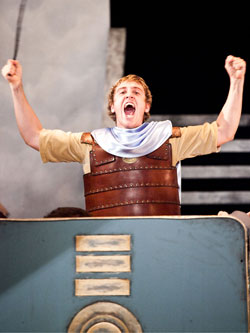
Matt Hocken as Ben-Hur. Photo kind courtesy of Nick Spratling, The Official Photographer

Having long forgotten my dream of becoming a professional actor in favour of a degree in sports journalism, I didn't think I would have the necessary skills to get a good enough part.

I came back to Bath after graduating and decided to audition hoping to escape the impending doom of having to find a job.

Never did I think that a month later I would have been cast as Judah Ben-Hur, a role made famous by Charlton Heston.

It's safe to say I felt just a little bit nervous at every rehearsal from then on.

From beginning to end this project was special.

It was the wish of Margot Boyd, the much loved actress who, for over two decades, played Marjorie Antrobus in The Archers, to show ordinary people the joy and excitement theatre could give to their lives. Margot left money in her will to finance an amateur production by the people of Bath.

You will be able to see for yourselves how much fun we all had.

Personally, I can't imagine a better way to spend a weekend than saving lives, racing chariots, being shipwrecked and witnessing the odd miracle or two.

I don't think my friends and family knew what to expect when they heard the news - no one, including the cast, could have imagined the outcome.

We hadn't even finished the chariot race on the day of the first performance.

In order to see this content you need to have both Javascript enabled and Flash installed. Visit BBC Webwise for full instructions

The chariot race is what every Ben-Hur production after the film will be judged on and it certainly caused many people sleepless nights. Do you think we pulled it off?

You may see in the programme that every move of the big ensemble scenes were done to counts of eight.

I can assure you, after six months of military drills, that somewhere in a house in Bath there is still some member of the cast doing the vacuuming to beats of eight.

Ben-Hur was never meant to produce 120 people who all wanted to be the next Charlton Heston or Audrey Hepburn.

It was designed to inspire people to get involved and try something different. The result for some people was remarkable - it changed their lives showing them a confidence which they never knew existed.

Matt Hocken appears as Ben-Hur in Ben-Hur, on BBC One and BBC One HD at 10.45pm on Tuesday, 14 December.

Ben-Hur is part of the Imagine series. For future programme times, please visit the upcoming episodes page.

Comments made by writers on the TV blog are their own opinions and not necessarily those of the BBC.

Macbeth with Sir Patrick Stewart: The Scottish play from stage to TV

Blog comments are currently unavailable. Find out more.

Post categories:

John WyverJohn Wyver|11:23 UK time, Thursday, 9 December 2010

Huddled against the cold in a huge overcoat, I'm cowering by a wall with a vicious-looking Alsatian snapping at my heels.

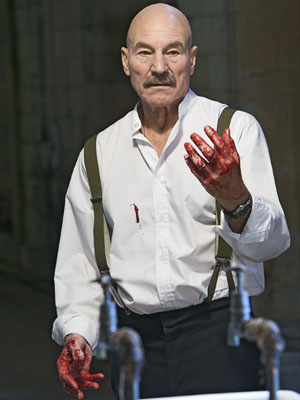
That's one of my more vivid memories from the location shoot for director Rupert Goold's film of Macbeth with Sir Patrick Stewart and Kate Fleetwood.

Fortunately my canine assailant was being expertly restrained as the camera captured my far from feigned fear. I'm the co-producer of Macbeth which is being broadcast on BBC Four on Sunday, 12 December. Sadly my starring moment ended up on the cutting room floor.

Sir Patrick Stewart and Macbeth, with blood on his hands

The shot was originally intended for the sequence we called, after the former East Germany's secret police, "the Stasi montage". Which suggests that our film of Macbeth is not exactly a conventional presentation of the Scottish play.

This is Shakespeare's bloody drama reimagined in the midst of a mid-20th Century war zone. The witches are deadly nurses and Banquo is assassinated by handgun and silencer.

Rupert Goold's Macbeth started at the Chichester Festival Theatre, transferred to the West End and then had a triumphant run on Broadway. The film came together after my production company Illuminations worked with Sir Patrick on the film for the BBC of the Royal Shakespeare Company'sHamlet with David Tennant.

As with Hamlet, shown on Boxing Day a year ago, we transplanted the stage production to a richly visual location and shot it across three weeks just like a feature film. Our setting was the eerie below ground world at Welbeck Abbey in Nottinghamshire.

This warren of tunnels, claustrophobic cells and a vast windowless ballroom was created in the mid-nineteenth century by the reclusive fifth Duke of Portland. His descendants still live in the main house, but they seemed content as Macduff's invading army fired off round after round of exceptionally loud blanks from their automatic weapons.

Although his production began life on the stage, Rupert Goold has crafted a fast-moving and highly cinematic version for the screen. Yet I believe it demonstrates a deep respect for Shakespeare's drama, and a full text (including the often-excised "England" scene) is played with very few cuts or additions.

Sir Patrick Stewart as Macbeth hugs Lady Macbeth, played by Kate Fleetwood.

But you may also recognise visual touches from contemporary movies like Downfall, the tale of Hitler's last days, and Stanley Kubrick'sThe Shining. Let us know in the comments which references you spot, and do please tell us whether you think our approach does justice to the play.


At the heart of the film are compelling performances from the immensely polished and practised stage cast.

Kate Fleetwood is a calculating and chilling Lady Macbeth who descends into a desperately moving madness.

Patrick Stewart is imperious as Macbeth: a man of "vaulting ambition" yet also hesitant, a deadly dictator of overweening confidence, but also a man tormented by guilt and regret.

John Wyver is the co-producer of Macbeth.

Macbeth is on BBC Four on Sunday, 12 December at 7.30pm.

Macbeth is available in iPlayer until 9.59pm on Sunday, 19 December.

Comments made by writers on the TV blog are their own opinions and not necessarily those of the BBC.
The Art Of Germany

Blog comments are currently unavailable. Find out more.

Post categories:

Andrew Graham-DixonAndrew Graham-Dixon|11:51 UK time, Monday, 6 December 2010

"Every nation writes its own history in three books, the book of its words, the book of its deeds, and the book of its art: the last of the three is the most reliable."

Well, that was John Ruskin's theory, and I'd go along with it.

I hope our new series, The Art Of Germany, lives up to Ruskin's proposition and tells the extraordinary tale of this often deeply divided nation through its art. It's an epic journey.

In order to see this content you need to have both Javascript enabled and Flash installed. Visit BBC Webwise for full instructions

From the primeval forests of Germania (as the Romans christened the place) to the Renaissance world of Durer, Altdorfer and Grunewald (what a painter of blood, sweat and tears he was!) to the Romantic castles of Bavaria and on into the deep, deep darkness of Munich and Berlin under the Nazis - ending with the art of the last 50 years, which in a very affecting, powerful way has all been about remembering, atoning, regenerating.

At times, when we were making these shows, I felt really weighed down by the almost unremittingly tragic patterns of German history.

Watching the programmes back, compared say with The Art Of Spain or The Art Of Russia, I was really struck by their relative solemnity and slowness of pace, which wasn't something we consciously set out to aim for.

It's just a question, I think, of form mirroring content. But I hope the experience of watching them is hopeful, at times even uplifting, rather than purely melancholic!

The actual art of Germany was so often created to lighten the gloom or to heal the wounds of the past.

So there's this constant seesawing in the series, between bleakness and hope, a kind of fight between grim political realities and art's ability to raise people up, to take them somewhere else.

And my goodness the art of Germany is wonderful.

I honestly believe that to many people in Britain it will be like travelling to an undiscovered country, full of barely known treasures.

Andrew Graham-Dixon at the Graphische Sammlung in Munich, Germany

Maybe I am wrong, but how many people watching at home will already be aware of the great limewood carvings of Tilman Riemenschneider (the greatest artist who ever set out to carve a piece of wood), the seething landscapes of Altdorfer, the bruised, mystical, almost empty world of Caspar David Friedrich, the solemn, strong, powerful photography of August Sander, the scabrous caricatures of Otto Dix, the genius of moderns such as Baselitz and Beuys?

I could go on and on, but I really am curious to know whether all this stuff will be as unfamiliar (or at least surprising) to the audience as I suspect it may be.

Most unfamiliar of all, I suspect, will be the material we cover in episode three, which is both the blackest and the most hopeful show of all.

In it, I attempt to demonstrate how the whole Nazi project was driven by a twisted sense of aesthetic priorities - to show how Hitler really did begin with art and architecture, poisoning culture as a dry run for his poisoning of Germany itself.

For me, it's the most surprising and revelatory of the stories we tell, but again, I am only guessing about its impact and I would be very interested to know what viewers make of that particular programme.

I think it'll be genuinely new and really shocking to many people. And I think it's an important piece of TV in its own way, because the opportunity to change people's ideas about a huge part of our shared history just doesn't come along that often.

But I'll just have to wait and see what everyone else makes of it...

The Art Of Germany follows The Art Of Spain and The Art Of Russia, with more to come, energy levels permitting! Which countries would you like to see more Art Of... from? Suggestions below please (no promises we'll make them into TV).

They are definitely as knackering as they are fascinating to make, what with six weeks on the road each time - and no, it's most definitely not five star luxury. I've got the photos to prove it.

But the truth is I've really loved doing the Art Of... sequence.

Andrew Graham-Dixon and sculpted character heads by Franz Xaver Messerschmidt

I think of it as a rolling 'series of series' not just about art and culture but cumulatively, a part-by-part history of the whole western world. A kind of alternative remake of Kenneth Clark's Civilisation, done by stealth!


And of course Kenneth Clark never talked about the art of Spain, or indeed the art of Russia. I guess he must have thought they weren't entirely civilised places.

But then that's a very important part of the point of these programmes, to broaden the story of 'civilisation' and the story of art, away from the usual suspects and show people how much else there is to explore in the cultures of other less explored countries.

On that note, I suspect there's been a certain British reluctance to engage with German culture - with the obvious exception of German music - over the last generation or two, and I wonder if all the bitter memories of war have played a part in that.

As far as I know this is the first overview of the German art tradition made for British TV, so I just hope everyone watching gets something out of it (even Basil Fawlty!).

Andrew Graham-Dixon is presenter of The Art Of Germany, part of BBC Four's Germany season.

The Art Of Germany continues on BBC Four and BBC HD at 9pm on Mondays.

For further programme times, please visit the upcoming episodes page.

Comments made by writers on the TV blog are their own opinions and not necessarily those of the BBC.

Watch a sneak preview of the BBC's Christmas shows

Blog comments are currently unavailable. Find out more.

Post categories:

Jana BennettJana Bennett|11:50 UK time, Friday, 3 December 2010

You will probably already have seen details of some of the great programmes we have coming up this Christmas across all of BBC television. This week we published our final schedules for Christmas and last night we gave a sneak preview of our festive highlights to the press, and I though it would be nice to share the film with everyone here too.

In order to see this content you need to have both Javascript enabled and Flash Installed. Visit BBC Webwise for full instructions. If you're reading via RSS, you'll need to visit the blog to access this content.

For me, Christmas and the holiday season is all about spending time with friends and families, board games, presents, carols, food and outdoor rambles to try and walk off the food, and of course tuning in to lots of great television. Every year at the BBC we aim to put on a great range of programmes that unite friends and family as well as appealing to a whole range of tastes.

This year there are an enormous amount of original commissions - from comedy and entertainment to music and children's drama - more than any other broadcaster. In fact this year there are no repeats in prime time on BBC One between Christmas Eve and Boxing Day, and repeats on BBC Two have gone down again.

To see whether this year's schedule holds up against our ambition of appealing to all tastes I decided to do a quick (although not very scientific) survey of my own extended family to see what they are likely to be watching over the holidays.

My son is a keen Top Gear fan so he will be switching on to see Jeremy, Richard and James as they set out across the Middle East, following the route of the three wise men (although they'll be doing so in wholly unsuitable sports cars rather than on camels, of course) and asking the question 'what exactly is myrrh and where do you buy it?'

In the film here you will see the hair-raising moment when the boys first touch down and realise exactly what lies ahead for them.

My daughter, back from university, will be glued to the Strictly Christmas special (and Most Annoying People 2010 on BBC Three!).

Luckily for me my husband is a keen and talented chef, so he is sure to feast on Toast, the drama based on Nigel Slater's memoirs starring the wonderful Helena Bonham Carter. My sisters (one a literary expert, the other an artist) are both fans of BBC Four, so Dirk Gently, the Douglas Adams' adaptation with Stephen Mangan is a must, plus Jools' Annual Hootenany and the Live Aid drama, When Harvey Met Bob, because they were there!

My sisters-in law and brothers-in-law are all accomplished classical musicians and will definitely be tuning in to see Jonathan Kent's new production of Don Giovanni from Glyndebourne on BBC Two and on BBC Four, and Simon Russell Beale's joyous Sacred Music featuring composers including Bach, Mendelssohn and Handel.

Christmas every year means all of us watching Carols From Kings as well as wall-to-wall BBC One from EastEnders to the big films. Doctor Who is a huge event for us, and has opera diva Katherine Jenkins taking on her first acting role with the marvellous Sir Michael Gambon.

Ronnie Corbett has a new all-star sketch show, The One Ronnie, and then there's the welcome return of Matt Lucas and David Walliams to BBC One in their airport mockumentary Come Fly With Me. You'll get to see just a few of their comic characters here in the film including the check-in girl Melody and Taaj, one of the airport ground staff.

Across the whole festive season, I can't wait to watch the revival of Upstairs Downstairs with my mum in particular, as she loves period drama. I'll warn her, and all of you, to catch the monkey.

And I'm sure all the generations will be tuning in to see Tony Jordan's thoughtful retelling of The Nativity to enjoy the story of Christmas and to see Peter Capaldi transformed from being Malcolm Tucker in The Thick Of It to one of the three Magi.

I hope you enjoy this sneak preview film and that you find plenty to whet your appetite this Christmas on the BBC. Everyone who works for me - the channel teams and schedulers, the talented programme makers and the camera and studio crews, marketing and press teams - all spend months preparing for the Christmas season and I know all of us want to wish you a Merry Christmas, Happy Holidays and great viewing!


Jana Bennett is director of BBC Vision.

Comments made by writers on the TV blog are their own opinions and not necessarily those of the BBC.
The incredible story of Operation Mincemeat

Blog comments are currently unavailable. Find out more.

Post categories:

Ben MacintyreBen Macintyre|11:13 UK time, Thursday, 2 December 2010

Operation Mincemeat was probably the most successful, and certainly the oddest deception operation of the Second World War - and perhaps any war. It involved obtaining a dead body, dressing it up as British officer, equipping it with false documents and leaving it somewhere where the Nazis would find it. All with the aim of fooling the Germans into thinking that, instead of invading Sicily in 1943, the Allied troops massed in North Africa were aiming for Greece.

I'm presenting BBC Two's documentary, also called Operation Mincemeat, and if the story sounds a little James Bond to you, that is no accident. It was partly inspired by Ian Fleming, then a young officer in naval intelligence. But it was put into action by two highly eccentric intelligence officers, Charles Cholmondeley and Ewen Montagu, neither of whom had any qualms about obtaining the body of a homeless man, and then turning him into someone else entirely.

In order to see this content you need to have both Javascript enabled and Flash installed. Visit BBC Webwise for full instructions

Their plan was inspired, and entirely illegal. After the war, the officials involved tried to keep the name of the dead man a secret, but then in 1996, by accident, a key document was declassified formally identifying the 'man who never was' as Glyndwr Michael, a Welshman who had killed himself with rat poison in a disused warehouse.

I doubt such a plan would be feasible today, even in wartime. Imagine the scandal if it was revealed that British agents had deliberately stolen a dead body. One of the reasons it worked so well was that the organisers were left alone to get on with it, almost without supervision. That would never happen now.

The operation required exceptionally detailed planning. For example, they had to create a fake identity card, but had real difficulty finding someone who looked like Glyndwr Michael.

He had never been photographed when he was alive, and his dead body could not be made to look anything but dead. Eventually they spotted someone in the MI5 canteen, a fellow intelligence officer who was a dead ringer for the dead man, and hauled him off to be photographed.

On the BBC History messageboards, Pete asks an interesting question about whether the Germans ever suspected the body with the top secret documents was a plant.

British intelligence scoured the Germans' intercepted wireless messages for any hint that the ruse had been rumbled, and found none at all. On the contrary, in the words of a triumphant message sent to Churchill, "Mincemeat swallowed rod, line and sinker."

The only person in the entire German High Command who had any suspicions was Josef Goebbels, the propaganda minister, who wondered in his diary whether the documents might be an elaborate hoax.

But he was far too cowardly to share his doubts with Hitler, who never doubted the authenticity of the papers - in large part because they confirmed what he already wanted to believe.

In order to see this content you need to have both Javascript enabled and Flash installed. Visit BBC Webwise for full instructions

Pete also asks how much of a success the operation was in terms of moving troops to Greece to defend against an invasion that never happened. Of course, that is very difficult to quantify, since it would have to be measured in lives saved, battles unfought, and blood unspilled.

But we can certainly say this: Sicily, the real target, was left comparatively lightly defended, and the island was conquered far faster than many had feared. An entire Panzer division was moved from France to Greece, to the precise spots identified in the Mincemeat documents.

And, perhaps most importantly, the great German assault on the Eastern Front, around Kursk, was called off once the invasion of Sicily was underway.

Urnungal is right that codenames were supposed not to refer in any way to the objective, individual or operation - a rule that was broken by all sides, throughout the war. Mincemeat was no exception. They chose the name because it appealed to their rather ghoulish sense of humour.

They did, however, re-use codenames. This was partly intentional since it was hoped that if, by any chance, the Germans did come across the code name, they might assume it referred to the earlier operation, and ignore it.

And lastly from the BBC History messageboards is Ferval's mention, of the film of The Man Who Never Was. It is indeed based on reality, but only very loosely. The book of that name, by one of the principal organisers, Ewen Montagu, was written under very particular constraints. Much had to be concealed, and parts are deliberately misleading.

The film went one stage further and, in the interests of drama, invented things that never happened and people, to coin a phrase, who never were. By the time the story reached Hollywood, it was partly fantasy.


Ben Macintyre is the presenter of Operation Mincemeat.

Operation Mincemeat is on at 9pm on Sunday, 5 December on BBC Two.

Read more on the BBC News website: Operation Mincemeat: How a dead tramp fooled Hitler

Comments made by writers on the TV blog are their own opinions and not necessarily those of the BBC.
At Home With The Georgians

Blog comments are currently unavailable. Find out more.

Post categories:

Amanda VickeryAmanda Vickery|10:04 UK time, Wednesday, 1 December 2010

I wrote and presented At Home With The Georgians at the suggestion of Janice Hadlow, controller of BBC Two. She'd heard me give some public lectures on 18th Century private lives and read my new book about homes in Georgian England.

Janice reckoned the combination of characters, stories and interiors would make appealing TV. Or "sex, scandal and soft furnishings" as the trailer promises.

A Georgian lady with Amanda Vickery

The recognisably modern middle class home was taking shape in the 18th Century when Britannia ruled the waves and became the world's leading manufacturing power.

The Gorgeous Georgians thought of themselves as 'a polite and commercial people', a nation of shop-keepers, consumers, and home-makers who loved to socialise and keep up with the Joneses.

Our towns and cities were rebuilt in the 18th Century according to the geometrical rules of classical Rome - all careful proportion, symmetry and clean lines. The Georgian townhouse is still the estate agent's dream ticket.

But inside those immaculate terraces there was a riot of up to date consumer goods - flock wallpapers, chintz curtains, silver plate tableware, Axminster carpets, and Wedgwood vases.

The polite threw open their doors to visitors, inviting the world into their parlours to drink the new exotic hot drinks (tea, coffee, chocolate), to gossip, and to admire the shiny new fixtures and fittings. Home improvements and interior decoration were the craze of the age.

The Georgians had this revolutionary new obsession: good taste. It sounds so quaint and suburban today, something that Hyacinth Bucket or Margo Leadbettermight get steamed up about. But 'taste' was fresh as paint in the 18th Century.

For the first time, quite ordinary middling people saw their interiors as an expression of personality. Your character, your education, morals, even the state of your marriage could all be judged from look of your home. Would your front room stand up to scrutiny? Would your choices cut the mustard?

The whole subject is so visual and colourful it leant itself to TV. I spent the summer getting behind the scenes in National Trust and English Heritage mansions, as well as the store rooms of the Victoria and Albert Museum and the Museum of London.

I loved finding hidden closets, back stairs and servants' back kitchens and garrets (some of the best are at Erdigg in Wales).

Amanda Vickery

But there is plenty of full-on design glamour too - like the brilliant yellow Chinoiserie of Claydon House (Bucks), the Neoclassical Bling of Syon House (Middlesex), the magical honey colours of Parham (Sussex), the old-fashioned romance of Townend (Cumbria) and the profusion of Chippendale furniture at Nostell Priory (Yorkshire).

But I'm not just interested in the interior lives of the rich. The Georgians came up with clever ideas for keeping up appearances on a middle income.

Slapping up wallpaper was one way to transform the look of a room for a fraction of the cost of textile hangings, wood panelling or stucco.

And if you were strapped for space, why not invest in some ingenious metamorphic furniture (multi-purpose tables, wardrobes that turned into beds) to get the most out of your bedsit?

Temple Newsam in Leeds has a choice collection - the drop-down bed that folds out of a chest is a wicked spring-loaded contraption that nearly crushed me.

Historians are all natural voyeurs itching to know what really went on behind closed doors. I have spent the last six years toiling in deeply unglamorous local record offices reading diaries, letters, accounts books, criminal records and business papers.

I use them to unlock the secrets of home sweet home and peel back the façade of Georgian elegance.


At Home With The Georgians is the story of men as well as women, master of the house as well as domestic goddess.

Only when he married and set up home did a frustrated boy become a fully fledged man. I used the plaintive diaries of half-baked bachelors Dudley Ryder and John Courtney to show how men yearned for domesticity.

They are so artless in their romantic failures and frailties - I found myself blushing for them. Ryder worried that he had bad breath but was too embarrassed to ask his mother. He even fretted that nerves would make him impotent on his wedding night.

The letters of Mary Martin reveal the Georgian ideal wife, loyal, bossy and frisky - a sexy battle-axe. But the papers of Ann Dormer and Gertrude Savile are painful to read - both were victims behind closed doors. They show that a rich man's house could still be a prison.

Ann Dormer was married to a pathologically tyrannical husband, Robert Dormer of Rousham, in Oxfordshire, who censored her letters, watched her every move and even kicked in the nursery door on the hunt for her.

She enjoyed none of the prestige and power the mistress fully expected to enjoy indoors. So her marriage was a 'yoke', a 'net' and a 'cage'. Rousham was never 'her house'.

Gertrude Savile was a morbidly shy spinster clinging on in her brother's house Rufford Abbey, in Nottinghamshire, dependent on him for "every gown, sute of ribbins, pair of gloves, every pin and needle". Even the servants "treated [her] like a hanger on upon the family".

Constantly made to feel her inferiority, Rufford had no warmth for her "home! Why do I call it home? I have no home".

There were winners as well as losers at home.

It's our attitude to house and home which defines the British as a people. Let foreigners keep their apartments, most Brits want their own front door and a patch of garden.

An Englishman's house is his castle after all. This series gets to the bottom of this very British obsession and recreates the interior lives, hopes and dreams of women and men.

Professor Amanda Vickery is the presenter of At Home With The Georgians and author of Behind Closed Doors: At Home in Georgian England.

At Home With The Georgians is on BBC Two at 9pm on Thursday, 2 December.

For further programme times, please visit the upcoming episodes page.

Comments made by writers on the TV blog are their own opinions and not necessarily those of the BBC.

More from this blog...