BBC TV blog - BBC TV blog

Archives for October 2010

Turn Back Time: Researching your High Street through the ages

Blog comments are currently unavailable. Find out more.

Post categories:

Tom St John GrayTom St John Gray|10:20 UK time, Friday, 29 October 2010

How do you think the British high street has changed over the last 150 years? In an era of online shopping and out-of-town retail centres, what skills, services and trades have disappeared from our high streets? Do we have a chance to bring back to life what we have now lost?

These were questions I thought about when accepting a job on BBC One's new series, Turn Back Time - The High Street, which brings together a group of modern shopkeepers in Shepton Mallet, Somerset. In a bold approach the shopkeepers are made to live, work and play through six key eras of British history.

In order to see this content you need to have both Javascript enabled and Flash installed. Visit BBC Webwise for full instructions

Over six programmes, we wound back the clock to the Victorian era, before transporting our traders through a century of incredible events.

The shopkeepers weren't alone on the journey - the Chamber of Commerce, a group of experts headed by MasterChef'sGregg Wallace, were there to support, guide and discipline our traders. There are brilliant points across the series when the shopkeepers face the wrath of the Chamber of Commerce - keep watching for the less than elegant first day at the Edwardian Tea Rooms.

Another compelling moment is when the entrepreneurial grocers get caught dabbling in the black market during the Second World War. After you've watched it, I'd love to know if you would have done the same?


As a producer on the series, I researched the history of the high street over the last 150 years. My background is in history, so I enjoyed getting stuck into a wealth of information available including detailed photos and archive film, censuses and surveys, and oral accounts from shop keepers and shoppers.

I even discovered my own family's shopkeeping past in the process - Welsh dairy farmers who moved to London in the Victorian era and set up a successful grocery business.

Michael Sharp, son of butcher Andrew Sharp, on the job during the Victorian era.

After many trips to museums, archives and reading lots of books, key themes emerged. There was the Victorian trend of adulteration and bulking up food with chemicals, and the Edwardian tea shop which enabled women to meet publicly and aid the suffragette movement.


We then moved on to rationing and the black market during the Second World War, and then the rise of self-service supermarkets which signalled the end of the high street's golden age. Throughout the series I was lucky enough to work with the widely respected social historian Juliet Gardiner, who was also part of the Chamber of Commerce.


As part of the research process, I also wrote nearly 30 shopkeepers manuals. These were detailed guides tailored towards each shopkeeper, outlining how their specific shops should be run in each era, including notes on rules and etiquette, recipes and day-to-day tasks.


The manuals also required a fully priced stock list for each shop which proved to be tricky, as the grocers alone had a range of hundreds of goods. Finding authentic prices in old money for each item was a real challenge.


I couldn't pick out a favourite era but I did love particular shops - the forge at the Victorian ironmonger, the etiquette and service of both the Edwardian grocer and the butcher, the kaleidoscope of colours from the 1960s milk bar, and the record shop in the 1970s.

Simon the Ironmonger at work in the Victorian forge

Be sure to keep an eye out for our Eurovision winning guests who really brought the market square to life. I would love to hear about your favourite era from the series - which shops did you particularly like or dislike?

Working on Turn Back Time was a unique experience and it was fantastic to see history brought back to life in such a vivid and tangible way.

I think the emotions the shopkeepers show in each of the programmes is a clear indication of how much passion and enthusiasm they invested in their shops and the experience. Their story is at the very heart of this series. I hope that you enjoy Turn Back Time and the journey into the history of your high street.

Tom St John Gray is a producer on Turn Back Time - The High Street.

You can read a post on the BBC TV blog by Karl Sergison, the dad in the grocer family, about his experience on the programme.

Turn Back Time - The High Street starts on BBC One on Tuesday, 2 November at 9pm.


To continue the Turn Back Time experience in your area, please visit Hands On History site or look for an event or pop-up shop near where you live.

World's Strictest Parents: Looking after two troublesome girls

Blog comments are currently unavailable. Find out more.

Post categories:

Mandy De ZylvaMandy De Zylva|11:20 UK time, Monday, 25 October 2010

I came to be a part of The World's Strictest Parents as a challenge thrown at me by one of my friends, who thought I brought up my four kids based on strong locally grounded beliefs, and felt that I could test myself out with some kids who did not know what these were and see how they coped with my rules.

When I first saw the two girls, Nicki and Jerri, my initial reaction was that they were not as bad as what I had expected. But that feeling didn't last too long when they were shown up in their true colours.

In order to see this content you need to have both Javascript enabled and Flash installed. Visit BBC Webwise for full instructions

After about two days my husband, Brindley, and I both felt that we would not be able to help the girls as they seemed too set in their ways and determined to carry on with life regardless of our values and thinking. These were based on tolerance, generosity, equanimity and love.


We founded our beliefs grounded on the conviction that people should concentrate more on fulfilling their obligations and not on demanding for their rights. Nicki's temper tantrums, for example, were quite shocking and, in my view, absolutely unacceptable by any sense of tolerance.

Each morning we got up wondering what the day would have in store for us. Their behaviour not only challenged our conduct as parents but also made us realise what their own parents would have had to go through with them. Luckily better sense prevailed at times when it came to breaking point, as it were.

For example, when Nicki shouted back at my husband on the second morning, he just issued her an ultimatum of accept or leave, and I am sure after some time she would have realised that he meant what he said and apologised for her behaviour, which made things more acceptable.

Nicki Stygall and Jerri MacVeigh, the two girls sent to live with Mandy and her husband Brindley

After about the second day we based our relationship with the girls on compromise. I believed that ultimately I didn't have to prove anything to anyone as we were sure that our system had worked well with our kids.

Though at times we wondered whether this was worth our while, where our kids were concerned, I am proud to say that they turned out the winners at the end. Not only did they value the grounding that they have got but came to our defence at all times.

At the end of the week we in fact felt sorry for the two girls as we saw the child in each of them emerge and we realised that they were just victims of circumstances and what life had to offer kids in the West. The system which always talks of everyone's rights seemed to have left the kids the wrong end of the stick to deal with life.

Mandy De Zvyla is featured in episode three of The World's Strictest Parents.

Episode three of The World's Strictest Parents is on BBC Three at 9pm on Monday, 25 October.

To find out future programme times, please visit the show's upcoming episodes page.

Renaissance Revolution: Applying cutting edge techniques to art

Blog comments are currently unavailable. Find out more.

Post categories:

Adam BarkerAdam Barker|12:11 UK time, Friday, 22 October 2010

When Renaissance Revolution was pitched to me, I was intrigued by the idea from the production company Blakeway Productions of using cutting edge graphic techniques to present classic artworks on television. Other television genres such as science and history programmes have made excellent use of graphic techniques to enhance the storytelling, whereas arts programmes have tended to be more conservative.

I was also slightly nervous about doing anything which might interfere with the visual qualities of the original paintings - which are, after all, among the masterpieces of Western civilisation - and we have tried to avoid that where possible.

Presenter Matthew Collings in front of Bosch's Garden Of Earthy Delights

In recent years a lot of innovative work has been produced in the field of high resolution image mapping using the latest digital technology. While online users have had access to large scale zoom capabilities, allowing them to focus in on specific areas of interest, rarely have these techniques been employed in producing broadcast television sequences.

The result is no ordinary art series. It pioneers techniques for how we view art on screen, allowing for a thrilling full high definition wide shot of a famous old master painting, and zooming to two centimetres of its exquisite details.

In terms of resolution these are the highest quality images ever made of complete paintings, the production team were able record at an amazing 65,000,000 pixels in one image. It is a credit to graphics maestro Paul Tierney and producers Paul Tilzey and Randall Wright that they managed to make this technology work.

The scary thing about working with graphics in this way is that you only see them right at the end of the edit. But some of the techniques used in the series are able to achieve astounding visual effects - a zoom in to a level of detail which would have been unachievable by any other means, movements across widely dispersed area of a painting faster than the eye could manage, and the simple pleasure of seeing such high definition renderings of these extraordinary paintings.

There is something weirdly appropriate to do this with Renaissance masterpieces like Piero Della Francesca'sBaptism Of Christ, Raphael'sMadonna Of The Meadow, and Bosch'sGarden Of Earthly Delights.

Looking at their beguilingly beautiful constituent parts and putting them back together with modern technology is very much what Renaissance painters did, pulling apart classical and medieval art traditions and updating them with perspective optical tricks, and new oil paint.

The presenter Matthew Collings is one of our most original and creative art critics, and the inspiration for this series came partly from a previous film he made for BBC Two called What is Beauty? Directed by Neil Crombie, this film combined images, music and commentary in a highly original and thought-provoking format.

Presenter Matthew Collings looks at Raphael's Madonna Of The Meadow

The challenge with Renaissance Revolution was to see whether a similar approach could work with the high art of the Renaissance. Having spent a lifetime immersed in the practice and study of art, Matthew Collings gets the chance to put this new technology to powerful use, helping him deconstruct and pore over these paintings in greater depth than he has been able to do before.

The result is a fresh and exciting vision of the Renaissance and a new way of seeing and understanding the secrets of technique, imagery and imagination that lie behind all great paintings

The main point of the series is to show how paintings which we now regard as part of the classic canon of Western art were the modern art of their own time. Our aim was to recapture the experimental and pioneering quality of Renaissance painting and show how these techniques evolved.

We must never forget that these images which we are now accustomed to seeing in grand museums were once blank canvases and pieces of wood in a young artist's studio. Renaissance Revolution gives a general audience access to the intricacies of technique and delicate details that are normally only seen by conservation experts, or the artists themselves.

I think this is a series which will divide opinion. Traditionalists may find it a step too far in its adventurous contemporary writing, film making and use of music. Those of you who are interested in arts programming that pushes the boundaries will, I hope, find it inspiring. After all, it's part of our job in the BBC arts department to be constantly challenging ourselves and our audience to find new ways of seeing art on TV.

Adam Barker is the commissioning executive for BBC Knowledge.

Renaissance Revolution is on BBC Two and BBC HD at 8.15pm on Saturday, 23 October. Episode one is available on iPlayer until 8pm on Saturday 6 November.

To find out details of future programme times please visit the upcoming episodes page.

The BBC One HD channel is ready for launch

Blog comments are currently unavailable. Find out more.

Post categories:

Danielle NaglerDanielle Nagler|14:04 UK time, Thursday, 21 October 2010

High Definition (HD) from the BBC will take another giant step forward in just a few weeks time. Back in May, I shared our plans on this blog to offer BBC One in HD. I can now share with you the news that BBC One HD will become available from the evening of Wednesday, 3 November, on all HD platforms (Freesat, Freeview, Sky and Virgin Media).

The channel will show exactly the same programmes as BBC One in standard definition, but wherever a programme has been made in HD you will be able to experience it in all its glory.

Wallace and Gromit's World of Invention

We'll open with The One Show, of course, at 7pm, which shifted to HD this summer. Over the weeks ahead you will also be able to enjoy a new science series from Aardman, led by old friends in Wallace And Gromit's World Of Invention, and the arrival of Film 2010 in HD.

There will also be food, from Jimmy's Food Factory and Nigel Slater, and entertainment with the continuation of The Apprentice and Strictly Come Dancing, Children in Need night, and The Royal Variety Show. Holby City, which has just started its HD life on BBC HD this month, will shift to BBC One HD from November.

Following the dramatic fire at the Queen Vic which led to the departure of everyone's favourite landlady, Peggy Mitchell, the iconic pub is now HD-ready, having been gloriously restored and placed under new management.

I can also reveal that viewers will be able to enjoy all the drama of Christmas Day in Albert Square in HD, as EastEnders broadcasts in HD for the first time.

You can enjoy a taste of what BBC One HD will have to offer - together with the first glimpses of Albert Square in HD - in the video below.

In order to see this content you need to have both Javascript enabled and Flash installed. Visit BBC Webwise for full instructions

Those shows which aren't made in HD - including initially EastEnders - will still be on BBC One HD but will be 'upscaled'. This means the number of lines in the Standard Definition (SD) picture are almost doubled - from 576 to 1080 - to use the space that an HD picture would occupy. As the original material is SD, the picture quality is not as good as HD.

We also won't be able to bring you regional news programmes or, if you are in Scotland, Wales or Northern Ireland, your own versions of BBC One in HD, and the programmes shown on them.

I'm sorry, this is something that we are working on, but the requirements of HD channels mean that we have to start with just a single version. Of course, you'll still be able to see your national and regional programming on your standard definition BBC One channel

Please don't think BBC HD is disappearing. BBC One HD is allowing us to grow the choices we can offer to you in HD, and BBC HD will be able to grow up alongside it. BBC HD will continue to be the home of many of your HD favourites (including Top Gear, Wimbledon, and our golf coverage).

We're also moving new programming into HD, and I'm delighted to share with you the news that we will be taking the opportunity to bring you the last couple of races of this year's Moto GP in HD as a trial run for the sport on the channel.

BBC HD will still offer children's programmes at the weekend, and great drama, comedy, music and factual programmes from BBC Two, Three and Four throughout the week. The channel will give you a chance to catch up on BBC One HD programmes you may have missed.

Programmes coming from the BBC's other channels to BBC HD will include programmes from BBC One Scotland, Wales and Northern Ireland, which can't be shown on BBC One HD. And we also expect to offer some classics from the archive of HD programmes we've shown since BBC HD launched.

With more hours to accommodate the growing number of HD programmes across the two channels, we'll be able to be more consistent about the HD schedule, showing programmes at the times they are going out elsewhere (which I know is often a source of frustration).

So get ready for November - I'll be keeping you up to date with our progress on Twitter at naglerhd - and start adding the new channel numbers to your favourites.

BBC One HD will be available - from November 3rd - on Freesat channel 108, Freeview channel 50, Sky channel 143 and Virgin Media channel 108. BBC HD will be available - from November 3rd - on Freesat channel 109, Freeview channel 54, Sky channel 169 and Virgin Media channel 187.


Danielle Nagler is head of BBC HD.

You can read more about EastEnders' move into HD on the EastEnders' blog.

For a list of frequently asked questions and answers please visit the BBC One HD FAQ page.

Holby City goes into High Definition

Blog comments are currently unavailable. Find out more.

Post categories:

Myar Craig-BrownMyar Craig-Brown|10:14 UK time, Tuesday, 19 October 2010

I've worked on Holby City off and on since series four - a whole nine series ago. I came in as a script editor, moving across from the daytime soap Doctors.

I thought all my Christmases had come at once, working on a show with such a stellar cast: the wonderful Hugh Quarshie and the gorgeous Tina Hobley to name just two.

In order to see this content you need to have both Javascript enabled and Flash installed. Visit BBC Webwise for full instructions

I did a couple of series of Holby, getting promoted to story editor. As story editor your job is to create and write all the regular character stories along with the lead writer. It's an amazing job - if you love being at the heart of the show, creating stories, characters and letting your imagination run wild, this is where it's at.

I then left to work on another medical BBC show, Born And Bred. Having worked on three medical shows, I'm half-convinced I've got a PhD or could at least diagnose a Coronary Artery Bypass Graft (CABG).

On returning from a couple of years' travelling, I heard they were looking for a story editor on Holby. I applied and here I am five years later, totally honoured and privileged to now be the acting series producer.

A series producer manages the show. You work alongside the line producer, managing the schedules and budgets, and with the consultant producer creating and shaping the regular characters' stories.

You oversee the process from attending the story conferences, where it all begins, right the way through production to signing of the show from a legal point of view.

Some of the things to be aware of are suicide, drug abuse - we have to be really careful we're not showing anything too distressing before eight o'clock or that there's anything people could copy, like drug use.

One of the key components of the job is just loving the show. And I do. Every time I read a script or watch an episode, I have to pinch myself to think I'm part of this all. The characters become part of your life.

Guy Henry as new Holby City doctor Henrik Hanssen

I totally cried when Jac and Joseph were locked away with a killer virus on the loose and Jac finally told Joseph she loved him. Or when Elliot held Gina in his arms as she died... amazing drama.

As I've only really been series producer since we started to go to HD, I can't say my role has massively changed. I've been in my current role for five months. I do know we've had to do a lot of work on the sets to get them HD ready - every chip, hole and imperfection was totally naked.

So that was a big undertaking for our design team. The look of the show is going to be much more crisp - I guess that's the biggest change our viewers will notice.

I know that EastEndersburnt down the Vic as its launch into HD. We didn't have a big explosive storyline, if you'll pardon the pun, but what we do have is the arrival of one of our new leads, Henrik Hanssen, played by the fantastic Guy Henry.

However, Hanssen's arrival is pretty explosive in its own way. He ruffles a few Connie Beachamp-shaped feathers. There's going to be ructions at Holby City - that's all I'm going to say.

So as well as getting our sets HD-ready with regards to make-up, costume and prosthetics, I know we spent a long time choosing the right red for our HD-ready blood. That was very important to get right, because don't you just love our blood and prosthetics?


Myar Craig-Brown is acting series producer on Holby City.

Holby City moves in HD on Tuesday, 19 October at 8pm on BBC One and BBC HD.

My debut on Film 2010 With Claudia Winkleman

Blog comments are currently unavailable. Find out more.

Post categories:

Danny LeighDanny Leigh|12:05 UK time, Wednesday, 13 October 2010

Some people are born performers. I, on the other hand, was a shy child, who it only seemed natural would then spend his career shut away on his own hunched over a laptop - working first as a film journalist, then a novelist and then a bit of both.

But life is a strange old beast - and with that in mind I suppose it makes perfect sense that I would be offered the chance to appear on at least some of the nation's TVs every week as co-host of Film 2010 alongside the wondrous Claudia Winkleman.

Claudia Winkleman and Danny Leigh

Those large shoes occupied first by Barry Norman and then Jonathan Ross? Peculiar thought as it is for me as much as anyone, I'm stepping into one of them.

The novelty factor for me is, as you might expect, vast. The sum of my TV experience to date involves appearing as a talking head on a pair of documentaries about British gangster movies and, yes, Sylvester Stallone.

This time round though, not only is the audience likely to be somewhat larger - we'll also be going out live. Weirdly, I'm feeling pretty relaxed about that particular aspect - which I'm putting down to my lack of understanding about what it entails.

Do please feel free to remind me of my current composure when, shortly before episode one goes on air on 13 October, I'm found crying and hyperventilating in a quiet nook at the BBC.

The good news is that there are, thank the Lord, a crack squad of proper professionals involved with the show - and on screen there will be Claudia, who obviously has all the experience I don't and can deal with anything live broadcasting could throw at us (clearly for my part I'll have to provide a lot of the glamour for the show, but I'm ready for the responsibility).

We did seem to click back at the screen test, which bodes well. My favourite film (David Lynch's masterpiece Mulholland Drive) reduced her to baffled hysteria, but that's OK, I'm used to baffled hysteria.

She's also someone with a real passion for films, and I'm nothing if not the same. So while there will be all manner of interviews, reports and debates going on, poring over the week's new releases will still very much be at the heart of the programme. It's just that there's going to be two of us reviewing instead of the traditional one.

People have asked if it's going to be tricky giving an honest verdict on a film if one of the stars is just off-camera waiting to be interviewed, but I think I can guarantee that whatever else happens, anyone watching will be getting a straight deal from us both (and when it all kicks off, I'll be hiding behind Claudia).

That said, I hope that most of the time we'll be getting to talk about films that deserve our love anyway.

Looking ahead to what's coming out while we're on air, there's a huge amount of movies I'm genuinely excited about, some of which I've seen already, most of which I haven't (in the former camp there's the new, 60s-set adaptation of a beloved novel of mine, Brighton Rock, in the latter director Darren Aronofsky'sBlack Swan).

There's obviously an element of risk hanging in the air, what with a writer wandering in front of the camera on live TV, and on a BBC institution to boot... but between the talents of the rest of the team and six months' worth of fantastic movies, I think we'll be all right.

That's another thing you can remind me of when they find me gibbering with fear on the night of the 13th.

Danny Leigh is the co-host of Film 2010 With Claudia Winkleman.

Film 2010 With Claudia Winkleman starts on Wednesday, 13 October at 10.45pm on BBC One

For further programme times over the next seven days, please visit the upcoming episodes page.

If you use Twitter, you can join in the conversation about Film 2010 using #bbcfilm2010.

Danny will be writing a regular column discussing the online reaction to the week's film news. Please visit Danny's page on the Film 2010 to read all his columns..

My role in lesbian drama Lip Service

Blog comments are currently unavailable. Find out more.

Post categories:

Ruta GedmintasRuta Gedmintas|11:11 UK time, Tuesday, 12 October 2010

I was trying to read the scripts for Lip Service, between scenes, covered in raspberry syrup, sat on a really cold and dirty set of a horror movie I was doing called Prowl in Bulgaria.


And two thoughts crossed my mind: Wow, Frankie is an awesome part, and... that'll never happen.

So with that in mind, I went to the audition, pretty much straight off the plane, bit scruffy, bit tired, bit shell-shocked from the horror film, probably a little bit of the crusty blood-syrup still in my hair.

In order to see this content you need to have both Javascript enabled and Flash installed. Visit BBC Webwise for full instructions

I had a bit of a chat and a read. I really liked the producer, Polly Williams, and the writer, Harriet Braun, who were with Jill Trevellick (the casting director) but I fully expected nothing to come of it. Then my agent called me and told me they liked me and that I wasn't allowed to go to New York. (I had been planning to move there for a little while.)

I thought Frankie should have stayed in New York and everyone else flew out to see her. It may have messed with the story somewhat, but we all would have had a great time in NYC.

Next came a couple of chemistry read sessions - these are auditions to 'test' the connection between two actors in front of a camera. Sometimes there is something that just works between two actors, and you're not quite sure what it is. This was when I first met John McKay, director of episodes one and two.


It was quite interesting for me to stay in the room after the other actor's audition was over. Usually you get around 10 minutes to prove yourself for a team you could potentially be working with for four months.

It's pretty cool to hear the commentary after an actor has left the room. It was never nearly as bad as we actors always assume it is. Kudos, the production company, and Jill brought in some brilliant actors for all the roles.

Being cast as Frankie was fantastic. I couldn't wait to get my grips on her. She's dark and wild, troublemaking and impulsive. She flips from being intensely introvert to bolshie and provocative.

Ruta Gedmintas as Frankie with Laura Fraser as Cat in Lip Service.

I remember John coining the phrase 'cold fire' for Frankie, referring to her emotional duality in any given scene. Because whatever Frankie appears to be thinking or feeling, there is quite often an intense contradiction underneath.

I liked that you couldn't put anything past Frankie, and that none of the characters would know what was coming next from her. That's quite exciting to play.

I got to work with some amazing actors on Lip Service. Not only were they abundantly talented, but really lovely people. We all got on really well, and although I didn't have much time to socialise whilst filming, we found our moments for dancing and debauchery.

I had very little time off. But I relished every moment of filming. We had to do some pretty intense scenes. And luckily we had a great crew around to support us.

Our director of photography, Neville Kidd, was fantastic. He shot Lip Service beautifully, and would make us feel very safe and comfortable, especially in the sex scenes. Even when his head was right by our bottoms.

One of the funny filming moments was the scene where Jay picks up Frankie from the airport. This is where the magic of editing is truly evident.

Because filming that scene, Emun Elliott (Jay) couldn't drive, so we had a driver double. This meant that during Jay's shots they had to fix a steering wheel to the passenger side of the car, and flip the shot in the edit.

Now, the car was quite small, so we had the driver double and Emun in the front, and I was sandwiched between John McKay and Neville and his camera. Giving my lines from the backseat, and vice versa with Emun for my takes.

If you look closely, you can see the shadow of the stunt driver's glasses on the seat next to Frankie. It goes to show how much work goes into what seems like a simple scene. I felt somewhat close to Neville and John after that.

The cast of Lip Service

Filming in Glasgow in the winter is bloody freezing. Underneath our costumes would be a multitude of thermals and secret handwarmers stuffed in bras and back pockets. During December we did not enjoy taking any of these clothes off.


We had a great costume and make up team on the show. They came at us with these fantastic ideas, and really listened to our thoughts and conceptions. I think every one of the characters has a very distinctive style that suits each of their personalities.

I also like the music in Lip Service. I think moments are picked out nicely with certain tracks, yet there isn't a need to have a score running under the whole show. Some times the silent moments are the most effective.

Funnily enough I listened to The XX pretty much every night when I was doing script work during filming, and one of their tracks has ended up scoring a very important scene for Frankie.

I actually had a Frankie soundtrack on my iPod. Songs that would either rile me up or cool me down or make me feel sexy etc. We stayed in rented flats while filming and I turned mine into what I thought Frankie's flat would look like.

I like photography myself, so I had all my cameras strewn about, films and negatives everywhere. I had a great postcard book of magazine covers of 1950s pin-ups, which I tore out and stuck everywhere. I also had a mirror covered in all things Frankie, from photos to poems to quotes scrawled in eyeliner and lipstick.

I think Fiona Button (Tess) thought I was mad. I probably was a bit. She didn't like hanging out in my flat, so we ran lines and drank tea in hers. Rock'n'roll.

It's always a combination of terror and excitement when a show you have done is going out. You never know what an audience will make of it. You wonder who you'll take to, who you'll like or loathe or want to get to know. Every character is so different.

I'm not sure I could choose between Tess, Frankie and Cat, as to who I would be friends with in reality. I think I would need a bit of all of them in my life. Even Frankie.

Ruta Gedmintas plays Frankie in Lip Service.

Lip Service is on Tuesday, 12 October at 10.30pm on BBC Three.

Creator and writer of Lip Service Harriet Braun has written on the BBC Three blog how she created the show.

The Sarah Jane Adventures: Writing for my childhood heroes

Blog comments are currently unavailable. Find out more.

Post categories:

Phil FordPhil Ford|11:08 UK time, Monday, 11 October 2010

Set your sonic lipsticks to thrill - The Sarah Jane Adventures is back. And I don't care if I've already seen the scripts (even written some) - I'll be on the edge of my seat watching them all over again. Just as I adore Doctor Who, I love this show.

When I was a kid Lis Sladen was my Doctor's companion. That was the suave Jon Pertwee, and then the barmy be-scarfed Tom Baker. Why wouldn't I love this show?

Elizabeth Sladen as Sarah Jane Smith, with the rest of the gang - Luke, played by Tommy Knight, Rani, played by Anjli Mohindra, and Clyde played by Daniel Anthony.

Now I've written four series of adventures for her. I am the biggest kid in the playpen and I'm playing with my favourite toys. Being a writer who gets to write for his childhood heroes is the best of the best.

When I wrote my first Sarah Jane, The Eye of the Gorgon (the one with the nuns who drove around in a hearse) people said it reminded them of Doctor Who from way back. There's no greater compliment. Now we are on the fourth series and the show just keeps getting better.

And scarier. I like the scary stories. My favourite episodes have been last year's haunted house story, The Eternity Trap, and The Day Of The Clown from the year before. Bradley Walsh, who played Odd Bob, scared the pants off me on set.

This year, Joe Lidster'sNightmare Man is right up my scary street. Gareth Roberts' Empty Planet is just about as big a mystery story as you can get - complete with robots. And Goodbye Sarah Jane Smith, which he has co-written with Clayton Hickman is both emotional rollercoaster and action-packed gobsmacker.

The Nightmare Man from the first episode of series four of The Sarah Jane Adventures, with Luke, played by Tommy Knight

Rupert Laight's Lost In Time is three stories in one and then there's Russell T Davies' return to Sarah Jane writing duties with a story that not only features Matt Smith but Katy Manning returning to her role as Jo Grant, the Third Doctor's other companion.

Then there's my Vault Of Secrets, which sees the return of a familiar reptilian face and some sharp-dressed villains with something nasty up their sleeves. It's going to be so much fun.

It's a bit different from Waters Of Mars - the Doctor Who special that I co-wrote with Russell last year. We visited a very dark part of our favourite Time Lord with that one.

People ask me about the differences in writing something like Waters Of Mars and Sarah Jane's adventures with Luke, Clyde and Rani. Is it a different process? No. It's just about writing the best story I can.

Instinctively you pitch the story differently, but I'm still using the same parts of my brain - the bits that get scared, the bits that laugh, the bits that get fired up by adrenaline, and the bits that cry,

Because stories are all about emotion. And I guarantee this year you will laugh, cry and hide behind the couch. I know, because I'll be there with you.

Phil Ford is lead writer and co-producer on The Sarah Jane Adventures.

Series four of The Sarah Jane Adventures starts on CBBC on Monday, 11 October at 5.15pm.

To find out times of future programmes, please visit the upcoming episodes page.

Until Friday, 5 November you can press the red button to test your knowledge of the show with a Sarah Jane Adventures Quiz.

My inspiration to write Single Father

Blog comments are currently unavailable. Find out more.

Post categories:

Mick FordMick Ford|11:34 UK time, Friday, 8 October 2010

I'm excited about Single Father going out on TV but also a bit nervous and a bit protective. I haven't felt like this with other things I've written. Maybe it's because I've spent five years on it but also because I never tire of watching David Tennant, Suranne Jones and all the actors zinging the characters into life.

Then there are the children, who could make or break it, because if the family's not believable the game's up.

In order to see this content you need to have both Javascript enabled and Flash installed. Visit BBC Webwise for full instructions

There were worries. I mean, how would they react to having Doctor Who as their Dad? Would they ever get over it? Would they forever be looking at David in wonder and awe? See what you think.

The story started to form nearly six years ago. I knew I wanted to write something around bringing up children but wasn't sure how to do it until I got some unintentional help from home.

We have three boys - at that time they were the same age as the children in Single Father. Like those kids they weren't allowed Xboxes, iPods, mobile phones, clothes with logos, virtually any television.

This ethos, which I agree with, was imposed by their mum, who one day looked at me and said "If anything happened to me, you wouldn't keep this going, would you? You'd give them everything they want!"

And there it was: Single Father, thank you very much. Except I almost didn't write it out of superstition, because to make a single father, I had to lose the mum and I didn't want to tempt fate.

David Tennant as Dave in Single Father, with children.

And maybe I wouldn't have written it if I hadn't had another nudge. I was down in Deal, in Kent, writing something else and overheard a story about a bandsman who was killed there in the bombing of the Royal Marines' barracks in 1989.

This bandsman's wife was working at the time in the café at the end of the pier. Because the wind was blowing off the sea, no-one there heard the blast, but at the exact moment her husband died, for no apparent reason, she blurted out "I love you too!".

And then felt an intense sense of warmth and wellbeing.

I couldn't resist that. It was a love story and that "I love you too!" contains everything.

There are no bandsmen or bombings in Single Father but that line's there and it echoes across the four parts.

I really hope you get involved with the characters over the coming weeks and enjoy the story.

Mick Ford is the writer of Single Father.

Single Father is on BBC One and BBC HD at 9pm on Sunday, 10 October.

To find out times of all future episodes, please visit the upcoming episodes page.

The Song Of Lunch: Making a poem into a drama

Blog comments are currently unavailable. Find out more.

Post categories:

Greg WiseGreg Wise|10:15 UK time, Thursday, 7 October 2010

One of my oldest friends, Martin Goodman, now the professor of creative writing at Hull University, thrust a little book into my hands about six months ago saying he thought the poem contained within, The Song of Lunch, would make a great film.

Martin had just taken over the professorship from Christopher Reid, the author of the poem.

The Song of Lunch in itself, is quite a brief story: man leaves his office, walks through town to a restaurant and has lunch with an old flame. However, as with all things great, it is also a huge story.

It is mythical - it is a Greek tragedy - it is Orpheus and Eurydice - it is a man trying to bring back to life his dead wife.

And is that possible? You will have to watch to find out...

In order to see this content you need to have both Javascript enabled and Flash installed. Visit BBC Webwise for full instructions

Before I had even finished reading it, I could see that this piece of narrative poetry would, indeed, be able to be transformed into a film: and most excitingly, nothing would need to be added - it was all there - the location described, the action relayed, the interior narrative and the dialogue was all present in the original writing.

I met up with the marvellous Christopher Reid at a local pub for a slightly boozy lunch and he kindly allowed me to put my case to the BBC.

I know Auntie gets a kicking a lot of the time, but all I can say is God bless public service broadcasting. I know no other broadcaster would have the vision, the bravery and the commitment to undertake a piece of work such as this, and for that the BBC should be praised.

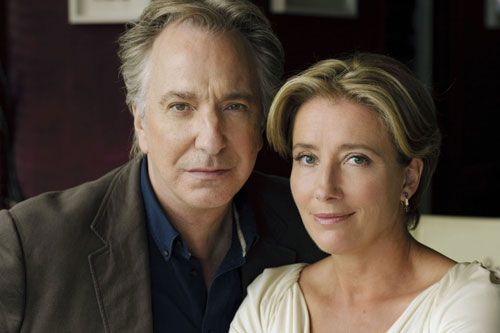
Allegedly, nobody had ever witnessed a quicker commission - partly as I thought the piece should be broadcast on National Poetry Day (which was fast-approaching) and partly because our two stars, Alan Rickman and Emma Thompson had a tiny window of availability (also fast-approaching).

Within a couple of weeks of my 'pitch' I was working with an executive, Sarah Brown, and a producer, Pier Wilkie - carefully going through the poem, putting it into script form, and finally working with our wonderful director, Niall MacCormick.

We were all in utterly uncharted territory, for, as far as we were aware, a poem had never been made into a film before: how were we to transpose verse into film - what were the rules, what was the grammar, how do we move from the interior monologue to dialogue?

Alan Rickman and Emma Thompson in The Song Of Lunch

Working closely with Christopher Reid, who, thankfully, sanctioned various cuts in the piece, a shooting script was put together and we embarked on 10 very hard days of filming. The filming coincided with the 30 degrees plus heatwave we had in London over the summer, and sitting in a heavily-lit restaurant, poor Emma got heat exhaustion on the first day of the shoot.

Air-conditioning units were wheeled in for the remaining days, gallons of water drunk, but it was still like an oven on set.

My job, as far as I saw it, was to try and launch the piece - persuade the BBC to make it, ask my old chum, Alan Rickman, if he'd like to do it, thankfully also have my wife, Emma, fall in love with the piece, work on the script up until the shoot - and then just to let all the wonderful people get on with it - for I thought there is nothing worse than having an executive producer (for that was my title) get in the way of the filming process.

The result is thrilling: a film full of hope, despair, regret, drunkenness, verbal dexterity, but above all, humour. The humour of life, of the absurd.

From the outset, I was adamant that this piece had to stand up in its own right, shouldn't be seen as a rarefied intellectual exercise, that we, as the audience, should forget that this is a poem, until a rhyming couplet suddenly jumps out at us - above all, we should be taken on a wonderful journey, surrounded by words: words seamlessly moving from voice-over narration into dialogue, back into narration.

We should wallow in a sea of words: hear them, taste them, smell them.

I am so proud of everyone connected with this film and I hope the joy I feel is shared by all who watch it.

Greg Wise is the executive producer of The Song Of Lunch.

The Song Of Lunch is on at 9pm on Friday, 8 October on BBC Two and BBC HD.

Lord Alan Sugar on the new series of The Apprentice

Blog comments are currently unavailable. Find out more.

Post categories:

Fiona WickhamFiona Wickham|11:00 UK time, Wednesday, 6 October 2010

Lord Sugar, could you tell us how the candidates were recruited for series six of The Apprentice? How involved you were in the process?

As always, aspiring candidates were encouraged to apply via the BBC website. The most impressive applicants are then invited to the interview process at which point we are always able to sift out the chancers and wannabes.

I always look at the final CVs and scrutinise every one. Ultimately one of these candidates will eventually have to join my organisation and that is something I take extremely seriously.

Lord Alan Sugar

What was your favourite moment of series six?

There are some great moments in this series but a particular favourite of mine was the international task where they will have to sell crisps to the Germans, who, let's just say, have a very particular taste preference.

What was the worst moment of all the series?

It's never good when candidates who are experienced in a particular field end up under-performing in a task that lends itself to their apparent skill set. This happens during the new series and it really gets on my wick.

What advice would you have for 16-year-old business GCSE students - should they continue studying business or crack on and get a job?

There is no right or wrong route to success. The academic route isn't for everybody, but that isn't to say all 16-year-olds should pack in their school work. I left school with no qualifications and went on to achieve great things in business, but courses for horses, as they say.

You've said that Philip Green would be too far out of his comfort zone to succeed at the challenges you set the candidates...

I am certain that if you took any of our country's most successful businessmen and put them in a factory, having had no sleep and told them to make sausages and then sell them on a market stall, they would fail.

The Apprentice is all about taking people out of their comfort zones and seeing how they perform. Even Philip Green has an Achilles heel, I'm sure!

In order to see this content you need to have both Javascript enabled and Flash installed. Visit BBC Webwise for full instructions

Do you enjoy watching the finished TV show or does it wind you up?

Yes absolutely, it's the first chance I get to see how they actually performed on a task as opposed to relying on reports from Nick Hewer and Karren Brady. Some of the mistakes they make are laughable.

Have you ever privately changed your mind over firing a candidate and wished you'd kept them in for an extra week?

I have never regretted a decision, but yes, there are some candidates that perhaps should have stayed in the process for a longer period.

Have you ever spotted a kindred spirit in a candidate - someone who reminds you of yourself?

I'm cut from a different cloth and have yet to meet a candidate that is a replication of me, but there are certainly candidates in the past who have shown flashes of me when I was younger.

What are you most proud of about The Apprentice's success - especially since it hasn't been matched in the US Apprentice?

I'm proud of how far we've come. From being considered a somewhat niche programme on BBC Two to being recognised as one of BBC One's highest rating shows really is no mean feat.

We are now on our sixth series and looking forward to seventh so we've proven what a successful format The Apprentice can be when fronted by Lord Sugar as opposed to Donald Trump.

Lord Sugar is a respected businessman and entrepreneur and star of The Apprentice.

The Apprentice is on BBC One and BBC HD on Wednesday, 6 October at 9pm.

To find out times of future programme times, please visit the upcoming episodes page.

Fiona Wickham is editor of the BBC TV blog.

More from this blog...