

The power of thought
 Imagine a world in which you don't have to flick a switch to turn the lights on or boil the kettle.
In this vision of utopia you don't even have to say "lights on" or "time for a cuppa". All you have to do is think it, and technology does the rest.
It's the stuff of science fiction. The kind of futuristic opening scene a film maker might employ to establish that the storyline is set well into the 22nd century.
Or maybe not. Scientists at the University of Southampton have managed to communicate the thoughts of one person to another across the internet without either of them touching a keyboard or voicing any commands. But this is not telepathy: Welcome to the world of Brain Computer Interfacing, or BCI.
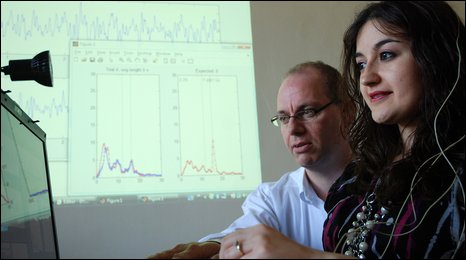
The idea behind the research is to translate thoughts into binary signals or commands that can be understood by a conventional computer. So with his motor cortex monitored by electrodes, the first subject is asked to think about moving either his right of left hand. The brain activity that results is transmitted over the internet as either a "one" or a "zero".
At the other end of the system a second subject sits in front of a set of LED lights that flash at a different frequency depending on whether a "zero" or a "one" is received. Crucially the pattern of flashes is too subtle to be consciously seen, but it does register in the subject's visual cortex.
That activity is picked up by a second set of electrodes and the binary series of ones and zeros flashes up on a nearby screen. Bingo! (or perhaps that should be "Eureka!") Thoughts from the motor cortex of one individual have been transmitted to the visual cortex of another across the internet.
"Dramatic proof of principle"
It has to be said the experiment is a little... clunky. It takes a few seconds for the electrodes monitoring the motor cortex to register the imagined left or right movement, and there's a similar gap before the message is downloaded from the receiver's visual cortex. Both are susceptible to a degree of interference in the shape of stray thoughts popping into the participants heads.
But that's just a matter of fine tuning. With refinement, Dr Christopher James who lead the research believes, we could one day use the power of thought to transmit messages and control machinery.
"The experiment provides a dramatic proof of principle. This is brain to brain communication through the power of thought."
It's early days for BCI, but already the US military is investing millions through the defence procurement agency DARPA in similar projects. And, while the idea of targeting enemy combatants or controlling battlefield robots by thought alone may still be the stuff of science fiction, Dr James is already experimenting with a motorised wheelchair that could be steered by the power of the occupant's mind.
BCI could also offer disabled people new ways to control their environment, and to communicate with those around them.
And you can also see an online film about Dr James's experiments .
 I'm Tom Feilden and I'm the science correspondent on the Today programme. This is where we can talk about the scientific issues we're covering on the programme.

Comment number 1.
At 11:54 14th Oct 2009, watriler wrote:I see a valuable application for the Today programme when politicians are interviewed!
Complain about this comment (Comment number 1)