

Help monitor air pollution with lichen
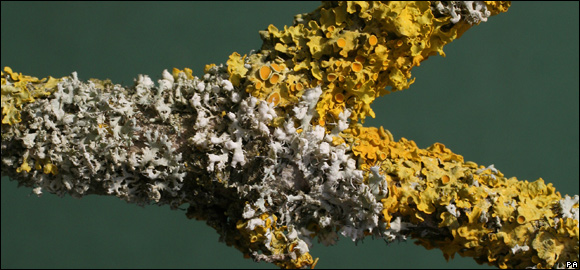
I have to admit that until today my familiarity with Lichens was limited to a walk on part in an evolutionary tale about peppered moths (more of that in a moment).
But the natural world never ceases to amaze. Lichens, it turns out, are not just good indicators of air quality (thriving where pollution levels are lowest), they're also two organisms for the price of one: a fungi growing in a symbiotic relationship with an alga.
Air pollution comes from a variety of sources, including cars, factories and agricultural processes.
The problem is we can't always see it, but we can measure its impact on the environment, and by building up a comprehensive picture of the distribution of lichens, scientists at Imperial College hope to create a comprehensive map of air quality across the country revealing the pollution hotspots.
And that's where you come in. Taking part is simple and fun. All you need is a copy of the survey fact sheet, and a handy guide to identifying lichens, which can be downloaded here.
In order to see this content you need to have both Javascript enabled and Flash installed. Visit BBC Webwise for full instructions. If you're reading via RSS, you'll need to visit the blog to access this content.
Now that story about peppered moths:
During the 19th century sooty smoke from the coal burning furnaces of the industrial revolution killed much of the lichen growing on the trees and blackened the bark.
When peppered moths landed on the trees the lightest, that had been well camouflaged against the lichen, stood out as easy pickings for birds.
It created an evolutionary pressure that favoured darker moths, which became progressively more common, and by 1895 98% of the peppered moths in the vicinity of big cities like Manchester were black.
Since the 1950's when pollution controls have significantly reduced sooty particles in the air, both the lichens and lighter peppered moths have made a comeback.
 I'm Tom Feilden and I'm the science correspondent on the Today programme. This is where we can talk about the scientific issues we're covering on the programme.

Comment number 1.
At 13:28 29th Sep 2009, thelovelypudding wrote:My printer is out of action Can you send by post a copy of the survey shee regarding lichen
Complain about this comment (Comment number 1)
Comment number 2.
At 16:48 29th Sep 2009, paulvanp wrote:unfortunately that peppered moth story has long since been found to be charming but untrue, even though many textbooks, generally older ones, popular science books and ones for younger kids and students, still repeat it.
Complain about this comment (Comment number 2)
Comment number 3.
At 21:43 29th Sep 2009, spoors1961 wrote:Paulvanp is plain wrong in his assertion about the peppered moths being a charming story that is untrue. Melanism in the peppered moth has been and continues to be the subject of research into increased predation of light-coloured moths resulting from increased visibility. Research by, for example, Cook, Mani and Varley (Science 231 611-613) and many others support the article that Tom has written.
Complain about this comment (Comment number 3)