

The greatest fossil hunter ever known
The shells she sells are sea shells I'm sure.
For if she sells sea-shells on the sea shore,
Then I'm sure she sells sea-shore shells.
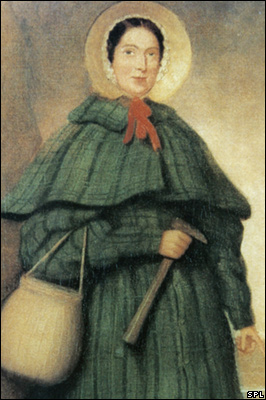 Not every working class girl collecting weird looking stones on the beach at Lyme Regis to sell to rich Victorian tourists could expect to inspire their very own tongue-twister, but then Mary Anning was no ordinary girl.
In 1811, at the age of just 12, she discovered the first complete ichthyosaur skeleton - a dinosaur looking something like a dolphin, only bigger - emerging from the Blue Lias cliffs to the east of Lyme.
It was the start of an impressive career. Described by the Natural History Museum as simply the greatest fossil hunter ever known, Mary's haul from the beaches of Dorset included thousands of fossilised dinosaurs. Besides the ichthyosaur, she was the first to discover the plesiosaur and even turned up the odd a pterodactyl.
But although her finds attracted the attention of scientists and collectors from all over the world, she never gained the public recognition her discoveries merited.
The sexual - and class - mores of the time dictated that it was her rich patrons who won all the plaudits and, incredibly for such an important figure, very little has ever been written about her life and achievements.
 The American journalist and academic Shelley Emling was determined to put the record straight and the result is the first comprehensive biography of Mary Anning's extraordinary life, entitled The Fossil Hunter.
By coincidence, the author of Girl with a Pearl Earring, Tracy Chevalier, stumbled across the Philpot Museum - which houses many of Mary Anning's finds - while on holiday in Lyme Regis.
Her latest novel, Remarkable Creatures, is a fictionalised account of Mary's life built around her friendship with a wealthy Victorian patron - and benefactor of the museum - Elisabeth Philpot.
Books, it seems, are like buses. You wait nearly 200 years for one to come along and then two turn up together.
 I'm Tom Feilden and I'm the science correspondent on the Today programme. This is where we can talk about the scientific issues we're covering on the programme.

Comment number 1.
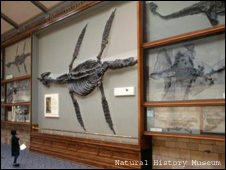
At 08:52 29th Aug 2009, Duncan wrote:It's good of the Natural History Museum to position a small child next to the ichthyosaur skeleton to convey a sense of scale.
Complain about this comment (Comment number 1)
Comment number 2.
At 22:13 29th Aug 2009, jmcanning wrote:I am interested in Mary Anning as I was an Anning before I was married. We live not far from Lyme Regis and have visited the museum and her grave. I've sent our grand daughter Tracy Chevalier's new book as she is interested too. Mary Anning is on our family tree I think.
Complain about this comment (Comment number 2)