

Boosting the body's natural defences
"It would be like having a fire engine or an ambulance ready and waiting on every street corner".
This is how Dr Sara Rankin describes the enormous potential of a ground-breaking new technique scientists at Imperial College London have developed to dramatically enhance the body's ability to repair itself.
Using a combination of drugs the team has stimulated bone marrow into releasing a flood of adult stem cells into the bloodstream. These then hurry to the site of an injury in the body to begin the process of repair and regenerate tissue.
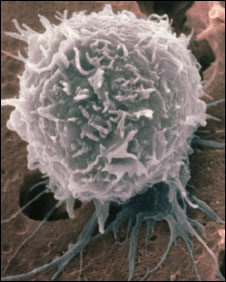 Unlike existing adult stem cell therapies - which involve extracting stem cells from the bone marrow and processing them in the laboratory with growth factors before they can be re-implanted at the site of an injury - the new technique is completely non-invasive. In theory it could mean the healing process would begin more quickly, leading to a more complete recovery.
The study, published in the American journal Cell Stem Cell, also managed to stimulate the development of a wider range of stem cell types, meaning that the technique could be used to regenerate soft tissues like heart muscle or liver, as well as bone and cartilage.
This additional flexibility raises the prospect that adult stem cells could one day replace those derived from human embryos in the development of new treatments.
In order to see this content you need to have both Javascript enabled and Flash installed. Visit BBC Webwise for full instructions. If you're reading via RSS, you'll need to visit the blog to access this content.
Until recently much of the research effort in the field has focused on embryonic stem cells because of their increased pluripotency - they have the potential to develop into almost all of the 200 cell types in the body. But if adult stem cells prove to be as malleable, Dr Rankin believes, it might be possible to avoid the ethical dilemmas associated with embryonic stem cells.
Although he welcomed the research, and acknowledged other recent advances (particularly in cell reprogramming), Cambridge University's Professor Roger Pedersen says it's too soon to think about abandoning embryonic research.
Not least because it provided the vital theoretical framework which had allowed these developments to take place.
 I'm Tom Feilden and I'm the science correspondent on the Today programme. This is where we can talk about the scientific issues we're covering on the programme.

Comment number 1.
At 08:33 11th Jan 2009, cping500 wrote:Yes but having all those bored 'medics' around on street corners would mean they would be looking for something to do. T Cells cause are wonderful but dangerous and can attack the body as well as the invaders so how will autoimmune reactions be prevented.
Incidentally how are stem cell treatments regulated. Drug companies take years to prove their products don't kill the patient. Surgeons just try it on, rather like DIY from a Readers Digest Manual. (or they take a course. Alan Bennett described recently how a gallery of them turned up at his op to see how it was done)
Complain about this comment (Comment number 1)
Comment number 2.
At 21:18 1st Feb 2009, nikolateslista wrote:This comment was removed because the moderators found it broke the house rules. Explain.
Complain about this comment (Comment number 2)