

Are standards in school science slipping?
Can you answer this?
Calculate the percentage by mass of phosphorus present in calcium phosphate, Ca3(PO4)2.
Relative atomic masses: Ca = 40; P = 31; O = 16.
No? Well, neither can the majority of the country's brightest 16-year-olds.
The question comes from an O-level chemistry paper set in 1965, and it's just one of 40 from 50 years of exams the Royal Society of Chemistry has put together to test the standard of science teaching in schools today.
Over the summer more than 1,000 of the best students from all over the country sat this extra paper online, and according to the RSC the results "demolish the myth of record-breaking educational performance in science".
The results do make painful reading, and although the winner of the "Five-Decade Challenge" managed an impressive 94%, the average score was just 25%.
Breaking the figures down by decade also reveals an alarming slump in performance over time, with pupils managing to answer 35% of the questions from the 2000s correctly, but only 15% from the 1960s.
The chief executive of the RSC, Dr Richard Pike, claims the results provide hard evidence of a catastrophic fall in the standard of science teaching, and explodes the myth that we've been enjoying a "great leap forward" in education.
In order to see this content you need to have both Javascript enabled and Flash installed. Visit BBC Webwise for full instructions
"The brightest pupils," he says, "are not being stretched, or trained in mathematical techniques, because they can get an A* grade without doing a single calculation. Conversely, the majority get at least a 'good pass' (grade C) by showing merely a superficial knowledge on a wide range of issues, but no understanding of the fundamentals."
To press home the message the Society has launched an e-petition on the Downing Street website - it's already been signed by 1,500 people - and is sending a copy of the report to every MP.
But even if today's pupils can't answer the questions put to 16-year-olds in the 1960s and 1970s, does that really mean standards have fallen? Professor John Holman from the National Science Learning Centre in York is not so sure. In the first place, he says, the way science is taught is very different. In the past, students were taught a much more limited curriculum in greater depth. Today's syllabus is much broader.
And of course you can't go back in time and get pupils from the 1960s and 1970s to sit today's GCSE exams so the comparison isn't really valid.
By the way, the answer to the question I posed at the top is: 20%. Each molecule of calcium phosphate contains three atoms of calcium, and two sets of one atom of phosphorus and four atoms of oxygen. That gives you a calculation of 40x3 + (31 + 64)x2 which equals 310. The mass of the phosphorus (62) as a percentage of the whole (310) is 20%.
Phew!
 To the untrained eye this nondescript seam of sedimentary rock hardly rates a second look, but to palaeontologists, it's worth its weight in gold. The Burgess Shale contains some of the oldest and best preserved fossils anywhere in the world, and offers a unique insight into the blossoming of marine animal life known as the Cambrian explosion some 500 million years ago.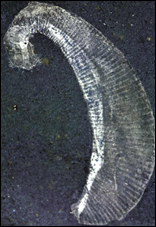



 I'm Tom Feilden and I'm the science correspondent on the Today programme. This is where we can talk about the scientific issues we're covering on the programme.
