

When planting trees could do more harm than good
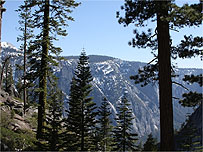 Trees are good. They store carbon, generate oxygen, suck pollutants out of the air, provide a habitat for complex ecosystems, promote water storage and rainfall, and (as every lazy lion knows) can even offer a little relief from an unforgiving sun. Ergo: planting trees is good for the planet.
Well, not necessarily. Sadly it turns out that things are not that simple. According to a new report from an international team of scientists it all depends where you plant them.
Too far north and you risk altering the albedo of the planet by replacing sunlight reflecting white snow with heat absorbing dark green. In the mid-latitudes the pros and cons are more finely balanced, and you need to make sure that extensive aforestation (that's converting open land previously used for crops or grazing to woodland) doesn't disrupt other ecological activities leading to an overall increase in greenhouse gas emissions.
By and large, planting trees in warm temperate regions and the tropics is most likely to succeed in reducing the global temperature, but - again - you need to be careful about the wider biophysical impact.
And getting it right matters because aforestation is an increasingly important part of the international carbon trading scheme. Big polluters can offset their emissions by planting trees or paying someone else to plant trees for them.
Today's report, published in the journal Environmental Research Letters, shows that simply throwing money at well-meaning tree huggers doesn't go far enough. Each individual aforestation scheme needs to be assessed against its overall impact on the environment.
Lead author Rob Jackson from North Carolina's Duke University says simple rules need to be developed to encourage best practice.
"Ignoring this challenge could result in millions of dollars being invested in mitigation projects that provide little climate benefit or, worse, are counter-productive," he says.
 I'm Tom Feilden and I'm the science correspondent on the Today programme. This is where we can talk about the scientific issues we're covering on the programme.

Comment number 1.
At 05:55 14th Nov 2008, CemeteryWall wrote:The Lawrence Livermore National Laboratory did similar work last year. I have a friend who grows willow as biomass for power stations so I contacted the LLNL. Here is part of the correspondence
QUESTIONS:
1. I get the points about tropical forests. They are clearly very effective. I also understand when you say 'the albedo effect in high latitudes overwhelms the "carbon sink" cooling effect'. But a Wikipedia map of boreal forests does not cover Yorkshire (or England) so can I presume that the willow that my friend grows does actually sequester carbon and there may be no significant albedo effect? (There are plans for power stations here in Yorkshire that use carbon capture. Would dried willow used as fuel in a power plant with carbon capture be carbon negative? )
2. I may have not made clear my concerns about the "short term". I am not suggesting that it is possible to stop climate change quickly. What I ask is "Will we need to bring in emergency, short term, measures to cut the carbon burden on the atmosphere?" For example, should much more biomass be used in the construction industry to lock up carbon in the fabric of buildings so it is stored for the lifetime of the building at least. I have heard that significant positive feedbacks have not yet been incorporated in the appropriate climate models (e.g. methane from the tundra) and that we may have an acceleration of climate change. Does this mean a tonne of carbon dioxide released now has a worse effect than one in a hundred years time? Do we need to think of emergency measures to buy time?
REPLY:
I am kind of busy now. Will get back to you.
QUESTIONS SUMMARISED:
I think your research shows that if we wish to slow global warming:
1. Planting (or keeping) trees in tropical regions is good.
2. Planting trees in snowy areas is bad.
3. Planting trees in other areas may be good or bad.
Is this correct?
REPLY:
Points 1 and 2 are ok.
Point 3 should be "planting trees in other areas may offer little benefit."
QUESTION FOR TOM FIELDEN:
Does the research you report help answer my earlier questions?
Where can I find it? (I could not find it via the link.)
Has the BBC reported that methane feedbacks are missing from the main climate models?
.
Complain about this comment (Comment number 1)
Comment number 2.
At 16:35 15th Nov 2008, Dusty_Matter wrote:Okay let's see. Planting trees provides shade, and so if there is snow on the ground wouldn't it stay frozen longer? Isn't the planet warming up already anyway with less trees? Less snow, means the darker soils are showing. Is the planting of trees worse than just having the sun beat down onto the dark earth? They help to retain water in regions, and moisture helps to cool things down. So how would planting trees cause global warming? They absorb carbon which is a green house gas, but if we plant trees, the planet will get warmer? We shouldn't spend money on trying to replant trees and forests, but instead we should spend money on trying to figure out how planting a forest could be determental and harm our environment? Planting trees is a waste of money, but we should give it to scientists or bankrupt institutions instead?
Worrying about planting too many trees in the northern or southern latitudes and thus altering the planet's climate, would be the same as worrying about storing and creating too much fresh water, and thus making the oceans too salty.
This type of hypothetical and substandard reasoning only stops any hopes we may have of slowing down the self-destructive course we are already on.
Complain about this comment (Comment number 2)