

Shedding light on dark matter
 Scientists in Canada have taken a big step forward in the search for dark matter - the enigmatic "stuff" that makes up 23% of the Universe.
The Picasso group, based at the Sudbury Neutrino Observatory near Ontario, have been using a bubble chamber at the bottom of a disused mineshaft to listen out for the sounds made by dark matter particles as they pass through a superheated fluid.
Until now this distinctive dark matter signal has been drowned out - lost in the background noise created by alpha particles. Alpha particles are relatively common on earth (they're emitted in the radioactive decay of elements like uranium) and were proving hard to eliminate from the experiment.
But now the Picasso scientists have discovered a subtle new way of distinguishing between alpha and dark matter particles. Montreal University's professor Viktor Zacek says it's a bit like tuning a radio. "If there's too much hiss you can't hear the programme properly. You need to screen out the noise without losing the music," he says.
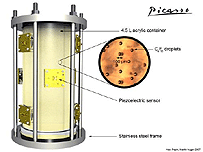
Tuning out the background chatter means the Picasso detector is now free to concentrate on isolating the signals left by dark matter's Weakly Interacting Massive Particles, or WIMPs.
But the SNO-lab team aren't the only ones in the hunt for dark matter. At the bottom of a Yorkshire potash mine another team of British, American and European scientists are waiting for a WIMP to pass through their 100m long "Zeplin 3" detector.
In Italy, scientists working deep beneath the Gran Sasso mountain in Abruzzo claim they've already detected dark matter in the form of theoretical particles known as axions.
And at CERN, where the Large Hadron Collider briefly flared into life last month, scientists plan to manufacture WIMPS as a by-product of proton-proton collisions.
Spinning fast
Any one of these lab-based experiments could be first in the race to end one of science's biggest mysteries. A mystery sparked by the Swiss astrophysicist Fritz Zwicky 70 years ago when he noticed that galaxies like the Milky Way were spinning much faster than they should given the amount of material they appeared to contain.
There must be something else, he argued, some other "stuff" we can't see or measure (hence "dark" matter), that accounts for the extra gravitational attraction we observe.
And observing dark matter - or at least its consequences - is something astrophysicists are getting very good at.
A spectacular series of images from the Hubble and Chandra X-ray telescopes published earlier this year show the distorting effect of dark matter on a massive collision between two clusters of galaxies 5.7 billion light-years away. As the two clusters collide the visible matter slows down, but the dark matter at the heart of each galaxy sails on regardless.
The latest astronomical observations suggest that dark matter accounts for about 23% of the universe. Ordinary matter - the galaxies, stars, gas and planets - makes up just 4%. The rest is made up of an even more mysterious quantity - dark energy, which is responsible for speeding up the expansion of the cosmos.
 I'm Tom Feilden and I'm the science correspondent on the Today programme. This is where we can talk about the scientific issues we're covering on the programme.

Comment number 1.
At 13:34 16th Oct 2008, U13638310 wrote:Interesting piece. You might want to note for future reference that Sudbury is not 'near' Ontario but rather a city located in the Province of Ontario that is actually larger than Britain. It's a bit like saying that London is located near England :0)
As for the ultimate nature of Dark Matter and Energy, we can only infer its existance from gaps in current cosmology theory and data. It is entirely probable that the ultimate answer to this puzzle lies outside the realm of dualistic perception, that of the observer and the observed, a central thesis of Quantum theory. Resolving this enigma will require delving into the nature of emptiness itself, that the universe has indeed arisen out of emptiness and thus emptiness is its inherent nature. The theoretical implications of this are profound. Our best models are still unable to address the nature of a singularity, where the rules of physics break down and we are left dangling on string theory and membranes as our best hope of resolving what is arguably beyond the mind's ability to grasp. Great experiments and instruments such as these will continue to improve our understanding of the physical universe but will I suspect not resolve these basic questions until such time as the mathematical and theoretical nature of emptiness, as distinct from nothingness or voidness, is fully embraced by modern science. Until then the Cheshire cat will grin knowingly at us from his sublime perch. Cheers.
[Personal details removed by Moderator]
Complain about this comment (Comment number 1)
Comment number 2.
At 13:34 16th Oct 2008, U13638310 wrote:This comment was removed because the moderators found it broke the house rules. Explain.
Complain about this comment (Comment number 2)
Comment number 3.
At 17:22 16th Oct 2008, Dusty_Matter wrote:What really surprises me is how slow people are in understandinding that dark matter is not some make believe idea, but it has been proven to exist.
The person who left the first post, should notice that the Hubble and Chandra X-ray telescopes have actually photographed evidence for it's existence. The photo is in this article, and the explanation of the picture is in the 2nd to the last paragraph! We are not infering it's existence from gaps in cosmology theory. You could have maybe said that as far back as 20 years ago, but hey, please people, try and keep up with progress.
We are not saying that dark matter MAY exist. It does exist! We don't need to day- dream about what emptiness means, or worry about Quantum theory. Dark Matter makes up more of the universe than ordinary matter, and we have proof of it's existence. Why are people still pretending that it may not exist?
This is a very momentous discovery, and we want to learn as much as we can about this elusive material, which is why we are carrying on with other possible ways to try and detect it. We are not trying to prove that it exists, but we are trying to learn more about it. This is modern science.
Do you want to compare it to the Cheshire cat? Well even an invisible cat would leave evidence of it's existence. Meows, claw marks, dead mice, smelly odors. Dark matter has made it's presence known as well, and we have the pictures to prove it. Now we just want to learn more about the nature of the beast.
Complain about this comment (Comment number 3)
Comment number 4.
At 14:43 20th Oct 2008, onefreeman wrote:images like this can be captured using a goog Digital SLR, on a clear night take a 30sec exposure. get it on to you computer using a good edditing suite,
step 1. Zoom in on a single speck 1600x more if you can.
step 2. set crop peramiters to 50cm/50cm
Step 3. select a small area around the point of light chosen.
step 4. crop
Step 5. you should have an image similar to the picture used.
Step 6. play with the coulor curvs and think of Magnets. in fact play with magnets whilst looking an the images.
its not so Dark its just we cant see with our eyes open. Occums Razor
Complain about this comment (Comment number 4)
Comment number 5.
At 05:22 22nd Oct 2008, U13638310 wrote:Dusty;
Although your point is well taken, with all due respect you have not fully grasped mine. We do not know the nature of dark matter any more than we can fathom the arising of an entire universe from the appearance of a primordial singularity event that science teaches is what existed in the moment before the so called Big Bang. It is here that present day physics stumbles. What was and is the nature of this emptiness? A voidness from which two primordial particles first arose, whose ghostly yet brief appearance gave rise to space and time itself and all phenomina, including so called dark matter whose very existance is inferred in the same ways as the event horizon disc of a Black Hole is indicative of the presence of that most elusive of all mythical beasts -- the singularity, emptiness incarnate. The incalculable power and subtle nature of emptiness is where the riddle of dark matter is likely to be found, not in M Theory, Branes or gravitation rose colour lenses. Physics would do well to pay closer attention to the natue of the canvas itself rather than the painting, so to speak.
I will leave you and anyone else who might happen up this post with a parting riddle: what is the one thing in the entire visible universe that the unaided eye cannot percieve?
Cheers, The Cheshire Cat
Complain about this comment (Comment number 5)