

Treasury’s five-year Rock loan
- 19 Nov 07, 07:30 AM
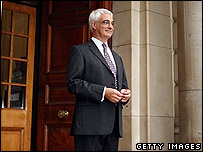 Alistair Darling doesn’t want taxpayers to lose a penny on the enormous financial support provided by the Treasury to Northern Rock.
And in a statement to the Stock Exchange he has said this morning that there is no certainty that any bidder for the Rock will have access to Treasury-backed Bank-of-England loans after February – which is when the current support package expires.
Those loans currently total about £24bn.
But what he didn’t point out is that there is a smaller financial exposure to the Rock by the Treasury which is not supposed to be repaid for five years (although there are options allowing earlier repayment).
Or to put it another way, the Treasury has already made one very long financial commitment to the Rock.
It arose because in October it – and the Financial Services Authority and the Bank of England – became concerned that the relatively high interest rate being charged on the Bank-of-England loan could do severe damage to the Rock.
So the terms of the Bank-of-England loan were altered.
The Rock would only have to pay interest in cash equivalent to the Bank’s 5.75 per cent interest rate.
A further interest rate “premium” – which I understand is 1.25 per cent – is rolled up into what is called “subordinated term debt” with a minimum term to maturity of five years. And this subordinated debt is owed to the Treasury, not the Bank of England.
It actually qualifies as part of the Rock’s capital base. To be more precise, it ranks alongside tier II capital under BIS rules.
One very important characteristic of this subordinated debt is it would rank very low down the list of any creditors in any wind-up of the Rock. It is just a hairsbreadth away from being equity. Or to put it another way, the Treasury has already come very close to taking shares in the Rock.
And what should also matter to taxpayers is that if Northern Rock continues to borrow substantial sums from the Treasury – and the bank itself can’t see how to do otherwise – this subordinated debt could grow quite big indeed.
If for example the Northern Rock’s loans from the Bank of England averaged £20bn over two years – which is a realistic scenario – the rolled up interest would total £500m.
There are two ways of looking at all this subordinated debt.
Some will see it as a taxpayer subsidy to a bank which got itself into a mess and was unable to raise money in a conventional way.
However shareholders are likely to view it as a potentially crippling burden on the company which – if the Treasury wanted it back – could wipe out the value of Northern Rock’s shares.
Update 08:00 Northern Rock's shareholders have had a huge dose of bad news this morning.
The company says that the preliminary bids for the business all value it at significantly less than the current market value.
And the Treasury has said that neither bidders or the company should assume that the £24bn of loans made to it by the Bank of England will be kept in place after February.
The Treasury has also warned that the support it has provided to the Rock represents state aid under EU rules and may therefore turn out to be illegal.
It means that Northern Rock's battered share price will fall further this morning.
And it also means that the future of the Rock, for its 6000 employees, remains highly uncertain.
However the Treasury has reiterated that the Rock's depositors have nothing to fear.
It will continue to guarantee that they do not lose a penny.
And its other aim - which may be harder to achieve - is to prevent the taxpayer losing a bean.
The BBC is not responsible for the content of external internet sites
I'm Robert Peston, the BBC's business editor. This blog is my regular take on the business stories and issues that matter.
Click here for all the business news
The New Capitalism: Download a PDF [37Kb] with my thoughts on how the global crisis occurred and what the re-made economy will look like


Archives
« November 2007 »
| Sun | Mon | Tue | Wed | Thu | Fri | Sat |
|---|---|---|---|---|---|---|
| 1 | 2 | 3 | ||||
| 4 | 5 | 6 | 7 | 8 | 9 | 10 |
| 11 | 12 | 13 | 14 | 15 | 16 | 17 |
| 18 | 19 | 20 | 21 | 22 | 23 | 24 |
| 25 | 26 | 27 | 28 | 29 | 30 |
Being Discussed Now
- Will Thiam survive at Pru?(50)
- BP's financial pain is America's pain(407)
- Government cuts private pensions(137)
- Peston Picks is moving(46)
- HSBC banks on UK(61)
- What price a Greek haircut?(91)
- The big PPI lesson for banks(85)
- RBS opposes internal firewalls(97)
- Lloyds to settle PPI claims(136)
- Lloyds: back in the red?(27)
Websites linking here
- "Robert Peston at the BBC [gets blogging's] deepest utility: an essential intellectual tool as well as a means for distributing stories"
Website: Slugger O'Toole - "Peston, Murdoch and Marr sounds like a firm of dodgy solicitors, but they are, of course, the names of important prognosticators of our media future"
Website: Nick Baines - "Politicians really should be stepping up to make these arguments, but in their absence BBC reporter Robert Peston does a pretty good job of summing up"
Website: SqueezeBox - "I outline how blogging went from being an activity by a handful of journalists to being adopted by some of the BBC's biggest names, such as Business Editor Robert Peston, despite at times vehement opposition from within the corporation"
Website: Reportr
Robert's TV/Radio reports
- Rock criticised over risk taking
Broadcast: 20 March 2009 - Row over Sir Fred pension advance
Broadcast: 17 March 2009 - Testing times for China's economy
Broadcast: 12 March 2009 - Chinalco president on Rio Tinto deal
Broadcast: 06 March 2009 - China's factories 'in trouble'
Broadcast: 06 March 2009

Latest from BBC News blogs
Nick Robinson: |  |
Douglas Fraser: |  |
Brian Taylor: |  |
 |
Richard Black: |  |
Jonathan Amos: |  |
- News Editors
- Sport Editors
- Journalism Labs
- BBC Internet Blog
- Radio 4 Blog
- Peston's Picks
- Nick Robinson's Newslog
- Stephanomics
- Mark Easton's UK
- Mark Mardell's America
- Nick Bryant's Australia
- Andrew Harding on Africa
- Gavin Hewitt's Europe
- Soutik Biswas' India
- dot.Rory
- Science: Jonathan Amos
- Richard Black on environment
- Today: Tom Feilden
- Fergus Walsh's medical files
- Newsnight: Paul Mason
- Newsnight: Mark Urban
- Torin Douglas
- Will Gompertz's arts
- Phil Coomes on photojournalism
- Magazine Monitor
- Mark D'Arcy in Westminster
- NI: Mark Devenport
- Scotland: Brian Taylor
- Scotland: Douglas Fraser
- Wales: Betsan Powys
- Martin Rosenbaum on FOI
- 5 Live Breakfast
- Newsnight
- PM programme (iPM)
- World Tonight: Robin Lustig
