

The governor speaks
- 6 Nov 07, 10:21 AM
Broadcast interviews by Mervyn King, the governor of the Bank of England, are as rare as optimistic bankers in the City of London’s current gloom. And what the governor told me, in a conversation recorded for a File on 4 documentary to be broadcast tonight, gives fascinating new insights into the seizing up of money markets this summer and the crisis at Northern Rock.
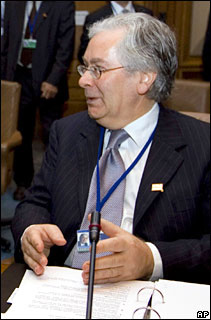 I spoke to him in an elegant meeting room next to what the Bank calls his parlour, at the heart of his neo-classical fortress in the City. We spoke for more than an hour about what he did and why, in the run-up to the Northern Rock crisis and during the first run on a British bank for 141 years. Such was the insight he gave into his actions and his state of mind that the difficulty we had was deciding what not to broadcast, since so much of what he had to say was gripping.
One of the most important questions was why he did not attempt to rescue Northern Rock over the summer in a quiet, inconspicuous way – which would have avoided all the drama of providing an emergency loan – by pumping additional liquidity into the banking system. Apart from anything else, that was what many big banks had been demanding and my understanding is that the City watchdog, the Financial Services Authority, supported their case.
Northern Rock’s chief executive, Adam Applegarth, told MPs on the Treasury Select Committee that if his bank had been based on the continent, it would never have suffered a crisis. He claims it would have been able to raised sufficient funding by exchanging its mortgages for loans from the European Central Bank in a way that wasn’t then possible in the UK.
King was blunt in dismissing Applegarth’s claim. He says the Rock chief executive is wrong, because it was clear from the start that Northern Rock needed far too much money to be propped up in a way that would not have raised the alarm to the market about its funding difficulties.
The governor says that the Bank calculated that Northern Rock would need £30bn in support. And that it was impossible to “rig” a money market auction to direct that level of funding to it without alerting journalists and other bankers to what was happening. What’s more, an “unrigged” auction would have been ludicrous, because it would have involved injecting mind-boggling sums into the banking system – thus raising fears that the entire banking system was effectively bust.
So, for him, there was no option but to direct support to the Rock using the Bank’s role as lender of last resort – once, that is, the Rock concluded beyond any doubt that it could not fund itself in the normal way from commercial sources.
So the decision of the Treasury and the Bank to provide emergency support in this form was their first momentous decision.
Their second momentous decision was not to announce, at the same time as providing the loan, that no depositor at the Rock would lose a penny – that the Treasury was guaranteeing their savings.
This guarantee was eventually made by the Chancellor, on the evening of September 17. And it did stop the run. But by then the run had been raging for four days in branches and on the internet.
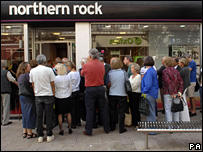 And it was the run that did so much damage to the reputation of British banking. As the governor describes, for a few days during and after the run, there was an international flight of capital out of the British banking system by global managers of great pools of cash, because they had been so shocked by the television pictures of the run.
If that capital flight hadn’t been stopped, well who knows what damage could have been wreaked on other substantial banks? The chairman of one big British bank was so worried that he went to see the head of the civil service and the head of the Treasury to express his concern.
What’s more, this retail run contributed to the steady withdrawal of funding from Northern Rock by other banks and financial institutions – such that the Rock has now borrowed some £20bn from the Treasury and expects to have borrowed £30bn by the end of the year.
There is therefore a fair body of evidence that the run has had damaging long term consequences both for the Rock and for confidence in the British banking system.
It is also likely that it could have been avoided if the chancellor had guaranteed that savers would not lose a penny right at the outset.
So why didn’t that happen? Well you will have to listen to File on 4 tonight for the detail.
But both King and Hector Sants – the FSA’s chief executive who was also interviewed by me for the programme – say that there was discussion of the possibility of a run before the emergency loan was granted. And that the idea of providing a 100% guarantee to depositors was raised by them in conversations with the Treasury.
And, as Sants says, only the chancellor could provide this guarantee.
They did not regard a run as inevitable however – which seems to be why the Treasury did not provide this guarantee till the run was raging in full frightening force.
But neither Sants, nor the chairman of the FSA, Sir Callum McCarthy, nor Mervyn King were prepared to give media interviews to reassure Northern Rock’s depositors during the run because they all regarded the existing system of deposit insurance as inadequate. King actually says it would have been “dishonest” to tell the Rock’s savers they had no reason to worry.
Which in the starkest terms shows why the delay by the chancellor in guaranteeing all Rock savings was momentous.
You can read the full transcript of Mervyn King's interview here (pdf file).
The BBC is not responsible for the content of external internet sites
I'm Robert Peston, the BBC's business editor. This blog is my regular take on the business stories and issues that matter.
Click here for all the business news
The New Capitalism: Download a PDF [37Kb] with my thoughts on how the global crisis occurred and what the re-made economy will look like


Archives
« November 2007 »
| Sun | Mon | Tue | Wed | Thu | Fri | Sat |
|---|---|---|---|---|---|---|
| 1 | 2 | 3 | ||||
| 4 | 5 | 6 | 7 | 8 | 9 | 10 |
| 11 | 12 | 13 | 14 | 15 | 16 | 17 |
| 18 | 19 | 20 | 21 | 22 | 23 | 24 |
| 25 | 26 | 27 | 28 | 29 | 30 |
Being Discussed Now
- Will Thiam survive at Pru?(50)
- BP's financial pain is America's pain(407)
- Government cuts private pensions(137)
- Peston Picks is moving(46)
- HSBC banks on UK(61)
- What price a Greek haircut?(91)
- The big PPI lesson for banks(85)
- RBS opposes internal firewalls(97)
- Lloyds to settle PPI claims(136)
- Lloyds: back in the red?(27)
Websites linking here
- "Robert Peston at the BBC [gets blogging's] deepest utility: an essential intellectual tool as well as a means for distributing stories"
Website: Slugger O'Toole - "Peston, Murdoch and Marr sounds like a firm of dodgy solicitors, but they are, of course, the names of important prognosticators of our media future"
Website: Nick Baines - "Politicians really should be stepping up to make these arguments, but in their absence BBC reporter Robert Peston does a pretty good job of summing up"
Website: SqueezeBox - "I outline how blogging went from being an activity by a handful of journalists to being adopted by some of the BBC's biggest names, such as Business Editor Robert Peston, despite at times vehement opposition from within the corporation"
Website: Reportr
Robert's TV/Radio reports
- Rock criticised over risk taking
Broadcast: 20 March 2009 - Row over Sir Fred pension advance
Broadcast: 17 March 2009 - Testing times for China's economy
Broadcast: 12 March 2009 - Chinalco president on Rio Tinto deal
Broadcast: 06 March 2009 - China's factories 'in trouble'
Broadcast: 06 March 2009

Latest from BBC News blogs
Nick Robinson: |  |
Douglas Fraser: |  |
Brian Taylor: |  |
 |
Richard Black: |  |
Jonathan Amos: |  |
- News Editors
- Sport Editors
- Journalism Labs
- BBC Internet Blog
- Radio 4 Blog
- Peston's Picks
- Nick Robinson's Newslog
- Stephanomics
- Mark Easton's UK
- Mark Mardell's America
- Nick Bryant's Australia
- Andrew Harding on Africa
- Gavin Hewitt's Europe
- Soutik Biswas' India
- dot.Rory
- Science: Jonathan Amos
- Richard Black on environment
- Today: Tom Feilden
- Fergus Walsh's medical files
- Newsnight: Paul Mason
- Newsnight: Mark Urban
- Torin Douglas
- Will Gompertz's arts
- Phil Coomes on photojournalism
- Magazine Monitor
- Mark D'Arcy in Westminster
- NI: Mark Devenport
- Scotland: Brian Taylor
- Scotland: Douglas Fraser
- Wales: Betsan Powys
- Martin Rosenbaum on FOI
- 5 Live Breakfast
- Newsnight
- PM programme (iPM)
- World Tonight: Robin Lustig
