Why the budget didn’t go as far as Mr Brown would like
- 12 Mar 08, 08:31 PM
Europe’s prime ministers and presidents will meet in Brussels today for their spring meeting. What will they be talking about?
•Green tax
The chancellor announced some green-friendly measures in the Budget but he didn’t go as far as the prime minister would have liked. 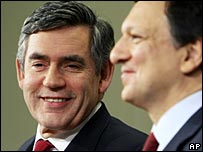
For that Mr Brown has to come to Brussels. Much of today’s summit of the European Union’s prime ministers and presidents will be spent endorsing the details of a plan aimed at fighting climate change.
But Mr Brown thinks they should go further and cut tax on green-friendly goods, whether energy-efficient refrigerators or loft insulation. But the EU’s rules say that sales tax - VAT - has to be set at a minimum of 15%. There are a whole load of exemptions for individual countries, but even then VAT can’t be set below 5%.
Will he succeed? You would think the other European leaders would be enthusiastic.
Their diplomats have already signed up to a text which urges the adoption of coherent policies which improve energy efficiency and “recognise that addressing energy and climate change is also a matter of shaping values and changing citizens’ behaviour.”
The French president is apparently signed up. 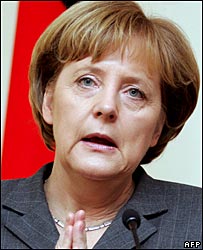
But the German leader Angela Merkel won’t back the plan. The last time this was raised, so many other countries asked for exemptions on their pet projects that it was abandoned.
But if this is a serious way to fight what the EU identifies as one of the biggest threats of our time, should they be prepared to squirm a little as they open a can of worms?
•Energy row
Mr Brown also intends to fire a few shots in the long-running war over Europe’s economic direction. The current battle is over a determination to break up huge energy companies. It’s happened in Britain, but not in France and Germany.
Fans of economic liberalism, such as the commission and the British government, say the single market can’t work properly while electricity companies own both power stations that generate the energy and the grid that distributes it (the same goes for gas companies too).
While the two are linked, it makes it very difficult for any other company to get into the market, so there’s no real competition.
The British government argues that making the single market work properly would mean more opportunity for British companies, and lower prices for consumers in the rest of Europe.
Ministers say that it would also benefit consumers because it makes energy supply more certain by encouraging fresh investment in equipment.
The commission’s first simple proposal to break up the companies was met with howls of protests from France and Germany.
They, along with Austria, Bulgaria, Greece, Luxembourg, Latvia and Slovakia, have come up with an alternative plan. They argue in a letter that splitting up the companies’ network doesn’t cut prices or encourage investment and has “negative social consequences”.
They propose instead that there should be Chinese walls between the two halves of an operation.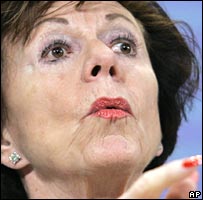
The commission has hit back in a speech by the tough Competition Commissioner Neelie Kroes who argues this falls short of what has already been agreed and doesn’t do the job required.
For a while now, the commission, clearly feeling aching muscles in this tug-of-war, has been urging Mr Brown to “pull on the other end of the rope” and perhaps haul Mr Sarkozy across the line.
Diplomats say Mr Brown will give “strong support” to the commission and will pull as hard on the rope as is needed to keep the main proposals alive.
The commission is feeling confident. Not because of any support from Mr Brown but because of one word, “E.ON”.
It’s the Germany energy giant which has agreed to break itself up and sell off its energy grid to avoid legal action by the commission. This row will be aired today, but perhaps not resolved until the next big meeting in June.
•How climate change could flood Europe: not with water but with people
Foreign affairs high representative Javier Solana will present his rather alarming vision of the political impact of climate change. 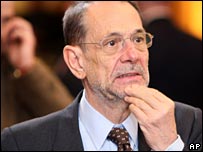
He suggests that, as island states and coastal areas disappear beneath the waves, and as fertile areas in Africa dry up, there will be increased conflicts over land, water and food.
These conflicts could fuel radicalisation. Shortages and disorder could mean a refugee crisis for the European Union. It’s a rather apocalyptic vision, perhaps appropriate given this bizarre website which I have just stumbled across.
•Taking Sarko too 'littorally'
The French have watered down their plans for a Mediterranean Union. This was originally a wheeze proposed by Nicholas Sarkozy during his election campaign, apparently to appease the Turks, whom he doesn’t want inside the EU.
The Germans felt that it could be a threat to the European Union itself, creating a club from which the landlocked and those next to rougher seas than the Med were excluded.
More practically they were concerned about EU funds being siphoned off to the Maghreb via this new organisation. They appear to have come to some agreement where it would supplement an existing link-up of countries in the region, called the Barcelona process.
The French President has also given way by turning a planned celebration of the Mediterranean Union on 14 July in aris into a summit of the European Union.
As ever, none of these may turn out to be what dominates the summit, indeed it may turn out, as people have been saying for weeks, that this is a summit with a lot substance, but no story.
Could Finland snuff out the Lisbon Treaty?
- 12 Mar 08, 07:58 AM
Those who want to stop the Lisbon Treaty may be in the mood for grasping, not at straws, but snus. 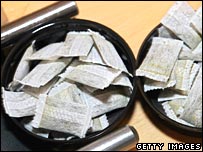
This is what’s known as “moist oral snuff” but is basically chewing tobacco in a sort of tea bag. It seems that Finland is so exercised about a European Union ban on the product that there is a suggestion that they could reject the treaty.
Or at least the Aland Islands' government could reject it. The islands are a semi-autonomous province of Finland, which voted separately to the rest of Finland to join the EU and have special exemptions from certain European Union rules.
Now it wants more... or else.
Snus ban
Although snus was banned in the European Union in 1992, an exception was made for Sweden when it became an issue in their 1994 referendum about joining the EU.
Ships from the Aland Islands want to be able to sell it in Swedish waters. Although the Aland government could vote against the treaty and simply be outside its scope, YLE news reports that Finnish government ministers don’t find this acceptable.
I can’t see the European Commission risking the treaty over the issue, and it looks very much as if the Finns are playing hardball to get concessions, but interesting nonetheless.
The BBC is not responsible for the content of external internet sites
Description
Archive
« March 2008 »
| Sun | Mon | Tue | Wed | Thu | Fri | Sat |
|---|---|---|---|---|---|---|
| 1 | ||||||
| 2 | 3 | 4 | 5 | 6 | 7 | 8 |
| 9 | 10 | 11 | 12 | 13 | 14 | 15 |
| 16 | 17 | 18 | 19 | 20 | 21 | 22 |
| 23 | 24 | 25 | 26 | 27 | 28 | 29 |
| 30 | 31 |
Being Discussed Now

Latest from BBC News blogs
Nick Robinson: |  |
Douglas Fraser: |  |
Brian Taylor: |  |
 |
Richard Black: |  |
Jonathan Amos: |  |
- News Editors
- Sport Editors
- Journalism Labs
- BBC Internet Blog
- Radio 4 Blog
- Peston's Picks
- Nick Robinson's Newslog
- Stephanomics
- Mark Easton's UK
- Mark Mardell's America
- Nick Bryant's Australia
- Andrew Harding on Africa
- Gavin Hewitt's Europe
- Soutik Biswas' India
- dot.Rory
- Science: Jonathan Amos
- Richard Black on environment
- Today: Tom Feilden
- Fergus Walsh's medical files
- Newsnight: Paul Mason
- Newsnight: Mark Urban
- Torin Douglas
- Will Gompertz's arts
- Phil Coomes on photojournalism
- Magazine Monitor
- Mark D'Arcy in Westminster
- NI: Mark Devenport
- Scotland: Brian Taylor
- Scotland: Douglas Fraser
- Wales: Betsan Powys
- Martin Rosenbaum on FOI
- 5 Live Breakfast
- Newsnight
- PM programme (iPM)
- World Tonight: Robin Lustig
