

Could the Irish scupper the Lisbon Treaty?
- 6 Mar 08, 05:00 PM
I watched several MPs in the Commons argue that there shouldn’t be a referendum because people wouldn’t read the Lisbon Treaty.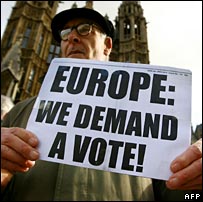
It’s something I discussed on the Jeremy Vine Show and it’s certainly true that it’s a difficult and abstruse document.
But the Irish government clearly credits its people with more intelligence and has published legislation to go ahead with a vote on the treaty.
No date yet, but the rumour is Bertie Ahern will announce it during next week’s European summit.
While European politicians were most nervous about the prospect of a British referendum, an Irish “No” is not an impossibility.
Of course, the Irish rejected the Nice treaty in 2001. The Irish government broadly blamed it on a lack of time spent campaigning and will not make the same mistake again.
Although after the Nice “No” they were required to vote again, I am pretty sure that would be impossible in the current climate.
So an Irish “No” would be a very serious business. It would surely kill off the treaty of Lisbon, as surely as the French and Dutch killed off the constitution.
Which would leave the leaders of the EU is a very tricky position: would they really spend the next two years trying to tweak the text again so that it looked sufficiently different, to go through the whole process again?
Rejection signs?
Some are already suggesting the foundations for rejections are there.
Euractiv cites an opinion poll that shows 33% of voters are undecided.
An interesting paper from the Centre for European Reform lists more factors that could encourage a “No” vote: from the investigation into the financial affairs of Bertie Ahern, which may make the government unpopular, to the Irish Independent reprinting articles from the Daily Telegraph (although it wrongly states the Telegraph doesn’t have a correspondent in Brussels).
In Ireland, the argument is already underway. There’s a new group call Libertas campaigning against the treaty. Its arguments are not the traditional British ones about sovereignty and an increase in the power of “Brussels” but about hard economics.
Their argument is the contention that: “The threat of the Treaty provisions is that the EU could force Ireland to behave like a ‘rich’ economy in terms of regulatory and other breaks for Foreign Direct Investment. The implications of this are potentially devastating.”
Tax veto
European Affairs Minister Dick Roche has hit back, saying the Reform Treaty preserves the existing treaty arrangements whereby taxation matters must be decided by unanimous vote.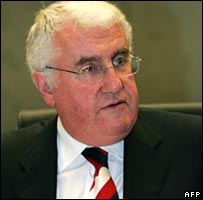
He says taxation matters are and will remain a decision for member states: any member state can veto any proposal on taxation.
He adds: “We need to ask ourselves what message a No vote would send to the US boardrooms where investment decisions are made. If we are seen to park Ireland in some Eurosceptic backwater, what message will we be sending out?”
The Commons debate was good but things always get more lively when a whole nation is involved, and this is going to be an interesting debate to watch.
The BBC is not responsible for the content of external internet sites
Description
Archive
« March 2008 »
| Sun | Mon | Tue | Wed | Thu | Fri | Sat |
|---|---|---|---|---|---|---|
| 1 | ||||||
| 2 | 3 | 4 | 5 | 6 | 7 | 8 |
| 9 | 10 | 11 | 12 | 13 | 14 | 15 |
| 16 | 17 | 18 | 19 | 20 | 21 | 22 |
| 23 | 24 | 25 | 26 | 27 | 28 | 29 |
| 30 | 31 |
Being Discussed Now

Latest from BBC News blogs
Nick Robinson: |  |
Douglas Fraser: |  |
Brian Taylor: |  |
 |
Richard Black: |  |
Jonathan Amos: |  |
- News Editors
- Sport Editors
- Journalism Labs
- BBC Internet Blog
- Radio 4 Blog
- Peston's Picks
- Nick Robinson's Newslog
- Stephanomics
- Mark Easton's UK
- Mark Mardell's America
- Nick Bryant's Australia
- Andrew Harding on Africa
- Gavin Hewitt's Europe
- Soutik Biswas' India
- dot.Rory
- Science: Jonathan Amos
- Richard Black on environment
- Today: Tom Feilden
- Fergus Walsh's medical files
- Newsnight: Paul Mason
- Newsnight: Mark Urban
- Torin Douglas
- Will Gompertz's arts
- Phil Coomes on photojournalism
- Magazine Monitor
- Mark D'Arcy in Westminster
- NI: Mark Devenport
- Scotland: Brian Taylor
- Scotland: Douglas Fraser
- Wales: Betsan Powys
- Martin Rosenbaum on FOI
- 5 Live Breakfast
- Newsnight
- PM programme (iPM)
- World Tonight: Robin Lustig
