

Conservative blames Eta for attack
- 7 Mar 08, 04:11 PM
Police in balaclava masks stand by the red and white tape that cordons off the crime scene, a very ordinary looking series of flats, divided by low hedges. It was here that a former councillor of the socialist party was shot three times in the neck, and he later died in hospital.
The conservative leader Mariano Rajoy has been quick to blame Eta. He said: "Everybody knows what I think: those who are guilty of this crime are the terrorists, the Eta murderers, and the only option is the defeat of Eta through the law, through the instruments of the rule of law, with the state security forces and bodies and the incorruptible will of the 45 million Spaniards who make up this great nation, which is called Spain."
It is a fair bet that Eta is to blame for this murder, and the police certainly think that they were responsible but they haven’t yet made a statement.
Rajoy’s alacrity is perhaps surprising seeing that most people think his insistence on blaming Basque terrorists for the Madrid train bombings lost him the last election.
Campaigning has been suspended and Zapatero and Rajoy will meet in parliament later tonight. Basque terrorism has been a big issue in the election with the opposition accusing the government of being too soft. But in all such cases politicians tread a very fine line between saying what they really think and being accused of exploiting terrible events for political gain.
Why Spain's opposition leader has an imaginary friend
- 7 Mar 08, 02:27 PM
The conservative challenger, Mariano Rajoy, looked happy and relaxed, clutching a microphone, dressed in a brown jacket and open-necked blue shirt, surrounded by pretty teenage girls.
He told the crowd a secret: when he made his speeches and his policy, he had in his head an imaginary friend, a little girl, Victoria Esperanza: Victory Hope.
Like a crooner, he holds the mic out to his female chorus who echo “Victoria, Victoria, Victoria”. Cheesy, I suppose, but I thought pretty effective. The crowd, of course, loved it.
I wasn’t there but instead in Aranjuez, the town built by Spain’s eighteenth century royal family as a summer retreat. 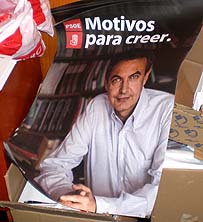
The old livery stables now house a poly and a cultural centre and I went there to see a small socialist rally. Zapatero’s party is in power, and they are determined not to lose it.
Turn-out
Most reckon they will win if they can motivate the voters to go to the polls on Sunday, but a low turn-out could see victory for the conservative People’s Party.
This small town rally began with a film of three famous singers belting out a tune in support of Zapatero: the hook-line - “don’t let joy be overtaken by disaster”.
At the end, they make the sign for Zapatero: a crooked finger over the eye, mimicking the man’s right-angled eyebrows. There’s no doubt, as I reported here earlier and will in my piece on the Ten O’Clock News tonight, that the economy is the background to the election, and the main concern of many people.
Two Spains
But here, among the activists, nearly all the people I talk to suggest that what they are campaigning for is the continuation of a socially liberal project: gay marriages, the fight against domestic violence (something mentioned a lot by both Zapatero and his supporters) and the legalization of abortion. 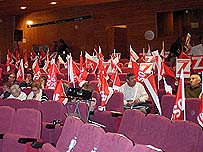
They say a conservative victory would turn the clocks back.
One of the main speakers, the town’s mayor, says that the conservatives have changed: when Spain was coming out of the dictatorship, all parties wanted to work together, but now the PP are negative.
He says they see democracy as a tax they have to pay, but believe power rightfully belongs to them.
Subtly, and not so subtly, the socialists are trying to brush the opposition with the tar of Franco. It is an obvious electoral ploy, designed to motivate not just the left but those who like the liberal, relaxed, new Spain.
It’s not just socialist supporters but objective analysists who tell me that Rajoy has moved to the right; allied himself more closely with the conservatives in the Catholic church, and cut out more moderate conservatives such as the mayor of Madrid.
There is a feeling here that the sharp conflict between the “Two Spains” that led to the civil war and survived throughout the dictatorship is re-emerging.
Of course, one can overstate this. And in one sense it is entirely natural that, in the effort to become a democratic country, differences had to be rather unnaturally submerged. Now the normal tensions between two visions of society are out in the open again.
'Man of moderation'
But Spain’s equivalent of the Shadow Foreign Secretary, Gustavo de Aristegui, tells me that this is simply not true. He says to associate them with the dictatorship “is so untrue its simply vile. We probably have more sons, grandsons and granddaughters of democrats that the other side”.
But what about the suggestion that Rajoy has taken the party to the right?
“I have worked with him for many years and he is a man of great moderation,” he says.
“We are probably more to the centre than the British Conservatives. The campaign is nasty, not because of the people involved, but because the issues are grave.”
He says the main issue is the economy. When I speak to him (by ‘phone), he’s campaigning in his constituency of Zamora.
He says a 65-year-old woman has just told him that the macroeconomics may be all right but she can’t buy bread with macro economics.
Mr de Aristegui says his private calculations show they will win at least 162 seats: enough for “Victoria”, although this may be more “Esperanza” than hard maths. However, he says there is a hidden conservative vote.
We will see on Sunday. Saturday is a day for reflection, not campaigning, and there is a news blackout we have to respect on this site until eight o'clock British time, but more after the polls close.
The BBC is not responsible for the content of external internet sites
Description
Archive
« March 2008 »
| Sun | Mon | Tue | Wed | Thu | Fri | Sat |
|---|---|---|---|---|---|---|
| 1 | ||||||
| 2 | 3 | 4 | 5 | 6 | 7 | 8 |
| 9 | 10 | 11 | 12 | 13 | 14 | 15 |
| 16 | 17 | 18 | 19 | 20 | 21 | 22 |
| 23 | 24 | 25 | 26 | 27 | 28 | 29 |
| 30 | 31 |
Being Discussed Now

Latest from BBC News blogs
Nick Robinson: |  |
Douglas Fraser: |  |
Brian Taylor: |  |
 |
Richard Black: |  |
Jonathan Amos: |  |
- News Editors
- Sport Editors
- Journalism Labs
- BBC Internet Blog
- Radio 4 Blog
- Peston's Picks
- Nick Robinson's Newslog
- Stephanomics
- Mark Easton's UK
- Mark Mardell's America
- Nick Bryant's Australia
- Andrew Harding on Africa
- Gavin Hewitt's Europe
- Soutik Biswas' India
- dot.Rory
- Science: Jonathan Amos
- Richard Black on environment
- Today: Tom Feilden
- Fergus Walsh's medical files
- Newsnight: Paul Mason
- Newsnight: Mark Urban
- Torin Douglas
- Will Gompertz's arts
- Phil Coomes on photojournalism
- Magazine Monitor
- Mark D'Arcy in Westminster
- NI: Mark Devenport
- Scotland: Brian Taylor
- Scotland: Douglas Fraser
- Wales: Betsan Powys
- Martin Rosenbaum on FOI
- 5 Live Breakfast
- Newsnight
- PM programme (iPM)
- World Tonight: Robin Lustig
