
Kosovo celebrates Independence Day
- 16 Feb 08, 11:37 PM
They had waited so long but just couldn’t wait any longer to celebrate independence. The streets of Pristina have been filled with people cheering and shouting, with cars honking their horns in a continuous cacophony. 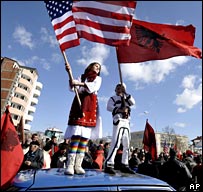
They drive round and round draped in flags, young men perched precariously on the roofs jiggling up and down with joy. In the midst of mayhem, an old man closes his eyes and reverentially kisses a scarf emblazoned with the word “Kosovo.” And you can see my TV report here.
Two young women drive, clapping their hands in time with the Turkish-style pop blaring out of the speakers.
A man in full, white Albanian national costume stands stock-still on the top of a car driving along. Cynics might see the gingerly-driven car, an Albanian flag on its bonnet, the stars and stripes totally and utterly obscuring the windscreen, as a metaphor for an uncertain future.
“The message is clear," says one man wearing a T-shirt bearing a single upright finger and the words “Bye bye Serbia ".
Another young man is even more succinct. When I ask him what he thinks he replies with three words, one Anglo-Saxon. Only “off” and “Serbia” are printable. 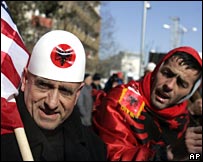
When I say that I can’t broadcast that, and can he put it another way, he thinks and puts the word “Serbia” first, followed by the rest.
The authorities desperately hope there is no in-your-face provocation towards the Serb minority here.
Awash with flags
Kosovo is awash with flags, determined to party.
This place is never short of flags, but now the Albanian black eagle on a red field is ubiquitous. In the capital, Pristina, some cars have twin miniature flags discreetly flying from their bonnets, others go the whole hog and have a huge flag draped across the boot.
I’m told that an incredible 80 tonnes of fireworks have been brought in and distributed all over the country. I watch as a team of women spread cream and chocolate on sections of a giant cake that is intended to feed 30,000 people. It took 11,800 eggs. You can’t make a nation without breaking more than a few eggs, apparently.
About 40 miles from the capital, I come across a group of men determined to put up a banner reading “Celebrate independence!” across the road, hanging it from a half constructed building, flags flying predictably from every corner.
Even the cement mixer by its side has a large flag attached, and the men argue amiably about the best way to get the banner up as lorries and coaches get entangled in it as they pass.
What does independence mean to them? One man tells me: “This day is for all citizens who want to be free. So many people gave their lives and sacrificed so much for this country.”
Four flags
Although the black eagle is everywhere, this Independence Day is a tale of four flags. Cars and buildings also fly the Union Jack and Stars and Stripes. Kosovo is one of the few places in the world that people will shake you firmly by the hand and thank you for Britain’s support.
This day may have been along time coming, but the majority Albanian population know that it was the Nato bombing campaign against Serbia that insured that they would and could one day split from that country.
As I get ready to do a piece to camera in the middle of Mitrovica, one man comes up to thank my country, and give me a firm handshake. 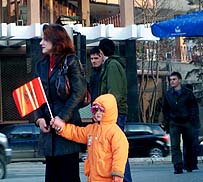
“It’s the most momentous moment for the Albanians here, because we had 500 years of occupation from a really terrible, horrendous occupier,” he says. “There’s been so much bloodshed that now we’re really happy.”
Formally what happens today is that the Prime Minister calls MPs together and parliament approves a bunch of laws described in the Ahtisaari plan. And then he will declare independence and the party will begin with classical music and later those fireworks.
There are government notices everywhere, including on the back of free T-shirts, asking people to “celebrate with dignity”. And I’ve heard they are also asking everyone to go home shortly after midnight. Informally it might be rather more raucous than that, as joy is unbound.
Day of tragedy
Of course not every one who lives here feels that way. For many Serbs this is a day of tragedy.
In Mitrovica it is just a short walk across a bridge to the Serbian side of town, over-looked by French snipers and Nigerian UN soldiers. Here, of course, there is no bunting, nothing hanging from cars.
Under a rather tattered Serbian flag there is some building work going on. I ask a man shovelling bricks into a wheelbarrow what independence will mean for him. He frantically shovels more bricks and says that he will stay and work, work hard. 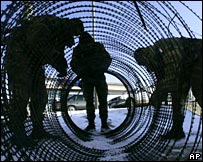
As for independence, he says, it’s like him coming to my house and saying that it is his. A teenaged boy interjects: “We may celebrate: with guns”.
I ask him what he means. He says that if the Albanians try to bring their celebration across the bridge, to taunt them, they will be ready to defend themselves. But I think the Serbian mood is as much sorrow as anger.
Today is a big day, an emotional day. But how much difference will independence make? Kosovo will declare independence today, but in a sense that is independence from the United Nations, because in reality it has not been ruled from Belgrade for nine years.
While Serbs may regard it as legally part of their country, for nine years there have been borders, and checks on documents between Serbia and Kosovo.
Equally in the north of Mitrovica, and other parts of Kosovo where Serbs live, they use their own currency and under the plan they will have a great deal of autonomy. Of course this does beg the question why they can’t choose to be part of Serbia if ethnic Albanians have the right to live in a new country.
EU flag
I wrote that this was a tale of four flags. The fourth flag is the European Union flag, which again you see hanging from every third building. Indeed I’m told Kosovo’s official flag will probably be pretty much like the EU flag with a map of the country inside the golden stars.
Some might think that rather justly symbolic: Kosovo will have a sort of independence but within parameters set down by the European Union. 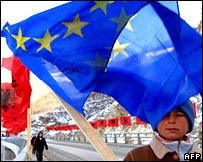
Diplomats are very keen to stress that today does not see the United Nations hand over to the European Union. Whereas the UN really was running the show, the EU will just be there to keep an eye on things. But the EU can, in the end, tell the government what to do and what not to do in certain areas.
One senior EU source puts it like this: “We have a big stick. But that big stick is locked in a safe in the cellar. And it would take a lot to make us get the keys out and go downstairs. But we can do it.”
One of the most important people around here is Roy Reeve, a former British diplomat with an easy manner who is at the moment in charge of planning the EU police mission, the biggest task the European Union has ever undertaken.
EU protectorate
I ask him if the arrangement doesn’t make Kosovo an EU protectorate, or even colony.
“It’s been a protectorate up until now but the responsibility is theirs now,” he says. “They are the new government, it’s for them to deliver results. Whatever we’re here to do, it’s not to leap in and take decisions on their behalf, but to work with them to make it clear that they are the ones in charge.”
It is more than simply ironic that, with the EU taking on such a big burden, it cannot get its act together. At tomorrow’s foreign ministers meeting there will be a smooth papering over the cracks, and then about 20 countries will recognise Kosovo.
That would leave seven not really on board for what some might see as the EU’s biggest project to date. But for the time being, that is not what is most important.
The next 24 hours will bring reaction from all around the world. But what happens here, on the ground, is what is vital. Let’s hope the only fireworks are part of the celebratory display.
The BBC is not responsible for the content of external internet sites
Description
Archive
« February 2008 »
| Sun | Mon | Tue | Wed | Thu | Fri | Sat |
|---|---|---|---|---|---|---|
| 1 | 2 | |||||
| 3 | 4 | 5 | 6 | 7 | 8 | 9 |
| 10 | 11 | 12 | 13 | 14 | 15 | 16 |
| 17 | 18 | 19 | 20 | 21 | 22 | 23 |
| 24 | 25 | 26 | 27 | 28 | 29 |
Being Discussed Now

Latest from BBC News blogs
Nick Robinson: |  |
Douglas Fraser: |  |
Brian Taylor: |  |
 |
Richard Black: |  |
Jonathan Amos: |  |
- News Editors
- Sport Editors
- Journalism Labs
- BBC Internet Blog
- Radio 4 Blog
- Peston's Picks
- Nick Robinson's Newslog
- Stephanomics
- Mark Easton's UK
- Mark Mardell's America
- Nick Bryant's Australia
- Andrew Harding on Africa
- Gavin Hewitt's Europe
- Soutik Biswas' India
- dot.Rory
- Science: Jonathan Amos
- Richard Black on environment
- Today: Tom Feilden
- Fergus Walsh's medical files
- Newsnight: Paul Mason
- Newsnight: Mark Urban
- Torin Douglas
- Will Gompertz's arts
- Phil Coomes on photojournalism
- Magazine Monitor
- Mark D'Arcy in Westminster
- NI: Mark Devenport
- Scotland: Brian Taylor
- Scotland: Douglas Fraser
- Wales: Betsan Powys
- Martin Rosenbaum on FOI
- 5 Live Breakfast
- Newsnight
- PM programme (iPM)
- World Tonight: Robin Lustig
