

Dancing at Versailles to the EU Treaty
- 4 Feb 08, 09:46 PM
You could hardly choose a more dignified, grand place for an important political event.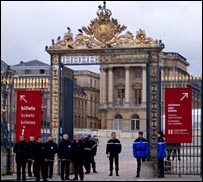
I suppose France’s politicians could hardly have chosen a more appropriate one either to ignore the hoi polloi protesting outside.
The French politicians from both houses were meeting to change the constitution so they could go ahead with the adoption of the Treaty of Lisbon. And you can see my TV report here.
By the weekend, the Senate, the National Assembly and the President himself will all have wielded the rubber stamp. Indeed, at Versailles they bring in a real, live, giant stamp to endorse the document.
No plan B
President Sarkozy had made no bones about it, and repeatedly made it clear in his election campaign that if he was president there would be no second referendum. Few politicians are open enough to say “we just can’t take the risk”, but I thought French Prime Minister Francois Fillion was pretty direct:
“Two years ago, we rejected a text that gave the European adventure a constitutional look. That was the choice of the French people, and it had to be respected. But we cannot ignore the fact that in doing so we threw Europe, Europe that had hope in us, into surprise and confusion.
“There was no Plan B, so the European Union was paralysed and the finger was pointed at us. When we voted ‘No’ to the 2005 text, we inherited a double responsibility - for ourselves and for Europe - that of giving it back the momentum and spirit that we took away.”
Surge of protesters
About 200 metres away from the building itself, a line of police confronts anti globalisation protesters chanting “we want a referendum”. Some surge forward and it looks as if things are going to turn nasty. One protester tries to make it over the fences in front of their vehicles and is dragged to the ground.
This is an anti globalisation protest against the treaty and these are seasoned campaigners, with many grey beards and bright, knitted jumpers among the youthful piercings and dreadlocks.
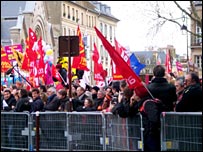
One of the organisers, Susan George, tells me they should have the right to vote on this in a referendum. “There’s only cosmetic changes in this text,” she says. “That’s what Giscard D’Estaing says and that’s what everyone in officialdom says. So we believe that we are being spat upon. They know we would vote ‘No’ again.”
I asked what she didn’t like about the treaty. She doesn’t think a constitution should contain details of economic proposals and says the only other document like this was the constitution of the Soviet Union.
“This treaty submits us to Nato,” she says, “which will always be headed by an American, and it says it is the basis of our defence. It makes us agree to increase our arms capacity: I don’t agree with that. It downgrades public services. It is only interested in the rights of trans-national corporations.”
By the time I leave, what seemed like a potential riot earlier in the afternoon has turned into more of a free festival: men and women, dressed in French Revolutionary red-felt bonnets, waltz gently to the sound of an accordion. I feel these class warriors would be rather surprised if the state did pause to heed their views.
The BBC is not responsible for the content of external internet sites
Description
Archive
« February 2008 »
| Sun | Mon | Tue | Wed | Thu | Fri | Sat |
|---|---|---|---|---|---|---|
| 1 | 2 | |||||
| 3 | 4 | 5 | 6 | 7 | 8 | 9 |
| 10 | 11 | 12 | 13 | 14 | 15 | 16 |
| 17 | 18 | 19 | 20 | 21 | 22 | 23 |
| 24 | 25 | 26 | 27 | 28 | 29 |
Being Discussed Now

Latest from BBC News blogs
Nick Robinson: |  |
Douglas Fraser: |  |
Brian Taylor: |  |
 |
Richard Black: |  |
Jonathan Amos: |  |
- News Editors
- Sport Editors
- Journalism Labs
- BBC Internet Blog
- Radio 4 Blog
- Peston's Picks
- Nick Robinson's Newslog
- Stephanomics
- Mark Easton's UK
- Mark Mardell's America
- Nick Bryant's Australia
- Andrew Harding on Africa
- Gavin Hewitt's Europe
- Soutik Biswas' India
- dot.Rory
- Science: Jonathan Amos
- Richard Black on environment
- Today: Tom Feilden
- Fergus Walsh's medical files
- Newsnight: Paul Mason
- Newsnight: Mark Urban
- Torin Douglas
- Will Gompertz's arts
- Phil Coomes on photojournalism
- Magazine Monitor
- Mark D'Arcy in Westminster
- NI: Mark Devenport
- Scotland: Brian Taylor
- Scotland: Douglas Fraser
- Wales: Betsan Powys
- Martin Rosenbaum on FOI
- 5 Live Breakfast
- Newsnight
- PM programme (iPM)
- World Tonight: Robin Lustig
