
Listen to Graham Harvey on BBC Radio 4's The Report - The Ambridge Price of Milk.
Britain’s dairy industry is in deep trouble. The price most farmers are paid for their milk has dropped catastrophically and many now face the loss of their businesses. In one month this summer 148 dairy farmers left the industry, and some fear the crisis could lead to the loss of one-in-three dairy businesses in Britain.
A few facts:
The average farm-gate price for milk (what the farmer gets) was around 24p a litre in May this year. In May 2014 the price was 33p a litre so we’ve seen a fall of 25%. Since, for many dairy farmers, 24p a litre represents the cost of production – or even a little less than the cost of production – there are clearly herds that are at best breaking even, or perhaps making a loss. However, a lucky few have been protected from the price drop – so far. They’re the dairy farmers who are on direct supply contracts with supermarkets including Tesco, Sainsburys, Waitrose and M&S. They’re getting around 32-33p a litre so they’re still in profit. Also dairy herds that are spring-calving and getting most of their production from grazed grass (sometimes known as the New Zealand system) are producing milk at costs well below 24p, so they’re doing OK too.
Farming Today - Dairy protests
I recently visited a dairy farm where they have around 300 cows. This was a bigger herd than at Brookfield which has around 200 cows. In May the milk price on the farm was 22p a litre (2p below the average) compared with 29p a litre in May 2014. The farm’s profit this year is expected to be around £10,000 less than last year. Because of the current low prices next year’s profit is being forecast as a fair bit lower. So profits are down, but not catastrophically so.
I also visited a big housed herd, similar to Berrow Farm. There were 2000 cows (1500 at Berrow) housed all year round and managed entirely by Polish staff. The owner – a farmer of about 40 – said the herd was still in profit, partly because he was getting a slightly higher milk price of 27p a litre. But his aim was to get production costs down so they can better withstand these price drops. He was an impressive chap and I wouldn’t bet against him achieving his aim. But across the country the current milk price crash is threatening large farms as well as small.
The moment Ed decided to get out of dairy.
What does all this mean for Brookfield? They’re not on a direct supermarket contract so they’re probably getting a price of around 24p a litre, but because of their intensive grazing system (extended grazing paddocks) their costs are probably a penny or two per litre below the average. They’ll still be in profit - just - but definitely feeling the pinch. David and Ruth will be mighty glad they didn’t spend thousands of pounds on a robotic milking system! Unless they can get a better price (very hard to get a supermarket contract at the moment for obvious reasons) they’ll be looking to bring down production costs. Berrow Farm will also have to bring down their costs.
Dairy industry pundits say price volatility in milk is now a permanent feature of the market. It’s very much a global industry. The international price for dairy commodities effectively sets the UK milk price. The current low price reflects a production increase in countries like the US, Australia, NZ, UK and Ireland and a demand drop in China, Russia (a result of the import ban) and Brazil. At some point in the future these trends will reverse and profits will bounce back. Many dairy farmers are hoping that if they stick with it they’ll reap rewards. But they’re all looking for strategies to make their businesses more resilient, principally by cutting costs.
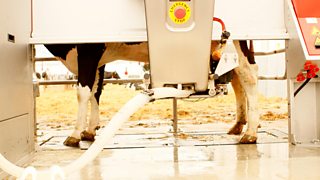
Robotic milking demo
Jill and Pip discuss developments in milking.
In future the good operators are likely to survive. But for the first time since World War II they’ll have to do it without subsidies. State support for dairy farming has almost ended taking us back to the situation in the 1920s and 30s when milk prices were on the floor, there were no subsidies, and imports – as now – were flooding in from all over the world. Ironically this was a time of great expansion in the dairy industry, partly because dairy farmers were so desperate many set up their own retail rounds.
Graham Harvey is The Archers’ agricutural advisor.
Listen to Graham Harvey on BBC Radio 4's The Report.
Read about Brookfield's 'open-air' dairy of the past.
And here's an unusual example of farmers taking matters into their own hands.
