

Our first truly digital building - Pacific Quay
 |15:43 UK time, Tuesday, 9 March 2010
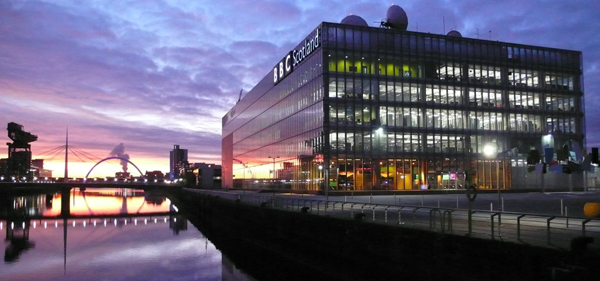
Pacific Quay is today approaching its third anniversary and is delivering big benefits for BBC audiences in Scotland. I thought it would be useful to reflect on the Pacific Quay (PQ) story, how it came to pass and its role in the overall BBC Estate story.
PQ is playing its part, too, in the continuing regeneration of this once derelict part of Glasgow, which is now, despite the recession, starting to become a Glasgow destination. PQ also functions as an absolutely undeniable public confirmation of the BBC's unshakeable commitment to Scotland with up to 3,000 visitors coming to see what the BBC gets up to every month. On the value for money side too, PQ has hit the mark and is now delivering on its savings targets.
Although it opened in 2007, this project was a long time in the cooking - in fact the original decision to consider relocation from the former BBC headquarters at Queen Margaret Drive (QMD) in Glasgow's West End was taken as far back as 1999. It was very far sighted at that time to consider not only moving away from the centre of Glasgow but to what was then regarded as the wrong side of the Clyde.
But let's consider why the BBC embarked on this journey. Three things were driving change. Firstly, BBC Scotland was growing fast - its programme making increased sharply as BBC commissioning policy changed and pushed more network production into Scotland. Secondly, the BBC was putting a new stress on efficiency, which translated into much tougher savings targets for BBC Scotland. Thirdly, the digital revolution was making possible a parallel revolution in the working practices of broadcasters. Those changes were the primary factors behind BBC Scotland's decision to move out of central Glasgow.
But there was also a fourth factor, not so much to do with efficiency or technology, but with the changing political landscape of Scotland. By 1999 the devolved government was in place in Edinburgh. Questions were being asked about the BBC's commitment to Scotland. A new building on a new site would symbolise the BBC's continuing strong commitment to investing in Scotland.
The BBC could, of course, have redeveloped the QMD site, but this would have involved considerable disruption to BBC Scotland's ongoing production and broadcasting activities on the site, and there were also potential planning problems as part of the site was listed. So BBC Scotland turned instead to the derelict dockland lining both banks of the Clyde.
Regeneration of the area had already begun with mixed success and, prior to the arrival of the BBC, the Scottish Exhibition and Conference Centre had been developed. The site included the Clyde Auditorium, opened in 1997, designed by Foster & Partners, which quickly became known as "the Armadillo" because of its striking shape. This was followed on the opposite side of the Clyde by the Glasgow Science Centre which opened in 2001.
In 1999, the BBC Governors gave approval in principle to relocate most of the BBC operations from QMD to Pacific Quay. As a pre-requisite, much better road access was needed to and from the city centre across the river. After representations from the BBC a commitment was given to build a new road and pedestrian bridge across the Clyde (now known as the Clyde Arc, designed by Richard Rogers and opened in 2006). The BBC held an international competition to choose an architect - won by the distinguished British architect David Chipperfield. In 2004, planning permission was granted for the new BBC Scotland HQ on the PQ site; the project was bond financed and construction began.
The project organisation was a variation on the approach used for the White City buildings in London. Land Securities was appointed as development manager to oversee the design team and the contractors were Bovis Lend Lease. In April 2004 Keppie was brought in as project architects to work alongside David Chipperfield Associates. Keppie is a locally-based firm with extensive experience in turning advanced design concepts into practical and effective spaces for people to work. Following the completion of the Bond negotiations, the final sign-off for construction by the BBC Governors was secured and construction began in July 2004.
The building has significant areas open to the public - one of the big drawbacks to QMD was that it was impossible to open it up to large numbers of the public. By contrast, PQ is now attracting more visitors than QMD could ever accommodate - turning the BBC's commitment to openness and access into a reality. To date, up to 90,000 people have visited the new building.
The project was organised as a change programme, with the building/development treated as one workstream within this. The project benefited enormously from the existence of a strong vision for technology and for the transformation it enables, clearly articulated and led by the BBC Controller of Scotland. PQ construction work was completed - on time and on budget - in August 2006. After the technical fit-out and the move of staff from QMD, PQ was officially opened in September 2007. More than 1,000 BBC staff now work there in one of the world's most technologically-advanced broadcasting centres.
For me, it was another step forward in how the property function helps the overall BBC change ambition and the move to providing great content to all of our audiences - the property workstream learned lessons from previous projects and put them into practice here. We had a really good project team environment where all of the players got on with the job and delivered a really good product without recourse to claims etc. In short it was a job we could all be proud of - delivered on time and on budget.



Comments Post your comment