Today marks the first anniversary of my blogging efforts - my, doesn't time fly!
In setting out to explore this new way of communicating I wondered whether it would be worthwhile or not. Over the last year I have learned a lot and tried to publish material which is interesting and informative.
At times I have struggled to keep up with my goal of publishing two items per week. It wasn't due to a dearth of material, far from it, but more down to a shortage of time.
In reflecting on the 100+ postings, I do hope that some have been of interest, although few have prompted readers of this blog to comment. Going forward I intend to be more provocative to see if this might tempt people to engage! After all, recent figures indicate that this website sees an average of 300 visits every week, so some of you must have a point to make.
Last Friday I toured the BBC's rainwater harvesting system at our Media Village complex in west London. I have always enjoyed the opportunity to spend time looking behind the scenes and speaking with some of our 2,000+ suppy chain.
This visit was really interesting on two counts. Firstly it's great to see something that helps our efforts to operate the BBC estate in a more sustainable manner. Secondly I met somebody who has supported the BBC for 40 years.
The rainwater harvesting system was built at the same time as the Media Centre and Broadcast Centre and helped the buildings achieve a BREEAM excellent rating - the leading environmental assessment method for buildings. The system collects water from the roofs of the buildings and pipes it to a huge 220,000 litre underground tank. The water is then treated and used within the buildings in place of mains water for tasks such as flushing the toilets. BBC Workplace estimates this will save three million litres of fresh water each year. That's a lot of flushes!
I was accompanied on my tour by Paul Cousins who has worked man and boy providing maintenance services to the BBC - he recounted to me his views of how the BBC has changed over the years. During this period the one thing to his mind that was constant is that the BBC never sits still, it's always on the move. It's interesting to see that this is very much the case at the moment.
I recently spent some time taking a reporter from Building magazine around Broadcasting House. The objective was to 'lift the lid' on the project and help people to understand what a great facility this is going to be and the role it will have in helping us to transform our estate in London - and the BBC as a whole. We also talked about our wider change agenda and how we, as a property team, are at the heart of supporting the transformation of the BBC.
Many people struggle to understand the complexity of our buildings, the type of occupier we are, and why we need specific services and support from the UK construction and property industry supply chain. We are charged with delivering the real estate platform that the BBC needs to do what it does best - to create quality broadcasting and journalism.
The article highlights some of the challenges we face and, in line with recent scrutiny from the NAO, some of the lessons we have learned.
Visit the Building website to read the full article.
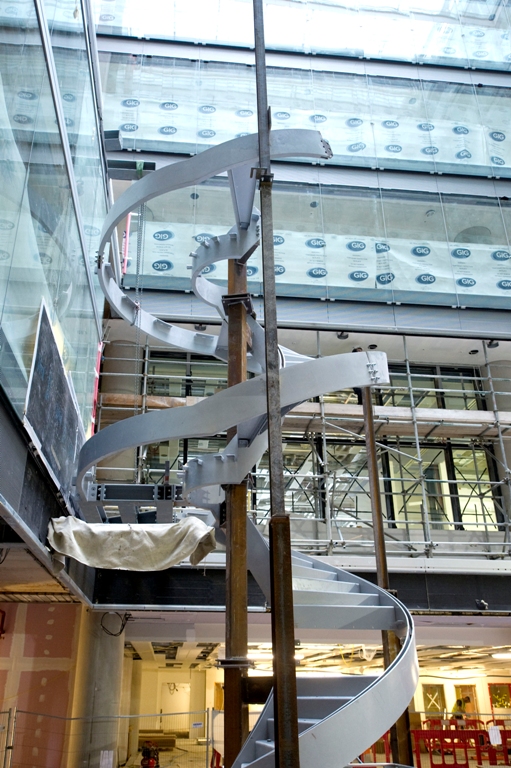
Pictured below: The helical staircase linking the second basement level with floor two
One of my big worries is whether we're doing enough about Health and Safety - with so many things going on across the estate day in day out, plus our enormous building programme going on at the same time.
When I think about the latter, and the fact that today there could be up to 2,000 people carrying out construction work on BBC sites across the UK, this is quite a challenge.
It was therefore very heartening to read some feedback about MediaCityUK in Salford where Peel Media and Bovis Lend Lease had a very positive visit from the Head of the Health and Safety Executive (HSE) who paid tribute to the high safety standards at the site.
Have a look for yourself by reading the 'Safety first for builders at the BBC's new Salford HQ' article on the HSE website.
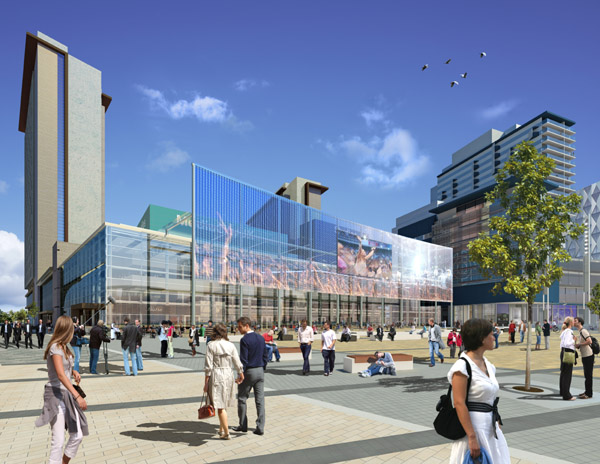
The BBC's digital city - MediaCityUK at Salford - is the wonderful new home for the BBC in the North.
This week marks another milestone for Workplace as we take delivery of another of the office buildings at the development - three weeks ahead of schedule!
As I consider what we're trying to achieve in Salford it prompted me to think about how it fits into our overall game plan. Salford is different. It is different both in the impetus behind it and in the way it is financed.
Unlike Pacific Quay and Broadcasting House, Salford is not primarily driven by the desire to make savings. Of course the project will save the BBC money over the course of its life. But the BBC embarked on Salford out of an urgent need to reconnect with Northern audiences.
In 2006, Salford Quays emerged as the clear winner from a shortlist of four possible new locations, but it took another twelve months for the BBC to conclude negotiations and satisfy itself that the deal was value for money. Salford Quays is a 200-acre area of former dockland on the Manchester Ship Canal a couple of miles west of the centre of Manchester. It is being developed under the title MediaCityUK and is the result of the BBC working with other public sector partners to develop the concept of a Media Enterprise Zone - a sustainable creative community with the BBC as a catalyst attracting other similar organisations onto the site. Between 2,300 and 2,500 BBC staff will work there - about 1,500 of the posts will be transferred from London and the rest will come from existing BBC bases in Manchester, which will be closed. Ultimately the other members of the partnership (Peel Holdings, Central Salford Urban Regeneration Company, Salford City Council and the North West Regional Development Agency) hope that up to 15,000 new jobs will be created off the back of the BBC project.
The BBC will rent three buildings and use technical space in a separate studio block, also available to other users. The BBC will start to take occupation of the buildings in late 2010. The studio block will come on stream in January 2011 and the move of staff will be completed by the end of 2011. The development work is being carried out by Peel Holdings who own the site and from whom the BBC will rent the buildings on a 20-year lease starting in 2010.
One of the big benefits of this contract - a lesson learned from Broadcasting House - is a very clear focus by the developer and contractor on meeting construction deadlines, since they bear the costs of any failure to do so.
The MediaCityUK project is designed to deliver a range of benefits to audiences, staff, the BBC, the media industry and the North of England:
- Benefits to the audience: A highly visible BBC centre that audiences will visit and interact with, that enables the production of content that reflects the life of the region.
- Benefits to staff: The project has ambitious goals for those who work there - to be the best place to work in the industry; to change the culture and working practices of the staff who move there; to develop a different tone and style; to have more flexible employment policies and practices, and to have an innovative and flexible relationship between the organisation and the individual.
- Benefits to the BBC: The BBC parts of MediaCityUK aim to be a catalyst and a benchmark for change across the BBC that help to deliver Creative Future goals and offer clear value for money to licence fee payers. On the site the BBC will sit alongside suppliers, distributors and potential collaborators, creating an environment conducive to establishing the partnerships necessary for the BBC to continue to thrive in a post-switchover world.
- Benefits to the Media Industry and the North of England: MediaCityUK is envisaged as a substantial creative centre outside London, attracting media players beyond the BBC to work in collaborative partnerships that build the competitiveness of the media industry as a whole and has a major impact on the economy of the North West and the wider North of England.
Unlike Pacific Quay and Broadcasting House, the BBC is playing no part in raising the capital for the Salford project. In line with the Creative Future theme of 'Simplicity', the three new buildings will be held on a straightforward 20-year lease. Responsibility for the delivery of the new space lies with the developer, Peel Holdings.
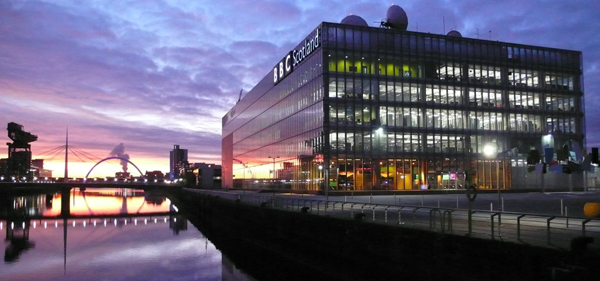
Pacific Quay is today approaching its third anniversary and is delivering big benefits for BBC audiences in Scotland. I thought it would be useful to reflect on the Pacific Quay (PQ) story, how it came to pass and its role in the overall BBC Estate story.
PQ is playing its part, too, in the continuing regeneration of this once derelict part of Glasgow, which is now, despite the recession, starting to become a Glasgow destination. PQ also functions as an absolutely undeniable public confirmation of the BBC's unshakeable commitment to Scotland with up to 3,000 visitors coming to see what the BBC gets up to every month. On the value for money side too, PQ has hit the mark and is now delivering on its savings targets.
Although it opened in 2007, this project was a long time in the cooking - in fact the original decision to consider relocation from the former BBC headquarters at Queen Margaret Drive (QMD) in Glasgow's West End was taken as far back as 1999. It was very far sighted at that time to consider not only moving away from the centre of Glasgow but to what was then regarded as the wrong side of the Clyde.
But let's consider why the BBC embarked on this journey. Three things were driving change. Firstly, BBC Scotland was growing fast - its programme making increased sharply as BBC commissioning policy changed and pushed more network production into Scotland. Secondly, the BBC was putting a new stress on efficiency, which translated into much tougher savings targets for BBC Scotland. Thirdly, the digital revolution was making possible a parallel revolution in the working practices of broadcasters. Those changes were the primary factors behind BBC Scotland's decision to move out of central Glasgow.
But there was also a fourth factor, not so much to do with efficiency or technology, but with the changing political landscape of Scotland. By 1999 the devolved government was in place in Edinburgh. Questions were being asked about the BBC's commitment to Scotland. A new building on a new site would symbolise the BBC's continuing strong commitment to investing in Scotland.
The BBC could, of course, have redeveloped the QMD site, but this would have involved considerable disruption to BBC Scotland's ongoing production and broadcasting activities on the site, and there were also potential planning problems as part of the site was listed. So BBC Scotland turned instead to the derelict dockland lining both banks of the Clyde.
Regeneration of the area had already begun with mixed success and, prior to the arrival of the BBC, the Scottish Exhibition and Conference Centre had been developed. The site included the Clyde Auditorium, opened in 1997, designed by Foster & Partners, which quickly became known as "the Armadillo" because of its striking shape. This was followed on the opposite side of the Clyde by the Glasgow Science Centre which opened in 2001.
In 1999, the BBC Governors gave approval in principle to relocate most of the BBC operations from QMD to Pacific Quay. As a pre-requisite, much better road access was needed to and from the city centre across the river. After representations from the BBC a commitment was given to build a new road and pedestrian bridge across the Clyde (now known as the Clyde Arc, designed by Richard Rogers and opened in 2006). The BBC held an international competition to choose an architect - won by the distinguished British architect David Chipperfield. In 2004, planning permission was granted for the new BBC Scotland HQ on the PQ site; the project was bond financed and construction began.
The project organisation was a variation on the approach used for the White City buildings in London. Land Securities was appointed as development manager to oversee the design team and the contractors were Bovis Lend Lease. In April 2004 Keppie was brought in as project architects to work alongside David Chipperfield Associates. Keppie is a locally-based firm with extensive experience in turning advanced design concepts into practical and effective spaces for people to work. Following the completion of the Bond negotiations, the final sign-off for construction by the BBC Governors was secured and construction began in July 2004.
The building has significant areas open to the public - one of the big drawbacks to QMD was that it was impossible to open it up to large numbers of the public. By contrast, PQ is now attracting more visitors than QMD could ever accommodate - turning the BBC's commitment to openness and access into a reality. To date, up to 90,000 people have visited the new building.
The project was organised as a change programme, with the building/development treated as one workstream within this. The project benefited enormously from the existence of a strong vision for technology and for the transformation it enables, clearly articulated and led by the BBC Controller of Scotland. PQ construction work was completed - on time and on budget - in August 2006. After the technical fit-out and the move of staff from QMD, PQ was officially opened in September 2007. More than 1,000 BBC staff now work there in one of the world's most technologically-advanced broadcasting centres.
For me, it was another step forward in how the property function helps the overall BBC change ambition and the move to providing great content to all of our audiences - the property workstream learned lessons from previous projects and put them into practice here. We had a really good project team environment where all of the players got on with the job and delivered a really good product without recourse to claims etc. In short it was a job we could all be proud of - delivered on time and on budget.
My day got off to a nice start when I received an email setting out some feedback on a project we had recently completed.
Feedback is the lifeblood of a service organisation such as ours and it's very heartening to receive positive recognition and notes of this nature. Rather than paraphrasing it - see below for the full text.
I'm glad we were able to meet the needs and expectations of a client especially as it involved moving 100 desks! Thanks to all who contributed.
Chris
Good morning Chris, I wanted to drop you a note to say how impressed we were with the Workplace team over the weekend. We have been planning an office 'lift and shift' for several weeks now, involving over 100 desk moves, and the Workplace team has been brilliant in the lead up to, and especially over, the weekend.
We arrived in yesterday to find it all where it should be, all the IT working and a few people walking around to solve any issues quickly. It was just brilliant. Very responsive and every detail was looked after.
A lot of people have mentioned that this was the smoothest move in BBC history! All that is thanks to the Workplace team and Siemens working so well together.
Very much appreciated, and a special thanks to David Bowen - he is just brilliant.
Emma Reynolds, BBC People
While it's not unusual for people to focus on the negative aspect of how we're transforming the BBC Estate, I want to focus for a moment on the 'why'. Essentially we're delivering ambitious projects that enable the BBC to change - to deliver even better content to BBC audiences.
These are enormously ambitious projects. The buildings broadcasters need today are nothing like the ones they worked in ten years ago. Our new buildings enable the BBC to work in new ways, using cutting edge technology to make even better programmes - and deliver even better value to BBC audiences.
The conception and realisation of these three projects occurred in a decade during which broadcasting experienced a profound and unprecedented transformation. The list includes: the development of digital, tapeless, high definition and multiplatform delivery systems, plus greater audience demands for out of London production.
At the end of the last century, the BBC had to face up to the legacy of thirty years of under-investment in keeping its buildings up to date. At that time, for example, 90% of our facilities in central London were more than 25 years old and were in dire need of modernisation. Therefore we had to do something.
There was however another factor that merits consideration - BBC senior management at the time recognised the need to move away from a civil service mentality. Given that most BBC staff at that time lived in cellular offices, allocated by grade, a series of pilots was launched to look at new ways of working. Looking back, this marked the start of the BBC's journey to open plan working. It also kicked off an awareness, that is still alive and well today, of the linkage between changing space and enabling business change.
Turning to the three big projects themselves - the business case for Broadcasting House grew out of the need to find a new home for the World Service once the lease on Bush House expired; the desire to rationalise the BBC's use of space in London by closing down many smaller BBC buildings and consolidating on a much smaller number of sites, to allow for more efficient use of space. It would also allow BBC News to move back to the centre of London from W12, giving better access to contributors.
Pacific Quay opened in September 2007, on time and on budget. The business case for Pacific Quay grew out of a number of pressures on BBC Scotland. Firstly there was a need to expand production capacity as BBC Scotland's workload began to grow sharply. Secondly, BBC Scotland had been given much tougher savings targets and had to find ways to increase efficiency. Thirdly, the digital revolution was opening up new ways of working that BBC Scotland wanted to adopt. There was a fourth factor too - the need for the BBC to make a symbolic statement of its continued commitment to Scotland as it moved into the post-devolution era.
The business case for Salford was made in the 2004 Charter Renewal document, Building Public Value, in which the BBC set out the need to become less London-centric and the relocation of a significant number of staff and the control of significant airtime to the rest of the UK.
Doing nothing was never an option. Bush House had a lease break coming up and needed complete modernisation in any case, along with Television Centre and Broadcasting House. We therefore set out on a journey to deliver massive transformation that would result in BBC buildings which:
- Provide programme makers with creative, collaborative working environments
- Support the BBC property and environmental strategies
- Enhance BBC employee's lives through more flexible working


 |16:15 UK time, Wednesday, 31 March 2010

