Noise: A Human History - Week 4 - Earliest recordings

Janet Topp Fargion
Curator, British Library
Dr Janet Topp Fargion, lead curator of world and traditional music at the British Library, previews the fourth week of Noise: A Human History. The thirty-part series explores the role of sound in the past 100,000 years of human history.
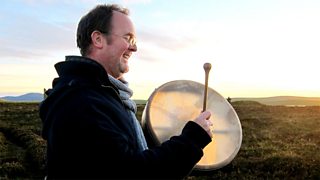
Prof David Hendy
This week Noise: a Human History focuses on the 17th and 18th Centuries, including historical moments of colonisation and settlement of the Americas.
We have no exact record of what environments and communities sounded like at that time, so early recordings of noises provide the nearest clue.
Early attempts at ethnographic recordings were typically found on wax cylinders. Invented by Thomas Edison in 1877, the phonograph - or wax cylinder recorder - remained in use as the most popular portable recording device for some sixty years.
We have no exact record of what environments and communities sounded like at that time, so early recordings of noises provide the nearest clue.
Early attempts at ethnographic recordings were typically found on wax cylinders. Invented by Thomas Edison in 1877, the phonograph - or wax cylinder recorder - remained in use as the most popular portable recording device for some sixty years.
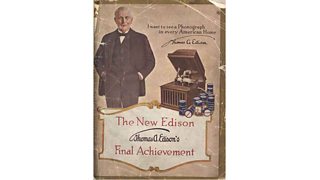
Thomas Edison's phonograph (copyright: British Library)
The first anthropologist to deploy the new apparatus in the field was the American, Jesse Walter Fewkes, recording amongst the Zuni and Hopi peoples as early as 1890.
Shortly afterwards, in 1898, Cambridge professor Alfred Cort Haddon led a British anthropological expedition to the Torres Straits, which lie between Australia and New Guinea.
This year-long expedition marked the start of British field recording, and produced the earliest wax cylinders in British Library’s collections.
Captain Charles Sutherland Rattray, a British officer stationed in Ghana during the early 1920s, made possibly the first ever recordings of 'talking drums', on wax cylinders.
Using musical instruments as a means of communication is widespread in West Africa where many of the spoken languages are tonal – not only rhythms but tones of the spoken word can be drummed out and heard over great distances.
Talking drums like these from West Africa are the signature riff for the Noise series, in which you can hear the stable, underlying percussive motif typical of this kind of ethnographic sound. Rattray’s talking drums are housed as brown wax cylinders, and latterly as digital files, at the British Library where they can be listened to in the reading rooms at St Pancras. Here’s a recording from 1921:
Shortly afterwards, in 1898, Cambridge professor Alfred Cort Haddon led a British anthropological expedition to the Torres Straits, which lie between Australia and New Guinea.
This year-long expedition marked the start of British field recording, and produced the earliest wax cylinders in British Library’s collections.
Captain Charles Sutherland Rattray, a British officer stationed in Ghana during the early 1920s, made possibly the first ever recordings of 'talking drums', on wax cylinders.
Using musical instruments as a means of communication is widespread in West Africa where many of the spoken languages are tonal – not only rhythms but tones of the spoken word can be drummed out and heard over great distances.
Talking drums like these from West Africa are the signature riff for the Noise series, in which you can hear the stable, underlying percussive motif typical of this kind of ethnographic sound. Rattray’s talking drums are housed as brown wax cylinders, and latterly as digital files, at the British Library where they can be listened to in the reading rooms at St Pancras. Here’s a recording from 1921:
Early recording on wax cylinders of 'talking drums' (Ghana, 1921).
This week’s programmes, focusing on the period leading up to the emergence of sound recording in the late 19th Century and throwing in the one or two enticing sounds recorded on the new technology at that time, sets the imagination going. What did the world really sound like before it could be captured through recording technology?
Download the last seven programme in the Noise series
Download the last seven programme in the Noise series
