
In Our Time: The Druids
Post categories: In Our Time, Melvyn Bragg, Radio 4
 17:48, Thursday, 20 September 2012
Editor's note: In Thursday's programme Melvyn Bragg and his guests discussed The Druids. As always the programme is available to listen to online or to download and keep - AI
Hello
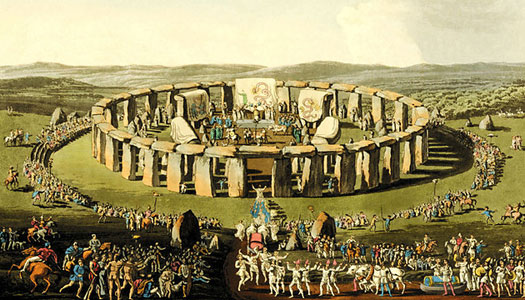
One of the advantages for me of In Our Time is that I become disabused of what I thought was certain knowledge. In 1978 I made a film with William Golding for the South Bank Show. We went to locations which were key to some of his novels and one of them was Stonehenge. We went on a misty morning and except for a man in a rumpled official suit there was nobody else around. We had the run of the place. We filmed William walking the Stonehenge estate and talking about the inspirational value it had. We talked about the inspiration of location. And I certainly took it for granted that this magnificent monument had been built by and used by the Druids.
Not so, it seems, although Professor Barry Cunliffe - and he is an Emeritus Professor! - sort of reserved the right to say that it just might have been the ancestors of the Druids, or the seeds of those who became Druids.
Now, when I drive past Stonehenge on my way to see a pal of mine and his wife down in Dorset, I see crowds cordoned off hundreds of yards away and think oh, what a pity. Bad luck for them. But I suspect like many of you, I'm regularly confronted by people who tell me I should have gone to places earlier (i.e., when they went) when it was so much better, so much quieter, so much more what it really was before I got there.
Well, I got to Stonehenge early, but it turned out to be not the place I thought it was.
The Druids are easy to mock. Even one of the scholars on the programme couldn't resist a little amusement. Miranda Aldhouse-Green talked of seeing her first procession of Druids and having to giggle at the fact that these solemn persons in white gowns all wore white plimsolls.
And there was the famous gathering on Primrose Hill in London where many of the rituals and observances of contemporary Druidism were hammered out.
Nevertheless, they led to inspirational art - William Blake - they spurred the discovery of the value of archaeology and therefore led to an increase in our affection for, and fascination with, the places in which we live. It led to what has become a lasting and very fertile provincialism - one of the more powerful, positive currents in this country. I didn't know that Aubrey had been such a scholar and indeed such an architectural drawer.
We hadn't time to talk about their influence on the preservation of landscapes. For instance, Mr Keiller - the marmalade king - was entranced by the Druids and bought Avebury in order that it should be excavated properly, in the course of which I think he encouraged the first aerial photography of an archaeological site in this country. And others too have fenced off areas they thought holy to the Druids and were certainly a part of the notion of preserving sacred sites.
I'm off to have lunch with Grey Gowrie at White's to discuss the relaunch of the London Magazine. Never been there. Evelyn Waugh used to drink champagne out of a silver tankard.
Best wishes
Melvyn Bragg
- Download this episode to keep from the In Our Time podcast page
- Visit the In Our Time website
- Follow Radio 4 on Twitter and Facebook

Comment number 1.
At 18:22 20th Sep 2012, Savage Henry wrote:I haven't yet had time to listen to the podcast, but can I rest assured that the programme discussed at length the theory of the druids express by Nigel Tufnell in Spinal Tap?
"In ancient times, hundreds of years before the dawn of history, an ancient race of people... the Druids. No one knows who they were or what they were doing..."
It seems accurate to me.
Complain about this comment (Comment number 1)
Comment number 2.
At 18:52 20th Sep 2012, Peter Bolt wrote:As always very enjoyable.
It was questioned "why mistletoe" ?
Driving ( or walking ) thro` the countryside in mid winter seeing a big bunch of mistletoe growing high up in a leafless tree is a strange sight.
The lack of a rational explanation as to why that tree and not another standing nearby merely adds to the mystery.
It is not at all hard to understand why it should impress Druids. I still find it impressive and I know the process.
Complain about this comment (Comment number 2)
Comment number 3.
At 19:32 20th Sep 2012, lagorunner wrote:I always understood that mistletoe was revered by the ancients as a clear sign of life and growth on otherwise leaf-less trees, during the winter months.
As an aside, the 'Boudica Dreaming' series of novels by Manda Scott provide an absorbing and imaginative account of the role of Druids in Roman Britain. This ancient culture clash was alluded to in the program.
Complain about this comment (Comment number 3)
Comment number 4.
At 19:34 20th Sep 2012, vhawk wrote:druids were not a race but members of a religious order about which virtually nothing exact is known; most of what is claimed about them is speculation compounded by hearsay,in short, invented.as an oral tradition it died out completely.
Complain about this comment (Comment number 4)
Comment number 5.
At 12:48 21st Sep 2012, JohnSauveRodd wrote:We loved the Stonehenge bouncy castle at the Olympic opening ceremony, loved it for it's irreverent joyfulness and the rarest of chances to leap on to a national monument when the real thing is quite out of bounds.
Complain about this comment (Comment number 5)
Comment number 6.
At 13:25 21st Sep 2012, vhawk wrote:there is no way of knowing anything about the mental processes and practices of druiids that is not hearsay and speculation/wishful thinking.it is no longer a real, living tradition(viz. the etymology of that word)the reason: the last druid died or was killed hundreds of years ago. most of the nonsense talked about druids is just that, and /or fantasy and invention.
Complain about this comment (Comment number 6)
Comment number 7.
At 14:33 21st Sep 2012, John Thompson wrote:Blake inveighed against systemetizers and priesthoods. He was for deities that ‘resided in the human breast’.He was for a Stonehenge of the imagination.The Romans had a lot to do with the destruction of Stonehenge,regarded by the occupying power as a dangerous focus for resurgent nationalism,when the flourishing cult of Druidism was stamped out with unusual ferocity,also due to the practice of human sacrifice,inimical to both Greeks and Romans.Druidism was thought to be more of a political force in Gaul than in Britain.
There is no evidence for connecting Stonehenge with the Druids,whose ceremonies and observances took place in natural groves of trees, caves, rivers,rather than in artificial temples.Only if the Romans did destroy Stonehenge would this be evidence for a Druidic association with the monument.Druids may have made ceremonial use of the stone circle but recent evidence suggests that the megalithic stones at Stonehenge belong to a BA culture(2100-1600BC).
Also deliberate overthrowing of the stones probably took place in the Middle Ages due to the use of prehistoric monuments as the centres of pagan rituals,a threat to the spiritual power of the Church.The Celtic priesthood ,the Druids,flourished in Gaul and in Britain from 200 BC.The Druids association with Stonehenge starts from John Aubrey’s and Stukeley’s suggestion of it being a Druidic temple.The popularity of this notion is due to its Romantic appeal and due to the public fascination with human sacrifice.The double whammy of the occupying Romans and the rise of Christianityboth were responsible for the decline of Druidism.
Complain about this comment (Comment number 7)
Comment number 8.
At 00:45 22nd Sep 2012, vhawk wrote:most of what is supposedly known about druids is guesswork, imagination and wishful thinking.-that is not remotely knowledge.
Complain about this comment (Comment number 8)