
The Art of Monarchy - Psaultier de David
Editor's note: To coincide with the Art of Monarchy, the Radio 4 blog is running a series of posts by the Royal Collection's curators on different aspects of the collection. In this post Elizabeth Clark considers an inscription by Queen Elizabeth I - PM.
Supplied by Royal Collection Trust / © HM Queen Elizabeth II 2012
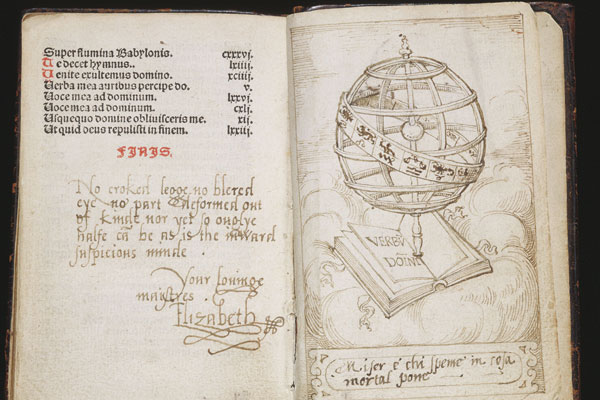
However ordinary a book may appear, it can, on opening, turn out to be extraordinary. One such in the Royal Library is a plain little brown Psalter (book of Psalms) (add hyperlink to:). On the second to last page it has a poem, written in the hand of Elizabeth I:
No crooked legge no bleared
eye no part deformed out
of kinde nor yet so uglye
halfe can be as is the inward
suspicious minde
Your lovinge
mistres
Elizabeth
Facing the neat letters is a drawing of an armillary sphere - a model of the heavens and one of Elizabeth's emblems - balancing on an open book, which a gifted amateur artist added to embellish the words.
Given to The Queen, then Princess Elizabeth, as a wedding present in 1947, this enigmatic book has no title page and no colophon (the publication details at the end of a text), so where and when was it published? Many more questions arise on reading the poem: why did Elizabeth write it and when? Why in this book? To whom was she referring?
This is the only known version of the poem, so it is likely that Elizabeth composed it herself. It is also likely that she did so before 1558, which is when she became queen, as thereafter she wrote 'R' for 'Regina' after her name. However, with no information about whose was the 'crooked legge' or 'inward suspicious minde', we can only guess who it was written for.
When was this book published? Probably before 1538, when we estimate it came to England, because Thomas Becket's name has been crossed out of the calendar of saints' days in the front as commanded by Henry VIII's Royal Proclamation of that year. The date of publication can be further refined by studying the preface, which advocates speaking to God in the vernacular (in this case French rather than in the approved Latin). These are the words of Jacques Lefèvre d'Étaples, who published his translation of the Psalms from Latin into French in Paris in 1525. While this is not the 1525 edition - and there is no other edition listed in any major European library catalogue - we can be almost certain that the Psalter dates from 1525-30.
Why did she write in this particular book? It had been thought to be her own volume, but it seems more likely to be an autograph in somebody else's, perhaps as a mark of favour. There are a number of examples of such inscriptions in books of this period, including some by Elizabeth's stepmother, Katherine Parr, who was influential in the Princess's upbringing. But we still do not know why this book was selected for Elizabeth's inscription.
Sometimes it is impossible to find the truth in history. Though we may have many sources for an event - eyewitness accounts, images, official documents - everybody embellishes and everybody misunderstands. Objects such as books can reflect the many possibilities behind people's actions: despite our conclusions, it could be that this book was just a source of scrap paper for Elizabeth. Sometimes not knowing the answers in history is what is most exciting about studying it.
You can see the Psalter on display at Windsor Castle with other objects from The Art of Monarchy series.
Elizabeth Clark is the Collections Information Assistant, Books and Manuscripts at The Royal Collection

Comments Post your comment