
In Our Time newsletter: The Continental-Analytic Split
Post categories: In Our Time, newsletter
 12:50, Friday, 11 November 2011
Editor's note: This week Melvyn Bragg and his guests discussed the Continental-Analytic split in Western philosophy. As always the programme is available to listen to online or to download and keep - PM.
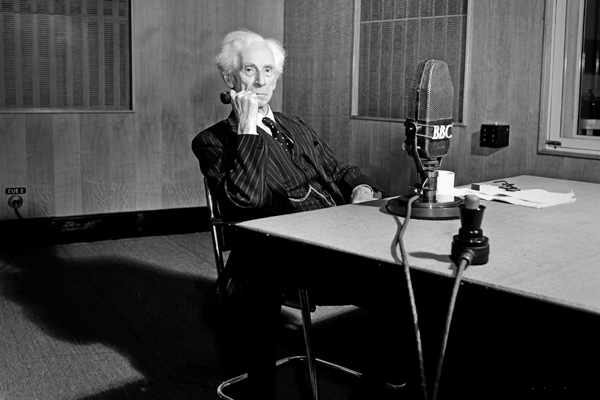
Bertrand Russell in 1953
During today's programme I had a distinct feeling that a quart was trying to get into a thimble.
This is not uncommon, but usually the thimble seems to expand as the programme goes on and, by and large, all's reasonably well that ends reasonably well.
Of course, as by now you know, after every programme the cry goes up "Why didn't we talk about X, or Y, or Z, or A, or B, or C...?" Well, it's because we have forty-two minutes and not three hours is the best answer.
But this programme did seem to be particularly crowded.
Stephen Mulhall, whose opening remarks on Analytic philosophy were stunningly good, I thought, did feel that putting Analytic against Continental philosophy was a mistake.
A better analogue would have been existentialism, say, or phenomenology. Or one or two other such subjects and not the whole Continental drift. On the other hand, that's what we set out to do, and we could and we would have changed it if pressed by those who know the subject better than we do.
It was a pleasure to meet Hans-Johann Glock - he had never been on the programme before, unlike the other two - and afterwards he launched into much more plain speaking about the divide between Analytic and Continental, having been as deeply thicketed as the others about it beforehand!
He also developed the idea of three sorts of arguments in philosophy: the mathematically tested, the legally tested and the poetic method.
Beatrice Han-Pile quoted Foucault: "You can't change a culture without changing its institutions", which I liked, but I can't quite remember what it was attached to, in the rather rushed few minutes while we have a cup of tea and are apprehensive of the arrival of the cavalry of Desert Island Discs.
A new programme possibility did come out of it, though: the notion of "ordinary language philosophy", especially Ryle, Austin and Strawson in Oxford in the middle of the last century, as it were, "supervised" by Wittgenstein. Tom Morris and I have chalked that one down and when we recover from this we will move on.
This is not special pleading, but among the e-mails I've already had (it's just after midday) is one saying that not much was understood, but what an enormous pleasure to hear such brilliant people talking in such a calm, collected way, when everything around seems to be falling to bits.
It made her proud to be in this country! And another saying it was one of the toughest he'd heard, so thank goodness he could hear it again and again.
Perhaps I'm overcompensating, but when Alice Feinstein (whose last In Our Time, in terms of being the editor of the morning series it was - farewell, Alice, you are going two doors down the corridor!) and Natalia Fernandez, who produced this programme, when we spoke we seemed to think that it had delivered what we wanted to deliver which is thoughtful conversation, often in areas that people find very difficult to follow but want to be led.
Instead of drifting down to St James's Park afterwards and looking at the ducks (I did that the last two days - they're all in good form, every single duck of them), I went up the hill to Belsize Park to get my teeth rattled. They're still there. They were jabbed and the gums were criticised, and then the whine of a descaler buzzed around like a hornet in the mouth.
On from there to the Royal Free Hospital to get a blood test, but the queue was so long I would have missed my train (literally - to Southwold for the literary festival). So, another day, another visit.
Off for some sea air now to what must be a contender for the prettiest seaside town in Britain.
Melvyn Bragg presents In Our Time
- Listen to this episode of In Our Time: The Continental-Analytic Split online and find out more about the programme including suggested further reading
- Download this episode to keep from the In Our Time podcast page
- More about the In Our Time archive of podcasts to download and keep
- Sign up to receive the newsletter by email

Comment number 1.
At 17:25 11th Nov 2011, Barcud16 wrote:One point which could have been made in the helpful but broad-brushed contrast of Analytic and Continental, maybe needing no more than two minutes of the forty-two, would be the all-inclusive tendency of the latter, compared with the narrower focus of the former.
It would then be a short step to mention and define a distinctive feature of much Continental philosophy - dialectical thinking. Given its influence on billions of people world-wide, its most famous practitioner, the elephant in the room, deserved more than a single passing reference.
Complain about this comment (Comment number 1)
Comment number 2.
At 21:37 11th Nov 2011, This is a colleague announcement wrote:If possible I always allow myself a lie-in on Thursdays to listen in to IOT. However, this is often a mistake as for some reason, the more interesting and absorbing I find the content, the more I am comforted, and so sent back to sleep.
On this occasion the suggestion that the Continentals would be concerned with questions such as "what is the meaning of life?" sent me down a mental road, stumbling over like structures, such as "what is the pH value of a train journey?" and "what is the protein content of a poem?".
Unfortunately, that's all I can remember until the start of "Book of the Week". Again...
Complain about this comment (Comment number 2)
Comment number 3.
At 07:59 12th Nov 2011, Malcolm Chisholm wrote:I thought the panel did very well, considering time constraints and difficulty of the subject. Of all people, philosophers ought to be the best at constructing categories. But “Continental Philosophy” seems to have no better definition than “philosophy practiced on the Continent of Europe beginning with Hegel”. As such it is a fruit salad of different things, but the name implies there is a commonality – maybe a system or a school – which there is not. A second problem is that Analytic philosophy begins a century later, so the panel sometimes seemed to be comparing 19th Century Continental philosophers with 20th Century Analytical ones. I do not think this worked very well.
Worse yet is the impression that all of philosophy beginning with Hegel falls into Continental and Analytic. That there were a lot of other things going on should have been stated up front by the panel, although these other things might be less popular. Worst of all is that together Continental and Analytic Philosophy have robbed the common man of so much. Three choices were offered at the end of what philosophy today could be – the handmaiden of natural science; part of belles letters; or some attempt at system of knowledge. Traditional philosophy had at least tried to offer ordinary people practical guides to “the Art of Reason” to help them navigate their everyday lives. Today, perhaps largely thanks to Continental and Analytic Philosophers, philosophy is practiced exclusively in Academia by self-referential groups who do not want to offer anything practical, nor add to important conversations of the day – say metaphysical problems that underlie the current financial crisis. What a pity.
Complain about this comment (Comment number 3)
Comment number 4.
At 12:42 12th Nov 2011, John Thompson wrote:If the toast falls are you a toast up or a toast down person,are you a glass half-full or glass half-empty person,are you a fly or a fly bottle?Are you for rigor or for sweep?Melvyn was clear in his no-nonsense approach to keep things simple,once or twice he cut speakers short, because he had not only to move but move on.Some of the speaker’s
explanations left him no clearer or able to follow up what had just been said.Each speaker covered their part of the subject of the split superbly in the time allowed.Hans even noticed Melvyn’s waving hand as if to cut him off from a 3 part summary,just managing to elicit enough sympathy to go ahead.Melvyn ran out of time so couldn’t allow Beatrice,a CP advocate to give her end summary after the other two gave theirs.
This didn’t matter anyway as she had to admit that Continental Philosophy is not even dominant on the Continent and has ‘no home’ on the Continent. Although she gave a good account of Being and Time,the major work of CP,there were notable omissions about
Sartre’s Being and Nothingness,Merleau-Ponty’s Phenomenology of Perception,Ricouer's hermeneutics,Foucault,and Kristeva as well as the contribution to CP of Freud’s psychoananlysis.But what about Husserl a major figure influencing Heiddeger and Merleau-Ponty?He like Freud considered his subject scientific,considered his method rigorous science.His concern with consciousness was epistemological in nature,taking Brentano’s thesis that consciousness is intentional. The ‘activity’ of AP is always stressed like good plumbing,vs.the historicity and synthesis of CP.AP is seen by some philosophers as a problem-dissolving activity,empty of ideas and content.Wittgenstein from Freud’s Vienna saw philosophy as a therapeutic activity,ironing out the confusions in language to get release.Hence his disdain from theory.
We clean the tools using analytic techniques.Russell thought his later philosophy a betrayal of his earlier.However AP had the major scientific brains of Frege,Russell and Wittgenstein and the programme was heavily tipped in its favour.Nevertheless existential issues are not solved by empirical facts and Heiddeger’s approach to prelogical primordial reality kicked CP into place,freeing philosophy from logic.After the division
of the noumenal from the phenomenal realms by Kant,Hegel’s backlash was the precursor to traditional grand meta-narratives and the inclusion of all reality(literature,history,art,etc.)into philosophy’s quest.FromHegel to Sartre has been a totalizing enterprise.After the great idealism of Hegel
Complain about this comment (Comment number 4)
Comment number 5.
At 14:02 12th Nov 2011, Julian Barker wrote:I have listened to nearly all editions of IOT since its beginning. I found this edition on analytical / continental philosophy to have been one of the most satisfying. Like any conversation, the individual and collective qualities of the contributors and the obtrusiveness or not of the host provide much of the enjoyment. Of course the subject is partial and incomplete. The comments made are apt reminders of the limitations to the format. Without entering any thoughts about the content, because that would take longer than the 45 minutes the programme was allotted, I would like to make a practical suggestion: that the programme be offered (if the subject calls for it) in two parts. The second part would be second thoughts and filling in some of the gaps and oversights. There is a precedent: a recent IOT was delivered in two parts. It would be interesting if the second part sometimes called upon the same contributors as the first, and sometimes a second team who might then almost constitute a second first team.
Complain about this comment (Comment number 5)
Comment number 6.
At 14:52 12th Nov 2011, oisinbourke wrote:Well, I loved the programme. I'm currently reading Bertrand Russel's History of Western philosophy and this discussion really helped me understand where Russell was coming from. it also helps clarify the link from Wittgenstein/Russell to Chomsky and lingusitics.
What would seem like a good idea for further programme is the apparent drift in highly specialised, technical analytic philosophy and the more "holistic" philosophy flowing (mainly) from the existentialist
school?
Anyway, great stuff. Things can sometimes be all over the place and utterly wonderful at the same time. Look at King Lear!
Complain about this comment (Comment number 6)
Comment number 7.
At 16:06 12th Nov 2011, John Thompson wrote:(Part 2,got cut off!):-After the great idealism of Hegel and during the ontological discoveries of Heidegger,the rise of existentialism came about.Hegel’s utopian concepts had not seen WWII and the rise of fascism.CP then shows an emphasis on individualism,no longer engaged in a totalizing project.Nazism drove the AP users out of the Continent to the Anglo-American universities,Marxists,social democrats and Jews. Later the clamour for CP courses revived CP in America,but became a term of abuse by AP in England.Russell:
“The rise of analytical philosophy decisively marked the end of the century-long dominance of Kant’s philosophy in Europe”.
Methodology, precision were emphasised, not the unprofitable web of speculative metaphysics.CP was thought of as over assertive,
rhetorical,obscurantist,not sufficiently based on logical rigor or reason. Comment is more important than understanding.Because of its appeal to departments of literature,the humanities, psychology, sociology, anthropology,politics and other subjects,it appeals to many former Marxists,its factional inroads have fostered gang mentality vs. the teaching of the ability to think of AP.CP has made its advances due to the emptiness of AP,its inability to formulate fundamental problems or possible solutions to these problems The history of the subject has to be taught as well as an ability to think,real content as well as explanatory theories,the contribution of the thinking mind to our perception of the world.
By the way Melvyn,you have returned the programme to its former peak
by the quality of the speakers in a difficult subject.However this should have been split into 2 or 3 parts of 42 minutes each.
Complain about this comment (Comment number 7)
Comment number 8.
At 16:54 12th Nov 2011, Barcud16 wrote:I liked Malcolm Chisholm’s very clear overview of the programme and the present climate into which it speaks…but surely better to light a candle than to curse the darkness. If greater philosophical luminaries than he or I are declining to elucidate the metaphysical problems underlying the current financial crisis, then it must be the time for lesser intellectual lights to come out from under their bushels.
And let them speak first of the Autonomy of Representation - of Signifiers without Signifieds, of Presentation, Presentation, Presentation, of Enron and of Northern Rock.
Let them not fear to use the name of the elephant in the room, if so be that his insights are true and valid. Ken Costa, charged by St.Paul’s to speak ethics to the City, was almost word for word Marx in his warning of what happens when money becomes separated from the moral and spiritual foundations that gave it its meaning and purpose.
And then let them scrutinise the culture that has been so eager to embrace the Autonomy of Representation in its many-varied forms – celebrity, marketing, consumerism, the aestheticisation of politics to name but a few – and why its allure has proved so irresistible for so many.
More difficult then, let them unearth, identify and express in contemporary language “The marred foundations we forgot” as Eliot called them in Little Gidding, at a time of crisis to which our present difficulties have been compared.
And let us see if philosophy has anything to say to 21st century Britain.
Complain about this comment (Comment number 8)
Comment number 9.
At 23:52 12th Nov 2011, Paul Gee wrote:There is one philosopher who really did bridge the gap between Continental and Analytic approaches: the Scottish philosopher, John Macmurray. He tackled the big existential issues whilst at the same time searching for the logic forms which could allow us to give expression to what it means to be human. He once quipped that language philosophers were all form and no content, whereas existentialists were all content but no form. Macmurray's approach to logic was highly original and little understood. This aspect of his work is only just beginning to be discovered!
Incidently, Macmurray was also the first philosopher ever to broadcast on the BBC - back in the 30s. He was the forerunner of this programme! He got peak audiences as well. Reith stopped him though.... a little too radical for the BBC! The subject for a future programme maybe?
The story is told here see https://johnmacmurray.org/wp-content/uploads/2011/03/JM-and-the-BBC-Philip-Hunt.pdf
Complain about this comment (Comment number 9)
Comment number 10.
At 00:16 13th Nov 2011, This is a colleague announcement wrote:A problem with analysis per se seems to me this:
There is no apparent basis to assert, that the components into which an entity is analysed will not each in themselves turn out to be more complex than the original thing.
An analogy in maths would be, that the number "one" can be represented as the negative of, the sum of an infinite series, "e": raised to the power of: the ratio of a circle's diameter to its radius, "pi", times the square root of minus one, "i".
This is often a problem I have with discussions of this kind, (even when unconstrained by any approach such as Analytic Philosophy) and would expect others to also, so I would have welcomed a note of caution to this effect early on in the discourse (assuming my concerns to be shared, if they are).
Complain about this comment (Comment number 10)
Comment number 11.
At 15:39 13th Nov 2011, John Thompson wrote:"We need to make a distinction between the claim that the world is out there and the claim that truth is out there. To say that the world is out there, ..., is to say with common sense, that most things in space and time are the effects of causes which do not include human mental states. To say that truth is not out there is simply to say that where there are no sentences there is no truth, that sentences are elements of human languages, and that human languages are human creations.... The world is out there, but descriptions of the world are not."
Richard Rorty,'Contingency,Irony and Solidarity.'
Complain about this comment (Comment number 11)
Comment number 12.
At 21:17 13th Nov 2011, Jack Knave wrote:The programme seemed to me to be a non starter as no one seemed to know what the continentals were about and the obvious answer to this is that the group or classification doesn't exist as a viable entity. Perhaps next time it should be more finely tuned.
Complain about this comment (Comment number 12)
Comment number 13.
At 23:15 14th Nov 2011, Des Brady wrote:Superb programme and so refreshing to hear a group of philosophers behaving so politely and calmly towards each other - rather like a group of bald men simply discussing whether combs exist or not.
No one waving a poker around for a change.
Complain about this comment (Comment number 13)
Comment number 14.
At 08:33 23rd Nov 2011, Edwin wrote:I listened to the first part just this morning in the Metro. Can't wait to go home and listen to the rest.
Complain about this comment (Comment number 14)