
Radio 4 Extra celebrates Roald Dahl
Post categories: Radio 4 Extra, Roald Dahl, children
 13:05, Tuesday, 13 September 2011
Today, Tuesday 13 September, is the 95th anniversary of the birth of Roald Dahl, a hugely popular and prolific writer who has been referred to as "one of the greatest story-tellers for children of the twentieth century". Dahl's memorable and magical books for children include: Charlie and the Chocolate Factory, James and the Giant Peach, the Witches, The BFG and Fantastic Mr Fox.
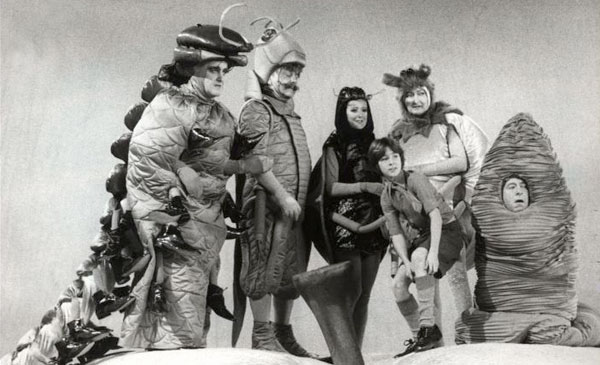
James and the Giant Peach shown on BBC 1 in December 1976. From left to right: Bernard Cribbins as Centipede, Thorley Walters as Grasshopper, Kate Lock as Ladybird, Simon Bell as James, Pat Coombs as Spider and Hugh Lloyd as Earthworm.
Novelist, short story writer, fighter pilot and screen writer, Roald Dahl was born in Cardiff of Norwegian parents in 1916, and he died in Oxford in 1990. Such is the continuing popularity of his work that 13th September is celebrated as Roald Dahl Day in the UK, Africa and Latin America.
Radio 4 Extra's 4 O'Clock Show not only marks Roald Dahl Day, but has also dedicated the entire month of September to celebrating the life and work of this great writer. Roald Dahl Month on 4 Extra features a range of his stories, Dahl-related delights, and archive interviews with the man himself. Coming up on The 4 O'Clock Show is a brand new version of James and the Giant Peach, read by the doyenne of the spoken word, Miriam Margolyes (Ed's note: Starting on 19 September 2011. More info here.) The story has been abridged and recorded especially for The 4 O'Clock Show, and marks an extraordinary 50 years since the book was first published.
Here is Rich's fascinating account of his visit:
When I was young, Roald Dahl was my favourite writer - my mum tells me I knew Fantastic Mr Fox practically off by heart. So I was thrilled to be given the chance to visit his home and see the place where he wrote all of his books.
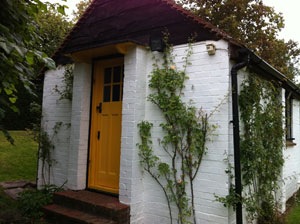
The Fantastic Mr. Dahl lived in Gipsy House, at the end of small country lane in the Buckinghamshire village of Great Missenden. And in the garden, with a bright yellow door, stands Roald Dahl's writing hut.
It was constructed for him by a local builder, Wally Saunders, who many believe was the inspiration behind The BFG. Roald had wanted a place to escape to, where he could be surrounded by his favourite things and simply sit and write. He called it 'my womb.'
You first enter a small ante room filled with large filing cabinets, which were home to his records and early drafts. Then you enter the main room itself, completely customised by Roald Dahl. His writing chair had belonged to his mother, and he'd cut a square out of the back pillow to accommodate an old wartime injury. A suitcase filled with logs is nailed to the floor a precise distance away from the chair. A heater hangs precariously from the ceiling - he used his walking stick to pull it backwards and forwards on wires for warmth. And a sleeping bag lay on the floor - he would pull it right up over his legs so he was totally cocooned. He would then place a roll of corrugated cardboard across his lap, and on top of that would sit his writing table. He would sharpen six Dixon Ticonderoga pencils and start to scribble on his yellow, American-ordered paper.
Roald hung on to things that mattered to him. The walls of the hut are covered in pictures of his family and things that his children had made. On a table next to his writing chair lay all sorts of things... including his own hip joint. Roald had had his hip replaced and the doctor at the time had commented on it being the biggest he'd ever seen - and so he gave it to Roald to keep, which he did. I was able to pick up and hold Roald Dahl's hip bone!
There is also a heavy, grey, metallic ball - every day after his lunch, Roald would have a Kit Kat. The foil wrapper was balled up and, day after day, he would add to the ball. He did this every day for the rest of his life, and the ball ended up about the size of a large, very heavy, ping-pong ball.
I also looked inside a small test tube which contained a Wade-Dahl-Till valve; a device Roald had co-invented following a disastrous accident involving his son Theo, to release fluid building up in a child's head. Although Theo recovered of his own accord, it became a commonly used piece of medical equipment. Another test tube contained shavings of Roald's back from that wartime accident - small grey flecks of bone and flesh. In life, as in his stories, he was as intrigued by the grotesque as much as any child.
Outside in the garden are paving slabs engraved with quotes from Dahl's books. "'Giants are never dying,' the BFG answered. 'Sometimes, and quite suddenly, a giant is disappearing, and nobody ever knows where he goes to.'"
My visit was unforgettable."
Mary Kalemkerian is Head of Programmes at BBC Radio 4 Extra

Comment number 1.
At 15:51 13th Sep 2011, STIG wrote:Yes all very well and part of the country's literary heritage what with chocolate wrappers and well-worn armchairs but come on why should we have to stomp up money to preserve it when the family are thanks to his writing and Sophie Dahls huge success as a model able to pay for it all themselves. If they are that concerned about it then they could recoup the costs by opening the hut to the public and charging an entrance fee. Also maybe the Norwegian government could throw in some cash as they are hardly hard up either.
I think most of the population will be affronted by this plea for cash and rightly so.
Complain about this comment (Comment number 1)