
Innuendo and enlightenment on In Our Time
Post categories: In Our Time, archive, newsletter, podcast
 10:01, Friday, 5 November 2010
Editor's note: Melvyn Bragg, presenter of one of the jewels in Radio 4's public service crown - In Our Time - has been entertaining a select group of his radio audience (38,482 of them in fact) for some years now with his elegant and funny weekly newsletter. It really ought to have a wider audience. So here, for the first time on the blog, is that newsletter. Details of how to receive it in your email inbox are at the bottom - SB.
Every Thursday morning I start listening to Radio 4 at 5.30. This is for the necessary 15-minute run-in to Farming Today, the most cheerful, pessimistic programme on radio or television. Full of resolute persons carefully planting complaints. It is a good wake-up call.
And then at six o'clock there is the dreaded moment. Will John Humphrys be introducing Today? If he is, then I'll have to step up to the plate in some way. No complaints. It's my own plate. I put it there. And he was! But he was in China! I had no idea what the link with China would be - was he doing a documentary or was he part of the general melee of the Today programme? But China! And we are temporarily lodged in Bush House, the centre of world broadcasting in so many languages. I rang up and asked if the Chinese Section could supply a phonetic message to John in Mandarin. They obliged. If I'd taken longer to think about it, I might have worked out that it would be a little more classy to say something other than "How are you? Good day" but nevertheless it was in Chinese. The boob I made was not to translate it. John then replied "xie xie" but, even so, I should have translated it.
Another owning up. I was wrong about Halley being famous when he visited Hevelius. He had not yet become renowned for spotting the comet, which Patricia Fara pointed out had been spotted by Newton anyway. He was, though, an active scientist and a wealthy man - but that's not the same as being famous for spotting the comet. Patricia Fara carefully pointed this out after the programme. Frankly, I'd much rather she'd pointed it out on the programme, then I could have got this apology over with.
There was a little laugh around the table (well suppressed) when I spoke of one woman marrying somebody "for his telescope". For one millisecond In Our Time teetered on the edge of an abyss. It wasn't helped when Judith Hawley went on to talk in passionate terms about a woman standing beside a massive sextant. Where were we going? Of course, we were going on to talk about women in science in the Enlightenment.
Innuendo, very, very occasionally, can be a problem. Last week talking about the unicorn there was much discussion on the meaning of the unicorn laying its head on the lap of a virgin. The carnal implication was never raised, although again there was a ripple of a smile around the table and discussion about it afterwards. I was even too bashful to raise it in my newsletter last week, but clearly it was there. And it would have been interesting to have explored it a little. Except that perhaps there's no evidence for anyone at that time exploring it a little. Perhaps they did not have innuendo in the High Middle Ages? Allegory was supreme.
After that, I walked back to the office which is now in Soho. In fact, I think it's the smallest office in Soho; it certainly has the smallest puppy in Soho! A little curious, after talk of these wonderful Enlightenment women and their fight for equality with men, in their right to study and be recognised for their work in science, to pass down dark passages advertising strippers of all different varieties. It's a funny old world is London.
Melvyn Bragg is presenter of In Our Time
- Listen to yesterday's episode of In Our Time, Women of Enlightenment Science, on the Radio 4 web site.
- In Our Time has been on-air since 1998 and you can listen to every single programme on the web site (the largest online programme archive at the BBC).
- Read and subscribe to Melvyn Bragg's newsletter and subscribe to the podcast.
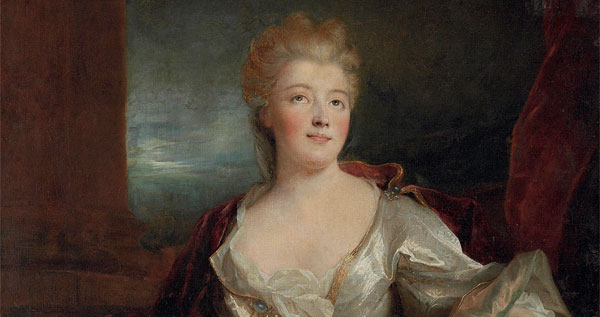
- The picture shows Émilie du Châtelet, Marquise du Châtelet, translator of Newton into French and star of yesterday's programme. It's from the Wikimedia Commons


Comment number 1.
At 21:47 5th Nov 2010, Lawrence Jones wrote:The programme made a dreadful mistake not to invite an engineer to take part in the discussion about complex numbers. Lord Bragg was pleading for some practical examples and the reference to AC current wouldn’t have meant anything to most listeners.
I don’t know if anyone listened to Saturday Review a few weeks ago, but Torquil MacLeod invited the panel to review the BBC 4 programmes about The National Grid. A pat on the back for Mr MacLeod. HOWEVER, it became clear that none of the panel knew the slightest thing about electricity. Elizabeth Jensen had a big cob on and moaned that she still didn’t know how electricity was generated :) :) :)
So, it’s time for an edition that features the history of the UK power network and how it evolved. The programme should explain what all the conductors on an electricity pylon actually do – including the single earth wire on the top of the tower. The concept of reactive – or imaginary – power is a wonderful example of complex numbers in action and could easily be explained on the radio. Similarly, the concept of synchronous generators and ‘stiff’ busbars could also be explained within a radio programme.
P.S. Thanks for being the only person on R4 to ever ask repeated questions about Displacement Current. The panel were very nervous in respect of discussing this great mystery. Hee-hee, you sounded like Charles Chilton!!!!!!
Complain about this comment (Comment number 1)
Comment number 2.
At 20:21 8th Nov 2010, U14679933 wrote:This comment was removed because the moderators found it broke the house rules. Explain.
Complain about this comment (Comment number 2)