
Bringing the voices of the Old Bailey to life
Post categories: 18th Century, London, court, crime, history
 15:45, Thursday, 15 July 2010
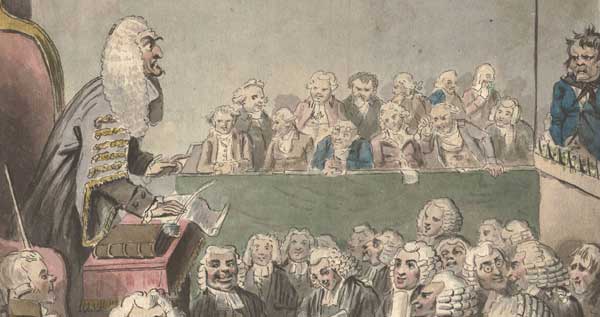
The job of the historian is to make the long dead speak again - we take dusty, unpromising documents and breathe life back into the faded hand-writing. It can be a magical craft, akin to necromancy - trying to communicate with the spirits of the dead. Scribbled love letters, desperate diaries, accounts and lists are all grist to my mill.
But what of the vast majority of people in the past who could not write? The unlettered and unsung. Beneath the tip of the iceberg of literacy, lies the hulking majority who could not record their struggles and successes on paper for posterity. But there was one special place where the words of the poor and the illiterate were recorded verbatim - the criminal court. Read court transcripts and you can hear at last the hubbub of the people.
This is why historians are so excited about court records. At the Old Bailey fifty thousand cases were heard in the eighteenth century alone. A great cast of characters had their day in court, the snooping neighbour, the innocent by-stander, the local gossips, as well as the beleaguered victim and accused criminal. Some are witty, some wily and some wistful - but all reveal the very rhythm of life in the salty vernacular - all taken down in shorthand by the clerks.
The Old Bailey was the principal court for London and Middlesex, but it tried cases from much further afield. London doubled in size over the eighteenth-century from half a million to a million souls. The metropolis drew people like a magnet, from all over the UK, from Ireland, but also from Africa, America and South Asia, as well as continental Europe. It was Europe`s biggest capital, a heaving city of migrants, particularly young women looking for work. The whole country flowed through the city: half of the entire urban population experienced London life at some point in their lives. So, the Old Bailey records are not in any way narrowly London-centred, they are a window on a booming nation.
Historians use the records of the Old Bailey to study criminal justice and the criminal underclass, but you can also use them to recreate work and play, relationships and attitudes, street-life and shopping, the list goes on and on. I am awed by the magical access they give to a world we have lost - and could recapture in no other way. I use them in this series, to offer pin-sharp impressions of ordinary people - under pressure, acting out the most dramatic episode of their existence, sometimes arguing for their very lives.
I first used the Old Bailey Online for my book Behind Closed Doors: At Home in Georgian England to re-imagine the interiors of London lodgings. I looked at theft cases to chart the pans, tea pots and boxes ordinary people had in their possession, and at burglary cases to think about privacy, rebuilding the boundaries that Georgian people, rich and poor alike, sought to defend. However as I read the cases I was struck again and again by the panorama of characters and the juiciness and grip of their stories. Here is the first script for that perennial staple - the court room drama. The dialogue is so fresh. It was just asking to be made into radio.
Professor Amanda Vickery writes and presents Voices from the Old Bailey
- Voices from the Old Bailey began on Radio 4 this morning with episode one of four: 'Highwaymen' (repeated tonight at 2130). Listen again and read more about the series on the Radio 4 web site.
- Search the Old Bailey archive for yourself. See if an ancestor appeared there.
- There are more pictures from the period in the Radio 4 group on Flickr.

Comment number 1.
At 10:24 16th Jul 2010, lilianp wrote:Just to let you know that a book by me on this subject is about to be published Called Upon my Word, it is ISBN978-1-907499 and based around the trial of Elizabeth Canning
Complain about this comment (Comment number 1)