Archives for August 2009

The Living World encounters the Great Bustard

Blog comments are currently unavailable. Find out more.

Post categories: , 

Julian Hector09:01, Saturday, 29 August 2009

Fergus the Great Bustard

At five years old Fergus is beginning to feel like a male, he spent the previous years looking like his mother, distinctly female. He's as tall as a man's waist and testosterone has deepened his voice and developed his brain in a way to give him a greater repertoire of noises. When sexually aroused he can now turn his wings and tail inside out in a big puff of white feathers and inflate a balloon in his neck and erect whiskers near his beak in a display that can be seen by females ffrom over a mile. Fergus is a Great Bustard (Otis tarda) extinct in Britain for 177 years, but no longer.

The down draft from Chinook helicopters make the grass swirl like a turbulent green sea. Soldiers run out of the back door and nearby tanks have cut deep tracks through the grassland plain. The odd boom of heavy guns provides the final military touch to this scene on Salisbury Plain in Wiltshire, the home of the Great Bustard in southern England. This area of chalk downland is "...pretty much as it was..." says Dave Waters, founder of the Great Bustard Group"...thanks to it being a military training ground..." and the first site chosen by the group for the licenced re-introduction of Great Bustards since their extinction in Britain in the mid 1800s.

Fergus will never be released in the wild. He and another older male live in captivity at the Hawk Conservancy Trust on public view as ambassadors of the species. Fergus was hand reared in Russia where there are still wild populations and he was brought back to the UK by Waters. It was this spring he entered sexually maturity for the first time and was screened off from his companion, the older male, who made short shrift of Fergus when Fergus wanted to show him how good a puff ball he can do.

Great Bustards are fabulous looking birds. Arguably the largest flying bird in the world, they have a wing span of two-plus metres and by getting airborne at twelve kilograms in weight they are certainly up there with Mute Swans and the Wandering Albatross. There have been some reports of Great Bustards getting in later life to over twenty kilograms, but at that weight they would be flightless. The closest relative, albeit a distant one, are the cranes, not turkeys as many people think. Their extraordinary display is a visual one, they want to look as conspicuous as possible on the vast grassy plains of Southern and Eastern Europe, where sound on its own is less effective to attract females.

They lek. Lekking is a relatively rare behaviour in the animal world, which has evolved in a few species of mammals, birds and fish - it's basically a marketplace for males to show off their wares. The Great Bustard lives on open ground, and in the breeding season the males exploit every little rise around, and tirelessly puff themselves, directing their glam costume over and above the grasslands. Females drop in and egg them on by their very presence - they are there to shop for genes. It's often the case that the all the females will choose only a few of the males. That's the free market for you. After mating, the males have nothing whatsoever to do with either the female or the chicks. The single chick reared by the female, often from a clutch or two or three eggs will stay with her for about a year, and like her mother, will wander around feeding on seeds and arthropods.

2009 is the first year that Great Bustards have been born in the wild. Lionel Kelleway, presenter of The Living World, saw the chick and mother who presumably incubated the egg, living free on Salisbury Plain. The chick, he said, "...looks like an ostrich." They spotted the head and neck of the mother periscoping above the sea of grass looking "like the Loch Ness Monster" retorted Dave Waters.

Eleven years since the formation of the Great Bustard Project we now have this spectacularly large bird living wild again and what's more, they are breeding. Tentative beginnings - but the county bird of Wiltshire is back and who knows, before long, under their own steam may get back to their other historic strongholds of Yorkshire and East Anglia - But surely it doesn't need to be a military exclusion zone so we can all go and see them.

But Fergus will be there, probably for the next twenty years, to drop in and see.

Julian Hector is Editor of Radio in the BBC Natural History Unit

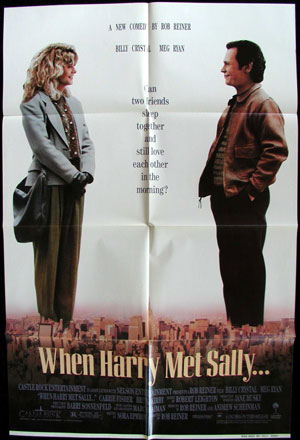
When Harry met Sally at 20

Blog comments are currently unavailable. Find out more.

Post categories: , , , 

Sarah ChurchwellSarah Churchwell18:02, Friday, 28 August 2009

When Harry met Sally

Editor's note - Sarah Churchwell is writer and presenter of yesterday's When Harry met Sally at 20. I asked her to tell us more about her subject - SB.

The only difficult thing about writing a script - or indeed a blog post - about When Harry Met Sally and its place in the genealogy of American romantic comedy was having to stop. Even harder was knowing it would have to be edited for time: my original script would have run over an hour, and we were only given 30 minutes, including clips. The response so far to the final programme has been what I hoped: people on email and twitter saying, "I didn't think romantic comedy would hold up to analysis, but it does." And several people have asked for more discussion of Harry and Sally's relation to the older romantic comedies of Hollywood's golden age. So I thought I'd use this opportunity to expand on a few of the ideas that didn't make the final cut.

Harry and Sally harkened back to the classic screwball comedies of the 1930s and early 1940s, the years before the Second World War changed the game, the films that invented the battle of the sexes as we know it. We mentioned the influence of Woody Allen, and the way that Harry and Sally fuse Woody Allen's late 1970s romantic comedies with an earlier classical Hollywood vision, but there wasn't time to say more. Unlike Allen's specifically Jewish-American comic take on romance, which focuses on Allen's psychodramas, the classical Hollywood comedies of the 1930s to the 1960s were generally WASPy in their characters and culture; in the 30s they were concerned with issues of class and social status; after the Second World War they started playing variations on the Difficult Woman theme: taming shrews, melting the frigid, educating the innocent, cutting career women down to size, and very occasionally teaching a straying man the error of his ways. Woody Allen, by contrast, made romantic comedies about Woody Allen.

Director Rob Reiner and writer Nora Ephron consciously and constantly make references to classic cinema and musical standards of the 1930s, 40s and 50s, visual and aural quotations that remind us of where we've come from and suggest where we're going. For example, the film ironically reproduces the famous split screen of the Day-Hudson comedy Pillow Talk, from 1959, thirty years earlier, in which the film wittily suggested that the lead couple, who could not be shown in bed together because of the Hays Code, were actually taking a bath together by juxtaposing pictures of them in their separate apartments while in the bath.

Reiner shows Harry and Sally in bed 'together' using the same split-screen technique, when they are in separate beds and separate apartments, watching the same film, Casablanca, a film they mention and argue about more than once - and by no coincidence it is the great American treatise on romantic loneliness and the consolations friends can offer: Casablanca finishes, after all, with the end of love and the beginning of a beautiful friendship. When Harry Met Sally finishes with the end of a beautiful friendship and the beginning of love.

As Harry and Sally watch Casablanca together late at night, the split-screen suggests not sublimated or displaced sexual tension, as the 1959 Pillow Talk did, but rather the easy companionship of post-coital 1989 'pillow talk,' of a couple in bed together watching a movie, rather than having passionate sex. Compatibility is key, and one of the things that defines Harry and Sally is their refusal to ever take grief from each other. They become friends at the precise moment when Sally finally hits back: "I just didn't like you," she says, "and you had to write it off as a character flaw, instead of accepting the fact that it might have had something to do with you." Suddenly, Sally is smarter, tougher, less of a straight man and comic butt of the joke than we might have thought. This is not a film that thinks women are stupid or passive - or mysterious, frigid, or threatening.

We noted that When Harry Met Sally marks the last time - to date - that Hollywood made a romantic comedy that was pitched equally at both sexes. Today, we dismiss romantic comedy, derisively as 'chick flicks.' Among other things, this reinforces the idea that only women are interested in relationships, as if only they want to see films about them, when of course love, sex, and comedy are, in real life, abiding interests of both sexes. But in films we assign romantic comedy to women: if it's a chick flick then only women care about love. The chick flicks we're getting today reinforce the stereotype that women are the custodians of relationships, and men are commitment-phobic.

But Harry isn't commitment-phobic: he's coming out of a marriage to a woman he loves. He just doesn't know that he loves Sally for a while. That's hardly a high-concept view of relationships. Harry is confused - but in contrast to the men in the so-called Bromance, he's also not a man-child refusing to grow up. He's a functioning, successful professional: both Harry and Sally are grown-ups. Ironically enough, this makes When Harry Met Sally a throwback - and one of the many reasons we still love it.

Sarah Churchwell is senior lecturer in American literature and culture at the University of East Anglia

Paul Lewis's week

Blog comments are currently unavailable. Find out more.

Post categories: , , , , , , 

Paul LewisPaul Lewis13:26, Friday, 28 August 2009

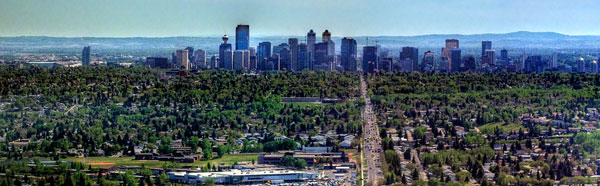
Calgary Downtown by Evan Leeson

Pitot tubes. Until recently I had never heard of them. But as we headed from Calgary to Toronto on an Airbus I wondered if they were icing up as the outside temperature hit minus 40 - that low, C or F is the same.

Iced up pitot tubes feeding the wrong information to the onboard computer are the leading explanation for why the Airbus A330 on flight AF447 plunged into the Atlantic between Rio de Janeiro and Paris on 1 June. The false readings confused the computer which mishandled the plane and passed control to the humans. They could not save the aircraft so close to its tolerances in turbulent storms above the Equator. Airbus has now advised upgrading all pitot tubes even though it insists there was nothing wrong with them.

Until then I had taken comfort from the fact that modern jetliners are flown by computer. Even the pilots admit it. Two weeks earlier as we approached Toronto from London the First Officer talked us through the weather and the time at our destination, then added 'we will shortly begin our descent into Toronto in about, ooh, five minutes the computer says.' Relax, First Officer, we'll be down before the Captain has finished his Sudoku.

So I kept a look out for ice on the sharp bits of our Airbus 320-1 as we sped away from Canada's West.

Ah the West! We had said goodbye to the Rockies the day before, driving East on the trans-Canada Highway (two lanes and warnings of elk crossing though we saw none). We over-nighted in Calgary, a city of a million folk and, gosh, a hundred years old or more. It turned out to be a weird place with little to see - and less on Mondays as the Art Gallery is closed. But we stumbled upon a secret none of the guidebooks mentions. Calgary has the best restaurants and bars in Canada. We had struggled to find either so far. But Calgary's 8th Ave SW has a string of them.

Lunch was an Atlantic burger (a wonderful Canadian invention for us semi-veggies which wraps a bap round a North Atlantic salmon fillet) with chips to die for and a light Caesar salad in the Trib Steakhouse. The local house wine, carefully measured in ounces and served in very large glasses, was fruity and rich.

Then to the museum which filled half the afternoon. Not least because the official panels explaining the exhibits, which took us back through a hundred years of the West, were paralleled with alternatives from the point of view of the Aboriginal peoples (as the First Nations or Native Americans now want to be known). Reading them thoroughly was my expiation as a visitor from the nation which had stolen their country.

A short walk to the Bow River, the rapids and canyons we had marvelled at in the West now calmed into a placid highway for timber. Then two beers at the Barley Mill Eatery and Pub, converted from the Calgary Water Power Mill and the wooden office of the Eau Claire and Bow River Lumber Company. More walking and then the search for dinner took us back to 8th Ave SW where we happened on the Mango Shiva. The food was perhaps the best Indian food we had ever eaten and the thin, crisp, buttery Nan bread certainly so.

Why, I asked our server Sharyse, were there so many good bars and restaurants in Calgary? A pause. 'Our demographic is, well, we have a lot of drinkers.' Her voice went up at the end in the rising inflection that nowadays adds emphasis to a statement. And it sits on huge oil and gas reserves. 'It's a very wealthy Province' she added.

The flight from Calgary to Toronto was the day before the flight from Toronto back to London and counted as the journey home. So my thoughts were allowed at last to turn away from waterfalls and glaciers and lakes and mountains and the complete absence of bears to money and the day job. There was plenty of time. What was scheduled to be a three and a half hour flight began with nearly half that rolling round the tarmac at Calgary airport. Problems with the cabin lighting would have left the toilets dark and several soft resets by the crew failed to cure the problem. We went back to the pier and took on a maintenance engineer whose orange jacket brought the lights back to life.

The young man next to me with blond hair, frayed jeans and walking boots, who was already so late he would miss his connecting flight, cheered himself up by reading the death notices in the Calgary Herald. I spent the time absorbing the business sections of the newspapers and magazines. In the press there was a long debate over whether the regulation of financial services should be principles-based (treat customers fairly) or rules-based (do this, don't do that).

Canada is moving to the former just as the UK is moving away from it to the latter. A Ponzi fraud was revealed, smaller than Madoff (of course) but just as devastating for its hundred or so victims. Controversy raged over the disposal of the bankrupt telecoms company Nortel and who bid what for it, when and to whom.

Half way through the flight the near-bankrupt Air Canada, which charged a hefty fare for the flight, now made us pay again for less-edible-than-usual cold snacks. No-frills service at flag carrier prices. It could be a slogan.

I moved on to pages about the Canadian pension crisis. Salary-related schemes closing, some being dumped (with no protection scheme in place) and Canadians being accused of spending too much and saving too little for too long. I could have been home already. That was followed by an analysis of why fund managers in the large public sector schemes had made such big losses on the hundreds of billions of Canadian dollars entrusted to them. The three largest lost 19% or C$72 billion off their C$385 billion assets in the last year because their active managers prefer to put the money at risk in shares rather than keep it in safer bonds.

Defending this approach Jim Leech, the CEO of the Ontario Teachers' Pension Plan which lost C$20 billion, said 'The fact of the matter is we have to take on risk to meet our pension promise.' Oh Jim! If taking a risk guaranteed those extra returns you need so badly it wouldn't be a risk would it? The risk is you may lose another C$20 billion. Perhaps Toronto teacher Kelly Alles should be put in charge. 'A high return is great' she told Canadian Business 'but when it comes right down to it I'd rather have a guaranteed lower return'.

And before I knew it we were landing at Toronto. Another journey survived. Only six more hours on the flight to London to watch out for ice on those pitot tubes.

Dramatising the Lockerbie trial

Blog comments are currently unavailable. Find out more.

Post categories: , , , , , , , , 

Jeremy HoweJeremy Howe11:06, Friday, 28 August 2009

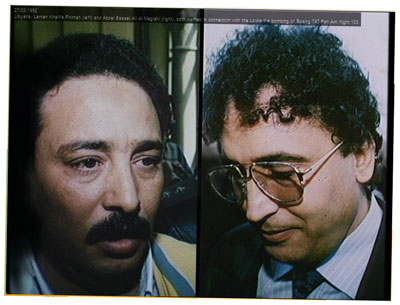
FhimahMegrahi.jpg

Steve (editor of the Radio 4 blog) asked me if we had any interesting material about the genesis of the Lockerbie on Trial programme that I co-produced with Margaret Renn back in 2001: court transcripts, etc. that he could use on this blog. I thought my offer of sending him the nearly 10,000 pages I have on file was a bit cheeky, but it did prompt me to recall the crazy days we spent in producing the programme.

It was an extraordinary trial and it seemed to me that one way of getting to the bottom of the story was to do a dramatised reconstruction of the trial itself, to get the feel of the court and the barristers, the judges and the gallery of witnesses, some of whom appeared to be characters straight out of a spy novel by John le Carré, and all in their own words. We wanted to tell the whole arc of the story. Slightly insanely I also persuaded Radio 4 that we should try and broadcast the programme while it was still in the news. Of course the problem with that was that no one knew when the trial would end: the transmission date, and therefore the production date, was a completely moving target.

Margaret, Peter Goodchild (the writer) and I had been tracking the story for months: the court sat for 84 days, commencing proceedings in May 2000 with long breaks for adjournments. Peter digested the daily transcripts, but by Christmas there was no end in sight. Then in January things changed, and events moved pretty rapidly when the defence teams announced that they would be offering no further evidence. Instead of having several months to gear up we had several days. What had been an ambitious programme idea looked alarmingly like it might become very real very fast. Which made me feel physically sick.

I remember sitting in a café in Bristol on the Wednesday the verdict was announced. The three of us calmly discussed the release of Fhimah and the conviction of Megrahi, and working out how we would put the programme together. All the time I was thinking how on earth do we write and make a drama which had been given a 90 minute transmission slot in just under three weeks time? Had I gone completely mad? Small matters like Peter needing to make informed decisions on which 9900 pages of transcript to junk and which 90 to keep in, decisions which needed to be made by the weekend.

It didn't help Peter that the verdict was not exactly what we had been expecting - in short we tore up all our homework and started almost from scratch. It was a long lunch. Apart from booking a studio for a three day record and a three day edit the week after next, and starting to think about casting a dozen or so actors with a variety of accents ranging from Scottish to American via Maltese, Libyan and Eastern European, there was precious little I could do until I had a draft script. I left early as I had to write the programme billing for the Radio Times to meet their deadline that afternoon: as a drama producer I do find it helps to write these things once the programme has been finished, not before I had started.

Now I had long preached how drama on radio could be reactive to news stories in a way that television could not, because of the very short production process radio drama has, but I had never actually made anything this fast. It felt like I had put my head on a block and had invited someone to chop it off. In public. I kind of think you need a fear factor to make an outstanding programme. But this was fear factor 10.

If I am an honest, making the programme was like making any other: the budgetting, the casting, the scripting, the scheduling, getting the logistics right - except none of us got any sleep, we all traveled at the speed of light and there was never an opportunity to deliberate over decisions. All this was tempered by the fact that the three of us felt an enormous duty of care to the victims of Pan Am 103, to their relatives and to the huge number of people who had given up their lives to bring this case to justice. We had to get it right.

Peter delivered several drafts of the script, with Margaret (a journalist) giving him notes on accuracy and nuance and me (a drama producer) giving him entirely contrary notes about the dramatic thrust of the storyline. Amazingly he never shouted at us. Miraculously we kind of had a cast by the time we started recording less than a fortnight after our Bristol lunch date, and the completed programme was biked over to Radio 4 with two days to spare before broadcast.

And listening to it again I am still very proud of it - not because I think it is a good programme or that we did it so fast - but because I believe we had done the story justice.

  • BBC News Online's special feature on Lockerbie from after the appeal in 2003.
  • Lockerbie on Trial airs in the Saturday Play slot at 1430 tomorrow. You'll be able to listen to the programme here for seven days after transmission.
  • The picture, captioned 'Libyans, Lamen Khalifa Fhimah (left) and Abdel Basset Ali Al Megrahi (right), both wanted in connection with the Lockerbie bombing of Boeing 747 Pan Am flight 103' is from the BBC's picture library.

Justin Webb on his first Today appearance

Blog comments are currently unavailable. Find out more.

Post categories: , , 

Steve BowbrickSteve Bowbrick13:47, Thursday, 27 August 2009

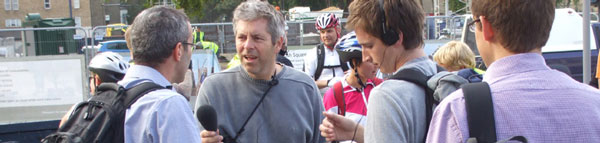
Justin Webb interviews bikers

Justin Webb, until recently the BBC's North America Editor, arrived in the Today studio this morning for his first appearance as a permanent presenter of the programme (he's filled in once or twice in the past). We asked Chris Vallance to talk to Justin - exclusively for the Radio 4 blog - about his first appearance and about the benefits of working with John Humphrys.

Chris started by asking how it had gone:

In order to see this content you need to have both Javascript enabled and Flash installed. Visit BBC Webwise for full instructions

Treating radio 4 output as data

Post categories: , , 

David Rogers15:38, Tuesday, 25 August 2009

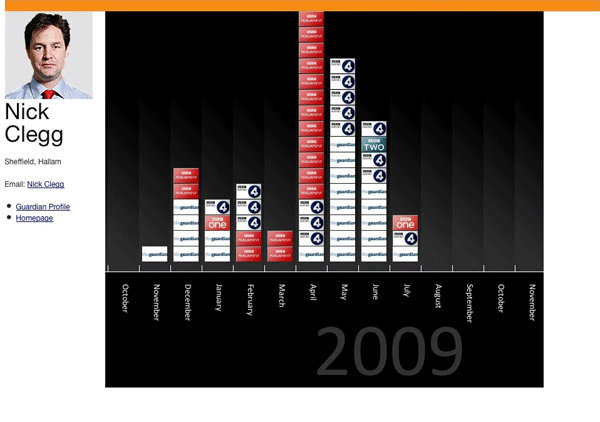
Editor's note: BBC techies have been working with their counterparts at The Guardian and elsewhere to build new sources of data - in this case data about the media appearances of our MPs - SB.

mps_appearances_600.png

At the end of July the Guardian held an internal hackday at their offices in King's Cross. They invited two engineers from BBC Radio's A&Mi department, Chris Lowis and David Rogers. We teamed up with Leigh Dodds & Ian Davis from Semantic Web specialists, Talis to produce an 'Interactive-MP-Media-Appearance-Timeline' by mashing up data from BBC Programmes and the Guardian's website.

Before the event Talis extracted data about MPs from the Guardian's Open Platform API and converted it into a Linked Datastore. This store contains data about every British MP, the Guardian articles in which they have appeared, a photo, related links and other data. Talis also provide a SPARQL endpoint to allow searching and extraction of the data from the store.

Coincidentally, the BBC programmes data is also available as a linked datastore. By crawling this data using the MP's name as the search key we were able to extract information about the TV and radio programmes in which a given MP had appeared. A second datastore was created from the combination of these two datasets, and by pulling in some related data from dbpedia. Using this new datastore we created a web application containing an embedded visualisation of the data.

Continue to read this post and leave comments on the BBC Internet blog, where it originally appeared.

.

Sarah Mukherjee's week

Blog comments are currently unavailable. Find out more.

Post categories: , , , , , 

Sarah MukherjeeSarah Mukherjee15:33, Friday, 21 August 2009

Conker

There are many advantages to working in August.

True, while many of our colleagues (and listeners) are battling with dilemmas like "white or red?", "pool or beach?" and "if I eat anything else for breakfast, will I still be able to get into my swimsuit?", I am trawling through websites, specialist journals and my contacts (those who are left at work, anyway) to see what stories they may have that we can get on air.

But while London can be, like any big conurbation, rather oppressive in hazy, sticky summer days, you can at least get a seat on the train, the queue for coffee is mercifully short, and anything story you turn your hand to will have an excellent chance of getting on.

I've been a broadcast journalist for twenty years now, and every year it's the same. There is often, sadly, one overwhelming story that happens in August - the death of the Princess of Wales, or the murder or the two little girls from Soham (both of which I covered).

But lower down the running order, there's an interesting shift in editorial standards that takes place at about the end of July. A gradual descent downwards, hurtling towards the bottom of the barrel at about this point in the summer. Part of the job of a specialist correspondent is to advise the outlets we serve about the merits of a story. But no-one wants to hear "we've done it before" at this time of year - there are still hours of airtime to fill, and not a lot with which to fill it.

But if you manage to dodge the pleading emails from output editors, August can be a fantastic time to prepare for the big stories later in the year. So much of modern day journalism can feel like a bit of a hamster wheel. Within a day you must take calls and read emails from contacts, mobilise resources, book crews, check equipment (when I do radio slots for the Today programme it's me and a satellite dish, no back up, so it's vital to make sure it's working before you leave), talk to editors, and research and turn around a story at lightning speed. So the chance to lift your gaze towards the horizon at quiet times is enormously helpful.

Yesterday, I and producer Nora Dennehy took a trip up to Sandy in Bedfordshire, to the headquarters of the RSPB, to talk to their experts about illegal bird hunting, here and in the EU, and about the effectiveness - or lack of it - of the European legislation designed to stop the practise.

Much of our planning time is now being devoted to a big UN meeting in December in Copenhagen, at which - it's hoped - there will be a global deal to reduce in the future the carbon dioxide emissions that the vast majority of scientists believe are causing climate change.

My big concern is how we are going to cover a story that involves lots of people talking impenetrably to each other in a large conference hall, and cover it in a way that makes it relevant to our listeners, explains what is going on and considers the difference it could make to us all. Already there are some very highly placed people I've been talking to who think such a deal is too much to ask in the time available - so we already have to ask the question: what happens then?

One of our ideas it to take a van that runs on chip fat around the UK to visit some low-carbon projects and schemes that are actually up and running. It's obviously a big commitment, financially and logistically, for the BBC, so we've been talking this week within the department about how viable it would be.

But before I think about covering talks designed to save the planet, I need to check out a story about a UK-wide early conker harvest, and conker-killing beetles that seem to be travelling by car. August may always be quiet, but the variety of stories that cross your desk as environment correspondent never ceases to surprise me!

Sarah Mukherjee is BBC environment correspondent.

Read the manual? Never!

Post categories: , 

Rory Cellan-Jones10:54, Friday, 21 August 2009

Pram instructions

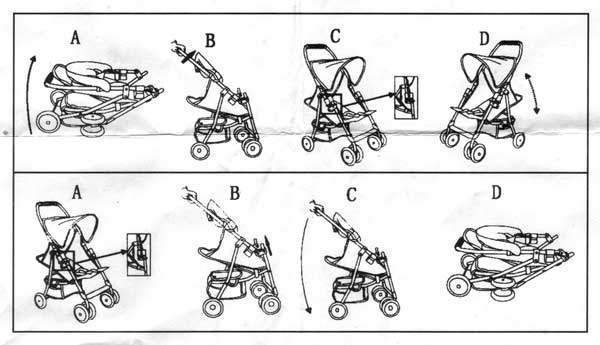
Ever been on an online discussion forum to inquire about some technical problem you're trying to sort out? Then it's quite likely that after a while you will have received a terse message from some smart-alec, which will end with the acronym RTM, followed by a number of exclamations marks. That apparently stands for Read The Manual! - and in fact the acronym usually includes the letter "f" placed before the "m" to supply added emphasis.

Well, sorry, I'm not going to read the manual, as I explained to the makers of a charming Radio 4 programme which you can hear this morning at 1100...

Read the rest of Rory's post and leave comments on the BBC Technology blog. Listen to the programme, which includes an interview with Rory, here.

Now Show geography

Blog comments are currently unavailable. Find out more.

Post categories: , , , , 

Mark DamazerMark Damazer16:47, Thursday, 20 August 2009

Now Show world map

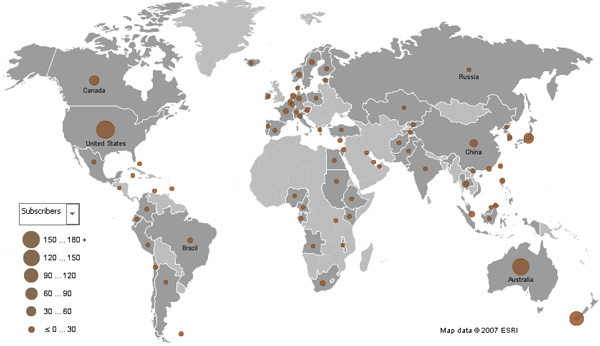
I went to the recording of The Now Show last Thursday night - the last of the current run. It's recorded at the Radio Theatre in Broadcasting House. Free - and a very jolly evening can be had. The News Quiz also records there - as do a lot of other BBC shows. Click here to find out how to get tickets. In the previous week's podcast (but not on air) the team asked listeners outside the UK to email with their (personal) big news. We got a lot back - and used some of it in this week's show. I am indebted to the producer - Ed Morrish - for the geographical breakdown.

  • When The Now Show asked for news from listeners around the world, 621 podcast subscribers replied, from 72 different countries. The most remote was South Georgia (lumped together with the Falklands on the map) and furthest away Stewart Island, New Zealand, 11,828 miles from the Radio Theatre.
  • We used Many Eyes to visualise the geographic data. The visualisation is here and the raw data here (CSV file). Many Eyes doesn't recognise Antarctica, Easter Island, South Georgia or Tibet as separate countries, although listeners from all four emailed the programme).
  • The Now Show is off-air at the moment but you can still listen to the most recent episode and subscribe to Radio 4's Friday Night Comedy podcast.

Test Match Special

Blog comments are currently unavailable. Find out more.

Post categories: , , , , 

Mark DamazerMark Damazer08:50, Wednesday, 19 August 2009

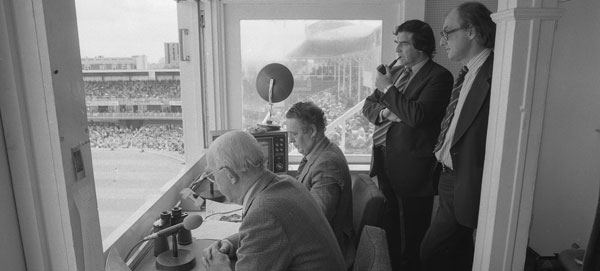
Alan McGilvray, Trevor Bailey, Freddie Truman, and Henry Blofeld, Test Match Special, Lords 1981

Test Match Special is a favourite programme. I first started listening more or less forty years ago. I remember not only the wonderful Arlott and Johnston - but Alan Gibson and Don Mosey and Alan McGilvray and EW Swanton. Like many others I turned down the TV commentary to listen to TMS - unless Richie Benaud was on TV duty.

That is a bit harder to do now as Sky (who do a very good job I rather think) and TMS are not in perfect sync. Alas.

Of course everyone with an interest in cricket and/or TMS knows of the Brian Johnston corpsing moment - or should that be corpsing minutes. I was listening live at the time. But I have other favourite moments. I do this next bit from memory - and someone out there correct me if this is wrong - but I recollect a New Zealand batsman in the 1970s (perhaps Bev Congdon?) making two successive huge hundreds. John Arlott asked Trevor Bailey what were Congdon's weaknesses. Trevor Bailey replied... "He loses concentration when he gets to 170." Very fine.

Why is TMS so good? Because it is about metaphor and simile - about literature and art, about weather and place - about food and drink - as well as about a great game (though not necessarily a better game than baseball - but that's another story). And we are always looking for the perfect balance between the sporting ingredients and the other delicacies that surround the cricket. Everyone has a different opinion about what that balance should be... and it is an art form. We must not miss a ball but it would be a mistake not to let the team go off piste.

We are in good nick at the moment. The programme of course is now online and on 5 Live Sports Extra but it will long stay a defining part of R4's culture. It will not be a sports commentary programme alone. I am going to see the TMS team on Saturday morning at the Oval. Let us hope the match is still alive at that point. I have an Australian wife and my children have Australian passports and some of them will be with me. I do not know whether I am impartial. I would not wish to fail the Tebbit test. So I shall pray for Freddie's knee.

"The most extraordinary thing I've ever been asked to do"

Blog comments are currently unavailable. Find out more.

Post categories: , , , , 

Steve BowbrickSteve Bowbrick18:30, Monday, 17 August 2009

Kathy Clugston, the posh Radio 4 lady

You'll know Kathy Clugston's voice. She reads the news on Radio 4 (and plays the ukulele). Knowing her as you do, you probably won't be surprised to learn that she's now a star of the Edinburgh Fringe too. She's just returned from a week in Scott Mills the Musical - the unlikely hit that David Hasselhoff calls "a true story, apart from the facts" - in which she reprises her on-air role: the posh Radio 4 lady. Listen to her exclusive report:

In order to see this content you need to have both Javascript enabled and Flash installed. Visit BBC Webwise for full instructions

Nice work..

Blog comments are currently unavailable. Find out more.

Post categories: , , 

Caroline RaphaelCaroline Raphael17:45, Monday, 17 August 2009

Edinburgh parade

To the person who commented on my Latitude blog post, 'nice work if you can get it', yes, it's fantastic work. And not just because I'm writing this on Sunday morning on the train to one of the most beautiful cities in the world, Edinburgh. I'm working in Scotland for the next fortnight. We are recording a raft of comedies, Front Row, Loose Ends and some readings from The Pleasance as part of the Edinburgh Fringe.

Every show is 'full' so about 5000 people will get a chance to watch the recordings; they sold out very fast, but if you happen to be up there and would like to come to a recording we do create a standby queue. As the tickets are free people don't always turn up or don't use all the tickets they requested so we can very often fit you in. Full details are on the Edinburgh Fringe web site or come and find us in the Pleasance courtyard. I'll be there with Lea Lauvray and Gill Carter who are managing the shows with me and we will be sporting incredibly bright pink tee-shirts with BBC Radio 4 splashed across them with an amusing quote from R4 star and Fringe doyenne Arthur Smith and hopefully not looking too bedraggled. Because we are in a fully functioning city the planning is less extreme than for a music festival in a field however, of course, it will still rain. But the venues are usually boiling hot so you steam dry quite quickly.

Radio 4 has been broadcasting from the Fringe for about 15 years if not more. It is important for us, as home of Radio Comedy, the place where some of the biggest names in British comedy started out, to be there both as participant and audience. Programmes such as Today, Front Row, Saturday Review and others look across the breadth of events and report back on this truly extraordinary cultural event.

Planning which shows will be available to broadcast, creating new ones especially for the Festival, programming them so that each has just enough rehearsal time, the outside broadcast team have time to do the technical turnaround and we can get audiences in and out, sorting out the precise venues and the tickets with the Pleasance and the Edinburgh Fringe Box Office (endless forms and proof checking) and then making sure that each programme does not end up booking the same talent and completing the Health and Safety procedures all starts in early January and finishes just before we come up here.

Between the recordings I go and see a lot of comedy. In previous years I have seen about 60 odd shows. I liken it to a squirrel harvesting for the winter. The comedy producers and I will find ourselves referring back to this year's performances till next August. The performers have worked incredibly hard to get their show into shape and for many this is as good as they are going to get for the next year or so, they are in peak condition and so this is the time to see them. It wasn't always like that.

This is my 31st consecutive year at the Festival - I started stage managing and lighting shows and then directing them as a Manchester University drama student in the days when students could afford to come to the Fringe and you could sleep on the floor of your venue - and in the olden days you knew some performers were still in rehearsal mode for the first ten days or so. You can't do that anymore. It is a showcase, a jolly expensive one at that, and the acts need to hit the ground running to get good early reviews, ensure sell out shows, happy audiences who can be paying upwards of £8 a ticket, as well as charm the broadcasters and woo the judges of what was the Perrier Award, then the if.commedie award and is now the Edinburgh Comedy Award.

And this year that's me - as I've been asked to be on the judging panel. I arrive in Edinburgh at about 1.30 and by ten tonight I will have seen my first five shows. We make the final decisions as to the winners in a fortnight so lots and lots and lots of shows to see first.

Quentin Cooper's week

Blog comments are currently unavailable. Find out more.

Post categories: , , , , , 

Quentin CooperQuentin Cooper15:10, Friday, 14 August 2009

Quentin Cooper, BBC Radio 4 presenter

Editor's note: Quentin sent me this update to his blog post this morning - SB.

Look, the thing about blogs is they're the almost unedited brain-to-webpage outpourings of whoever writes them and although I thought "Star Trek II - The Wrath of Khan" which is one of the most fun in the series, unfortunately I typed an extra "I" which made it Star Trek III which, as any fule know, is pretty rubbish. My error was not noticed until blog-readers started pointing it out. I am suffused with shame..."

Now read on:

Swine flu has arrived in Dubrovnik. Two passengers on a cruise ship are showing symptoms. So how should the authorities respond? The press - including me - are summoned to a large meeting to hear what's been decided: 30,000 face masks will be made available (Dubrovnik has a population of only around 40,000); curfew will be enforced; all gatherings including football matches to mass are cancelled. Although not - as I point out through barely-suppressed laughter - this one. Clearly the press are expendable.

As you might have guessed - this was an exercise (it worked as a trick opening for Star Trek III so I thought it was worth trying for a Radio 4 blog post). The bad news was that I was watching scientists from across Europe make a right pig's ear out of trying to deal with a simulated swine flu scenario, suggesting a strategy that would have turned a small-scale problem into a full blown panic.

The good news was that this was taking place in the real Dubrovnik, a stunningly beautiful city I'd last been in before the 1991 siege and which is now back looking better than ever. I'm mentioning this not only because I've hugely enjoyed being at these science communication workshops in Croatia attempting to explain the workings of the media, but because I think some Radio 4 listeners imagine that for once-a-week programmes like mine, presenters are kept in a freezer between shows, thawed out just before transmission and returned there as soon as we are off air.

Material World takes up roughly half my week - preparing, researching, scripting and coming up with puns most but not all of which never get past my producer. The rest of the time I'm usually running around between conferences, other (lesser) programmes and the odd bit of more exotic work like these Dubrovnik workshops.

This was something aimed at senior figures who were supposedly already fairly media-savvy. Many were - but what I found alarming was how there remain some people high-up in science and science policy who are adamantly antediluvian in their thinking that it's entirely the public's own fault if they don't understand scientific issues or can't work out what a scientist is waffling on about. During our mock press conference on the swine flu outbreak one of them protested that "this isn't about science communication, this is about thinking on your feet" - as if helping science reach people doesn't involve responding to people and situations.

This is something which used to be a minor passion and that I'm now - including right now - at the risk of becoming a major bore about: I fervently believe that science shapes all our lives, that everyone has the right to at least a basic grasp of how, and that if you can help people past their prejudices that science is boring and/or incomprehensible, there's myriad fascinating and life-enhancing stories to tell. So it really gets my goat and other metaphorical livestock when I run into those - like one or two of the scientists in Dubrovnik - who blame the media, the public and everyone but themselves for a lack of wider scientific appreciation.

As I said - I can bore about this at length, so best leave it there even though this has been a big part of my week, like it is most weeks. That aside - apart from the continuing strange sensation of being a Manchester City supporter on the edge of a new season where the mountain of cash is overshadowed only by the mountain of expectations - I'm in recovery from 6 weeks of the 'visualisation' of Material World.

In case you missed it - and the vast majority did because it's a radio programme usually listened to via radios - this was a pilot scheme to give added visual content to for anyone hearing us live via their computer. Some people loved it, some hated it, and some liked it but found it got in the way of all the other things they usually do while hearing us live via their computer. That mixed response aside, the main focus seemed to be my physical appearance. There was a lot of guidance on my terrible posture, comments pro and anti my lively gesticulations (I wave my hands more when broadcasting than in real life, discuss), and - despite having my photo on the website - widespread disappointment at what I look like. My favourite was the backhanded compliment that came in during the final week of visualisation: "Quentin's not at all like I imagined. Great voice though".

Quentin Cooper is presenter of Material World

  • The next edition of Material World is on Radio 4 at 1630 tomorrow. It's a live programme. The programme archive is here and the podcast is here.

Being multiplatform

Blog comments are currently unavailable. Find out more.

Post categories: , , 

Jennifer ClarkeJennifer Clarke17:30, Wednesday, 12 August 2009

multiplatform

It used to be so simple when people asked what I do. "I work for the BBC," I would say. "I'm a radio producer, making programmes for Radio 4." Simple.

But since last summer, it's not been quite such a straightforward question to answer. "I'm a senior multiplatform producer." Cue puzzled look. Producer is fairly self-explanatory. It's the multiplatform bit that confuses.

I'm a member of a small team that's part of Radio Current Affairs. We make a number of long-running series and one-off current affairs documentaries, for, er, radio - mainly Radio 4, Radio 5live and the World Service, but also occasionally for Radio 3, the Asian Network and 1Xtra. (When we're not fending off fox attacks of course).

Our programmes include many Radio 4 stalwarts like Money Box, File on 4, From our Own Correspondent and In Business, along with younger series like More or Less, The Bottom Line and 5live's Donal MacIntyre. Plus lots of specials such as the recent Reith Lectures, the current three-part series on the history of MI6 A Century in the Shadows, and the forthcoming four-part series Robert Peston and the Moneymakers.

Our output is incredibly rich and diverse. And the multiplatform team's job is to make the most of it, and find new outlets for our journalism across the rest of the BBC.

This could involve anything from making a shorter version of a documentary for The World Tonight, or Woman's Hour, setting up an interview with one of our reporters on Today or 5live Breakfast, or liaising with colleagues on the Asian Network, the World Service or Radio 1's Newsbeat to enable them to produce their own pieces from our content.

Despite being a radio department, we also increasingly generate material for television as well. Our reporters regularly pop up on the News Channel to talk about our stories, often accompanied by clips which we have filmed as well as recorded for radio - as was the case for this interview which Simon Cox did with Dignitas founder Ludwig Minelli for The Report

We've also made short television 'packages' for BBC Breakfast - such as this investigation into the controversial Yes Loans company.

It was filmed and edited by my fellow multiplatformer Ruth Alexander, at the same time as the reporter Samantha Washington made a radio 'package' for Money Box and a separate item for Radio 5live's Donal MacIntyre programme, also part of our department. Another shorter version ran in radio and television news bulletins.

Why? The answer is simple. It enables us to get much more bang for our - or rather, your - buck.

And that's before we've talked about the web, which is another crucial platform. As is often the case, the Yes Loans story, was also written up for the BBC news website.

It has almost ten million unique readers in an average week, and so is a supremely important target for our programme material.

We therefore spend a lot of time liaising with our colleagues in the different sections of the news website - especially The Magazine - to try and tempt them to commission articles from our reporters and producers.

We don't just turn our content into written features either. We also make picture galleries - such as this one from a Crossing Continents programme about life in a Mumbai slum.

Our programmes have also generated fantastic audio slideshows, such as this one - inspired by a Radio 3 documentary about Yiddish's struggle for survival.

More slideshows accompanied our 90-part (yes, 90) series for Radio 4 America, Empire of Liberty - all still available online (David Reynolds wrote about the series for the blog).

And that's not to mention the time we spend making sure all our programmes are present and correct across the BBC's digital landscape, be that on the Radio 4, 5Live or World Service websites, or the iPlayer or in the podcast directory. And not forgetting our work with sites beyond the BBC, such as Twitter, which I've already discussed here.

The common thread which runs throughout all this work is that, er, it involves a great deal of extra work. Many of our programmes are made by one producer and one presenter - often the same person wears both of those hats. Asking them to wear an additional multiplatform hat is tricky.

Getting our content onto other platforms is not a copy-and-paste kind of operation. In every case the journalism has to be re-imagined for a different medium and/or a different audience.

Although we always hope to bring people back to the original programme, each separate audience has to be satisfied by the version of the story which they receive - wherever and however they get it.

Our job is to make that process as efficient as possible. To help achieve this, I've spent much of the last year on an extended training boot camp, learning to shoot and edit video, make pieces for television, produce content for the web and more.

Along the way, I've had to get to grips with a frankly bewildering range of different (and often mutually incompatible) systems: from CPS and IPS to APS and PIT, from Jupiter and Q-cut to Premiere and VCS, and not forgetting Top Cat and (of course) Top Cat 2. And no, I didn't make any of those up.

It's been a demanding twelve months, but also exhilarating. So - multiplatform producer. Not a great job title, but definitely a great job.

Miriam Margolyes on Bluestockings

Blog comments are currently unavailable. Find out more.

Post categories: , , 

Steve BowbrickSteve Bowbrick16:02, Monday, 10 August 2009

Newnham

While Miriam Margolyes was recording the current Book of the Week, Bluestockings, it became clear that the text had particular meaning for her because she had been a Bluestocking herself. Producer Justine Willett writes:

Cambridge University is celebrating its 800th anniversary this year. And on this week's Book of the Week, you can hear award-winning actress Miriam Margolyes reading Jane Robinson's Bluestockings, the remarkable story of how the first British women went on to get a university education. Miriam, herself a former Newnham College gal, in the early 60s, found reading the book took her back took her back to those extraordinary days at Cambridge, where she shone in the Footlights, made life-long friends, and embraced eccentricity by smoking a pipe...

After the recording, Miriam recorded a few words about Bluestockings:


In order to see this content you need to have both Javascript enabled and Flash installed. Visit BBC Webwise for full instructions


Does 'Muslim Demographics' abuse numbers?

Blog comments are currently unavailable. Find out more.

Post categories: , , , 

Richard KnightRichard Knight13:30, Friday, 7 August 2009

In order to see this content you need to have both Javascript enabled and Flash installed. Visit BBC Webwise for full instructions


On More or Less we patiently survey the statistical landscape. It's a kind of mathematical stakeout. When, finally, a number-abuser strays out into the open - we pounce.

Our victims are usually journalists or politicians. But of course now there are other channels open to the purveyor of rogue statistics.

A recent YouTube video, Muslim Demographics, uses data to portray the rapid Islamification of Europe and the United States. The claims it makes are rather startling.

But is a YouTube video fair game for More or Less? It's an interesting question - not least because we don't know who made the video. Or why (though one might speculate).

We decided to pounce. After all, the video's been played over 10 million times. That's a big hit. And it chimes with a thesis - the rise of 'Eurabia' - which has some traction elsewhere.

So how reliable are the statistics in the Muslim Demographics video? The short answer is: not very. But the long answer is more interesting, because the video is mix of the right, the wrong and the unknowable.

It's quite hard to dispute a figure for which there's no firm data either way. Take, for example, the video's claim that half of Dutch new-borns are Muslim. The Dutch cannot provide the relevant data because they don't collect it.

But Dutch statisticians estimate a Muslim population of 5 per cent of the total population. So to put it bluntly: could 5 per cent of Dutch women really be having 50 per cent of Dutch babies?

It sounds unlikely. But it's not an easy question to answer. If you want to see how we set about it, you might like to read this essay by my colleague Oliver Hawkins. Indeed, if you're into maths, we positively encourage you to; you might be able to suggest an even more elegant calculation.

The video is over seven minutes long, covering more ground than we could deal with on the radio. So we've made a video of our own - a more thorough analysis - and we've posted it on YouTube as a reply to the original video. It's embedded here, too.

If you like it, do pass it on.

Richard Knight is Series Editor of More or Less

  • You can embed the More or Less video on your own web site: click the 'share' button at bottom right of the video and copy the embed code to your web page.
  • The new series of More or Less starts today at 1330 on Radio 4. In the first programme Tim Harford investigates statistics which some claim reveal the 'Islamification' of Europe and checks whether the Home Office has been doing its sums properly. Do its claims about the DNA Database really add up?
  • Muslim Demographics on YouTube and the More or Less reply.
  • Richard Knight has written a longer piece about Muslim Demographics for the BBC News Magazine.

It's RAJAR day at Radio 4

Blog comments are currently unavailable. Find out more.

Post categories: , , , , 

Mark DamazerMark Damazer11:22, Thursday, 6 August 2009

Radio 4 DAB

It's a RAJAR day - when the radio industry gets its audience figures.

I must stress that RAJARs are not the be all and end all of matters. Quality, range, impact - all count a great deal. But still - I'd rather they were good than not. And they are.

We appear to be increasing quarter-on-quarter in microscopic increments - from 9.98 million reach to 9.999. (Reach is defined as the number of people who listen to at least 15 minutes a week). I left here last night uncertain about the theological decency of rounding this up to 10 million. I am told that this is indeed considered to be 10 million. Hooray.

Share - is a little down quarter-on-quarter - from 12.5% to 12.1% but is still very satisfactory. The average amount of listening per listener is over 12 hours, the most for any BBC network.

I am not quite sure why we are having such a good RAJAR year. The likeliest answer is the strength of the economic story. R4 did very well early in 2003 when the war with Iraq was happening and also in the quarter of 9/11 so maybe it's that.

What is clear (to me at any rate) is the strength and depth of R4's coverage of this sort of serious story - and of MPs expenses where we put together some very strong programmes - peppered with exclusive interviews. It was The World at One that had Anthony Steen's extraordinary outburst - and The Report had the first interview from within the House of Commons fees office. Nick Robinson's programme - featuring the first broadcast interview with The Telegraph's editor Will Lewis - gave a terrific insight into the dilemmas of reporting the story.

And meanwhile - there' s been Smiley (the brainchild of Patrick Rayner in BBC Scotland Drama), Inside the Ethics Committee - one of my favourite factual treats - drama meets ethics - which is on at the moment. And The Odd Half Hour last night at 1830 - and so on.

The best bit of this job is listening to the programmes.

A merger of Radio 4 podcasts

Blog comments are currently unavailable. Find out more.

Post categories: , 

Steve BowbrickSteve Bowbrick17:09, Monday, 3 August 2009

Open Country

Radio 4's two big countryside programmes are coming together. Don't worry, neither programme is changing. The Ramblings podcast (downloaded 24,599 times in June) is merging with Open Country (which didn't have a podcast of its own) to make a new year-round podcast called Coast and Country.

The programmes have a lot in common so listeners to one may well be interested in the other. Subscribers to the new podcast, which is called Coast and Country, will get something interesting and outdoorsy to listen to every week of the year instead of for just half of it.

And because it's a new podcast you'll need to subscribe here, even if you already subscribe to the Ramblings podcast (which will no longer work, so you should remove it from your RSS reader or iTunes). The new series of Open Country started a month ago and you can listen to all the episodes online here. Both programmes also have quite wonderful archives, with over 400 programmes to listen to between them (Open Country and Ramblings).

In other podcast news, both Feedback and Gardeners Question Time now have their own podcasts, something many listeners have been asking for. Subscribe to Feedback here and Gardeners Question Time here.

  • The picture illustrates the current Open Country, which is about the Second World War secrets of the Peak District.

More from this blog...

Categories

These are some of the popular topics this blog covers.