
This week’s Jazz on 3 features British big band Loose Tubes, back together after 24 years. BBC Radio 3 commissioned new music as part of the performance and here three of the band’s composers - Chris Batchelor, Steve Berry and Eddie Parker - reflect on their new commissions.
Chris Batchelor – Creeper (listen here from 00:24:40, later this evening)
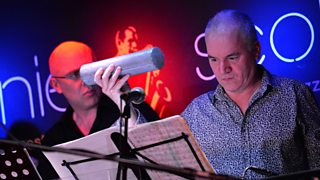
After a break of 25 years, writing a new Loose Tubes chart was an intriguing prospect. On the one hand the band had established a very distinctive ensemble sound and approach, but in the intervening years members have matured and developed as players, so there were other elusive and imagined dimensions in the mix. Another factor was the great variety of compositions in the existing Loose Tubes repertoire; I rejected many early ideas as being too similar in style or character to other pieces, in a way that probably would not occur if the band had played all swing charts, or fusion material.
When I had finished writing I realised that I had revisited some characteristics of my previous Loose Tubes compositions; the tempo and feel of one chart, the texture of a second, the melodic arc of another, but combined in new ways. (I also realised that I had borrowed an idea from pianist Liam Noble, having unwittingly acquired it while playing his absorbing music on tour last autumn.) Another pervasive influence was the baritone saxophone playing of Julian Argüelles. I imagined his sound and phrasing when improvising, and then wrote some material in this vein for him to play in the early stages of his solo, which subsequently becomes purely improvised.
The bell-like sound that comes in halfway through the piece is an A flat bass chime bar, which I recognised to be an essential element fairly early on in the writing process. I then set about finding an instrument, which I bought online for the bargain price of £21. I recorded the chime bar part and spent some time playing other parts with and against it, and as a by-product I now have perfect pitch in A flat, which is moderately useful. By strange coincidence, at the same time Steve Berry was sourcing a desk bell pitched at A flat for the final note of Smoke and Daffodils, albeit 6 octaves and 200 miles north of mine (see below).
I was also happy to find the word ‘Creeper’ on my list of potential titles, collected from here and there over time and filed away, in anticipation of the difficulty of naming compositions. It has a slight association with the slow but insistent climbing lines of the main part of the piece, but mostly I just like the sound and feel of the word.
Steve Berry – Smoke and Daffodils (listen here from 00:33:15, later this evening)

On the cover of my score I have put the following paragraph of creative writing. It was done by a Year 3 pupil and family friend of Andy Williamson (musician and long-time friend of mine). The subject was ‘The Big Bang’.
"Once there was nothing, then swirling light. It was every colour. It made atoms electrons, life, trees, but also stars, supernovas, Mars and the amazing Moon. It made oxygen and H20, us, bacteria, germs, smells, monkeys that morphed into humans, gravity, light, glass and fire. The universe when it was creating was courageous and imaginative. When it exploded it made tons of things it had never thought of before. Gases that smelt like smoke and daffodils. It looked like blues, yellows and reds whooshing to join up. It made the first animal eyes. Those eyes might have seen the sun and life on the world for the first time."
The phrase ‘smoke and daffodils’ leapt out at me, declaring itself in an instant to be the title of my piece.
As usual, up until that moment the title had been vexing me. It always does. The hardest part of the composing process for me, every time.
To understand the title requires only a little explanation. John Ellis formed a large Mancunian ensemble in the '90s, calling it ‘John Ellis's Big Bang’, the play on words being at once very obvious. That association was immediate for me as I read these words, and the freshness and sheer inventive imagination he manifested was very striking.
Freshness, inventiveness, imagination - all things that motivated those of us who wrote for Loose Tubes, right from the beginning. London then (and to a lesser extent, now) was awash with rehearsal bands, chock full of great players all mining the 'tradition' of Count Basie, Stan Kenton and Glenn Miller, so much so in fact that we were keen to differentiate ourselves from that, wanting to reference less established, less mainstream inspirations. This indeed was part of Graham Collier's thinking at the outset, to start an anti-matter alternative to NYJO I suppose. Between us we had ears full of Kenny Wheeler, Carla Bley, Stravinsky, Terry Riley, Berio, Hermeto Pascoal, Gil Evans, Don Ellis, Brotherhood Of Breath and Weather Report, to name but a very few. Neil Hefti, Billy May & co were well enough represented out there already. We wanted to be different.
‘Smoke and Daffodils’ as a title therefore alludes to all of the above, somehow (in my mind at least...).
For direct references I can identify, the fanfare intro harks back a little to Django's own opening for ‘Accepting Suites...’, though mine being somewhat less plangent, using it to catch the attention and lay out the underlying chordal structure used at various times in my new piece.
Immediately after that I put my heart on my sleeve with a direct nod to Kenny Wheeler, whose harmonic and lyrical concepts have long entranced me. Hence the lone flugel melody entrusted to Noel Langley. This soon unfolds with more and more instruments joining in, the whole tune being revealed in more detail and colour across the band.
Repeating the harmonic form, I tried to allow ideas to develop and grow from within the original melody, all heading on towards a moment where the feel mutates into a 9/8, 'bembe'-type groove, an African reference beloved by so many of us, John Parricelli and Django having a history of being beautifully adept at comping in and around each other in a constantly evolving dialogue.The horns simply lay down lush and full chords on top of the bubbling and chattering rhythm section. The chord sequence at this point is derived from the main theme's sequence, but modified slightly to suit the solo from Julian Arguelles, taking care to try and construct a form that breathes in a more natural way for improvised ideas to flourish.
Tempted to orchestrate this solo with backgrounds, I decided nonetheless to stay my hand. I've long been bothered by written backgrounds, feeling that they can sometimes dictate the shape and trajectory of a solo. Instead I elected to leave Julian and the (by the way, I do hate this phrase) 'rhythm section' free rein to pursue whatever story occurs to them. They have one conundrum to consider - how to finish the solo as it segues into the soli that follow it. Solving that conundrum can always be an open question, their approach able to be different every time, should they wish.
Whatever happens, the soli burst onto the scene in a 'no prisoners' way, being a last tour through the solo changes, my pen seeking to capture and orchestrate a hint of the inventive possibilities it affords improvisationally. This eventually calms into a restatement of the original theme, then on into a coda that has a looped section where mass improvisation is encouraged to develop from within an already busy brew.
For the broadcast the looped section is restricted to four repeats for reasons of time allowed (each composer required to generate 7 minutes per commissioned piece). It is my hope that should the band get more opportunities to explore the piece beyond this premiering week - and if they like the piece enough - the end section might be allowed to catch fire with an open-ended repeating of the loop, more and more improvisation erupting jubilantly from within (and eclipsing) the written material heard there.
The coda ends with two huge, full-voiced chords by the whole band, then whimsically capped off with a simple A flat, played in octaves with Django's right hand. It's somehow like a microwave 'ding', letting you know it's finished cooking, though that thought occurred to me after the event and wasn't really my intention.
Post-script:Originally I thought the performance at the Cheltenham Jazz Festival was going to be the one recorded by Radio 3, and so to capitalise on the sense of occasion, I hatched a plan to inject a final, surprise element into the mix.
I decided it might be fun to suddenly appear on stage and play that A flat in unison with Django, dinging it on a service (or 'counter') bell. Only he and I would know, so it would surprise band and audience alike.
Soon I discovered how difficult it is to find service bells for sale. Worse still, even when I found 'em, a bewildering array of pitches cropped up, but no bell I ever found was pitched to A flat. This wild goose chase ground to a halt after a week or so and I reluctantly gave up, but...
Driving home one day an impulse caused me to check out the charity shops in Chorley. The third one had a petite service bell on the sales counter, with a hand written notice taped on - "NOT for sale".
You guessed - it was A flat.
Staff responded negatively to my request, prompting me to elaborate further, explaining to them about why I needed it. Thankfully they mellowed, enough to agree that I could have the bell if I sourced an adequate replacement.Trouble is, experience had already taught me that buying one (whatever it's musical pitch) usually means trekking to out-of-the-way antique dealers. You can't just pop into yer average town centre and buy one.
Chorley ain't yer average town centre... Wilcock & Sons (est 1878) ain't yer average hardware store. Yep - there it was, for £4. A bigger and better bell, giving off a resounding F natural (not that anyone in the charity shop will care about that). Seconds later the swap was effected, together with a donation to the charity. As I turned to leave with my new prized possession, I noticed the staff eagerly re-applying their "NOT for sale" notice to theirs.
Rock 'n' roll, baby.
Eddie Parker - Bright Smoke, Cold Fire (listen here from 00:52:00, later this evening)

The piece started as a bag of disparate elements and ideas about the kind of thing I wanted it to be – lots of changes of tempo and texture, something in the Mahavishnu Orchestra/arpeggiated-chord vein, something beguine-ish with rhythmic brass, a swooping tune, a busy, unpredictable tune, a rising sax soli gesture; these jotted down in the summer of 2013 when the idea of a reunion commission first came up. Then I let it go to sleep.
When the project was confirmed I began to work on the piece in earnest. I still had the idea of music which changes abruptly from one area to another and I set to work on fleshing out the different kinds of material. As I went on, it became evident that these different areas were related - they were transformations or translations of each other. I also became fascinated by the idea of how seemingly angular, atonal melodies could become tonal, and vice versa. There is a jagged, abrupt melody in the opening half-minute, which comes back a little later in a more harmonically focused context. Motifs from the opening melody are harmonically refocused later on, and extrapolated contrapuntally towards the end.
The harmony is the real foundation of the piece. The sequence of 9 harmonic areas, expressed in chord symbols, goes:
F maj7+5, B11, Bb maj7#11, Bb11, E maj7#11, E min11, Ab maj7+5, C7alt, F# maj7+5
This is quite a rich sequence. Looking at the chord scales, you find that an A major triad belongs to the first two chords, and that the 7th and 11th of the second chord become the major 7th and sharp 11th of the third, and so on. In arranging and voicing these chords you can also express them in ‘close’ form, with the 13th a semitone below the 7th, or in expanded form emphasising minor 9th intervals. This is a bit of a technical explanation, but it means that the sound of the harmony can go through different transformations. The music can sound sometimes ‘jazzy’ and sometimes ‘contemporary’.
After the opening rising sax figure, the first version of the harmony, a tribute and reference to John McLaughlin’s Mahavishnu Orchestra, is a filtered version of the sequence, with fewer notes to give a more gutsy sound. When it returns at the end in fuller orchestration the bare intervals remain – I didn’t fill the sound out with other extensions etc. I like this ‘white hot’ sound – it expresses the shock of revelation in Mahavishnu's music, and here something hopefully similar: wake up!
Next comes the keyboard arpeggiated chords – another Mahavishnu trademark – and then the band comes in with parts that trace the keyboard and an angular phrase over the top at odds with the harmony, from which a lot of the later melodic material is derived. A sound that suggests a complex woven thread.
The next version of the harmony is in beguine tempo, with close voicings arranged for the brass. The large-interval melody which appeared earlier is on the guitar, doubled below on bass and bass clarinet. Also in this section is a little melody for alto and trumpet harmonised in fourths. This is lighter in mood, with a dancing rhythm.
Now comes another harmonic sequence, unrelated to the central one and providing a release from it; the time signature settles to a regular three in the bar. Now the atonal angular phrase is recontextualised in tonal harmony. There follows a flute solo on the sequence, followed by a recapitulation of the melody with high woodwind trills – suggesting a Debussian delirium. The fourthsy melody has now acquired a little countermelody.
An abrupt change leads to the second half of the piece, a percussion-heavy groove in six with accented bass notes. A saxophone solo weaves in between until the horns begin their contrapuntal explorations of the intervallic and melodic material. There is an urgency in this section - the high woodwind trills sound like a phone ringing (must take this call!), the chromatic lines propel the music forward with increasing complexity, like a polemic. The grand brass chords which stand monumentally over the music from time to time are another iteration of the original harmonic sequence, this time arranged in expanded intervals to give a more plangent contemporary sound. In fact the bass notes spell out the roots of the original sequence, and the rhythmic accents have been in the piece from the beginning. So the abrupt change to something seemingly unrelated is in fact a change to the same thing as before!
The contrapuntal section leads headlong into the opening Mahavishnu-style music with cataclysmic force; then comes a final reiteration of the beguine tempo section with yet more dancing counterlines. And finally another abrupt change: the mood becomes more forgiving, more wistful, thinner in texture, and gently waltzes to a close that feels unresolved, a dot-dot-dot ending. The harmony in this section is in fact a re-spelling of the original chord sequence – each chord has the same parent scale as the original, F maj+5 becomes A maj +5, B11 becomes F# min11, and so on. The voicings are similar to things that happen in the late Pete Saberton’s music, and this section is a fond tribute to his memory.
So what, finally, is the meaning of the title ‘Bright Smoke, Cold Fire’? In the original Shakespeare, Romeo uses the phrase to illustrate what it feels like when he doubts Juliet’s love for him – a world turned upside-down. But here I intend other, broader meanings. The world is not as it should be: there is still, even now in the 21st century, war, children starving to death – that’s Bright Smoke, Cold Fire; greed, fear and power are still abroad both in the wider world and in the interactions of daily life – that’s Bright Smoke, Cold Fire; music is still used by many as acoustic wallpaper while doing something else, or as mere entertainment, or as social badge, or as a means of manipulating opinions and buying habits, instead of as the supreme medium of transformation and healing – that’s Bright Smoke, Cold Fire; music history is a list of officially approved figures rather than a universal legacy of generosity, free to all – that’s Bright Smoke, Cold Fire… and more… I think, or I hope, the urgent need for these revelations is there in the sound of this music.
