
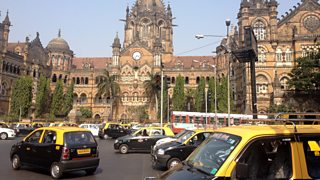
On a stiflingly hot April morning we made our way through the traffic jammed streets of Mumbai to visit one of India’s most distinguished classical musicians, the violinist and singer Kala Ramnath.
After a warm welcome and some even warmer samosas, we made a start. Kala lives in a small flat and we had two rooms to choose from one at the back of her flat and one at the front. Neither room was ideal as at the front there was incessant traffic noise and at the back there was major building works going on with drills, banging and lorries reversing. We settled on the back room in the hope that the workers would stop for an early lunch to avoid the midday sun. Unfortunately it’s not only mad dogs and Englishmen who go out in the midday sun – Indian builders do too – so we had to pause often for particularly loud bangs and drills and record as much as possible in the short periods between the loudest noises.
Having only a passing knowledge of Indian classical music, this was a real education for me. The great thing about being a BBC producer, is that you get to meet wonderful musicians and listen to their music in unique environments. Hearing Kala and her Tabla player perform in her living room was a real pleasure and a privilege. Her explanations of the themes within the music bring it to life. The fact that most of it is improvised means that no two performances are the same and, as Kala, pointed out, the performance is very much linked to their emotional state at the time of playing. The music, then, becomes something which is affected by their emotions rather than something which affects their emotions.
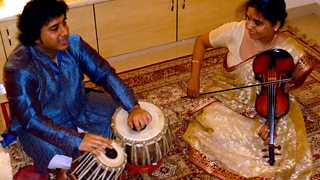
The differences between western classical and Indian classical music were made very clear as, for part of our trip to India, we were working with the BBC Scottish Symphony Orchestra. So going from the structured world of the orchestral tour and the necessary sheet music and rehearsals to a lady sitting cross legged on the floor beside her tabla player was a bit of a culture shock. The music is more like jazz than western classical music and the musicians exchange glances and knowing looks as to when the music should move on, develop and ultimately finish.
Kala told us that the voice is the most important thing in music and was able to demonstrate how closely the violin can replicate it. The ability to use the bow to sustain notes and bend them on the violin using the Indian music scale, means the violin and voice can sound incredibly similar. Because of the violin’s ability to mimic the voice, it has become embedded in Indian classical musical culture, despite the fact that the instrument only came to India during colonial times.
Kala explains that whatever is going on in the world, or with her personally, is put to the back of her mind as the music takes over her emotions. Sitting listening and watching her perform, I can only agree and add that it does the same for the listener.
We left her home late in the afternoon and dived back into the stream of non-stop Mumbai traffic. The white knuckle ride of near misses and emergency stops seemed a lot less stressful having been enriched and nourished by this wonderful music.
