
Late Junction's Bogota adventure
Post categories: BBC Radio 3, Late Junction, world music
 |17:27 UK Time, Thursday, 31 May 2012
Wilson Cifuentes Late Junction producer Juan Carlos Jaramillo introduces the musicians and unusual instruments from a recent session recording in Colombia. You can hear the results in Late Junction on Thursday 31 May 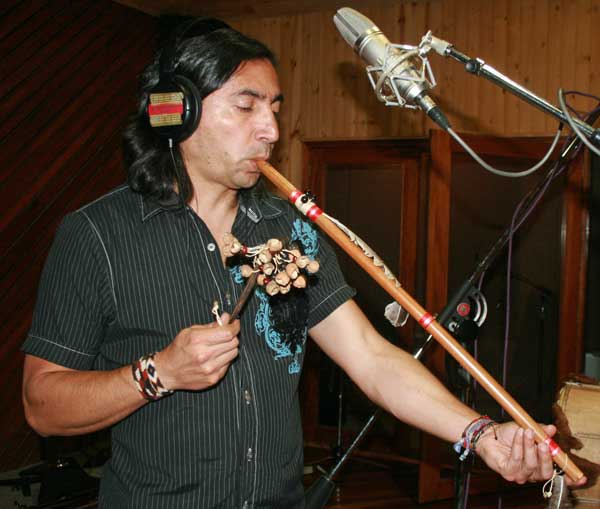
The first thing that came to my mind when planning this Late Junction session in Bogotá was making sure we offered a varied and colourful portrait of Colombia’s music. Ok, I wasn’t after traditional folk music as such, as that’s not necessarily the aim in this type of session, but rather to find musicians who’d be inspired by the country’s cultural diversity and who’d be able to blend it all with modern, studio produced sounds.
After all, Colombia is an amazingly rich and varied country, 4.5 times bigger in size than the UK, and its complex geography has produced quite distinct and clear cultural regions, each with its own music – there’s every climate on earth at any given time; there’s the Andes with its high, snowed mountains travelling across the whole country from South to North; there’s plenty of seaside with coasts both in the Pacific Ocean and the Atlantic Ocean, the latter a region which culturally belongs to the Caribbean; and there are huge plains to the East, and the Amazon rainforest to the South to add for good measure. And if you add to this the blend of races and cultures coming from the local indigenous populations still living there, the black Africans which arrived as slaves centuries ago, and the Spanish and European heritage which came with the Conquistadors, you’ll find that Colombia is many countries in one!
Hence, I got multi-talented keyboard player Carlos Iván Medina involved in this Late Junction project as ‘Distrito Especial’, the band he helped to create back in the 1980s reached iconic status in the country’s rather underdeveloped rock scene. Then came the other musician in this experiment: Wilson Cifuentes, as I wanted somebody rooted in the folk music traditions – and he fitted the bill as he’s played all sorts of wind instruments and percussion in some of the biggest folk music groups of the last 20 years. Wilson has other strings to his bow as he has a soft spot for Jazz and plays the saxophone and the clarinet in other bands closer to the urban scene. Both Carlos Iván and Wilson love to improvise, something that I hope shows in the session!
For the first piece of our session, which they appropriately called ‘kwisi’, I wanted Wilson to concentrate on the two types of flutes he brought along to the studio: first and foremost the kwisi, also called gaita as the Spaniards found it similar to a flute they had in their own music. The kwisi has been traditionally made from local cane by different indigenous tribes in the North of Colombia, near the Caribbean, and it’s the instrument associated with Cumbia, undoubtedly the country’s most famous rhythm. Wilson wanted to use, at the very beginning of the piece another, smaller flute, this one coming from the Orinoco region, closer to the frontier with Venezuela. The piece has a dream-like atmosphere thanks to the delay we put in the recording and its calm, reflective pace.

Wilson Cifuentes and Carlos Iván Medina
The second piece evokes the music from the Pacific region to the West of Colombia, a part of the country which not even Colombians know too much about. It’s an underdeveloped region, particularly up the North, near the border with Panama, with a very thick rainforest and one of the highest rainfall rates in the whole of South America! Its population is mainly of African descent, and hence the use of a traditional instrument with roots in the Black Continent: the marimba. In this region the ternary rhythms, played slow or mid-tempo are truly mesmeric, and if that wasn’t enough, in this piece Carlos Ivan’s keyboard marimba and Wilson’s clarinet play to the sounds of the Colombian country-side in the background, something which we recorded earlier and decided to use in this session. The name of the piece is ‘Clarimba’ – clarinet and marimba.
‘Ron Caribe’ or Caribbean Rum describes very much the mood of the third piece Carlos Ivan and Wilson improvised in this session recorded in Bogotá for Late Junction. Not many people abroad think of Colombia as a Caribbean country, but the truth is that the whole of the Atlantic coast, to the north of the country, is under the influence of the Caribbean Sea and its culture. In many ways, the Caribbean Colombians have more in common, in music, food, accent, use of language, etc, with fellow Cubans, Puerto Ricans, Dominicans, that with the Colombians from up in the Andes, the rather cold mountains far away from the sea! In this piece Wilson takes the lead with his saxophone and is supported with some nice rhythms on the keyboard by Carlos Ivan. A bit of percussion was added later, to give the perfect blend of music and flavour in this ‘Caribbean Rum’.
For the last piece, I wanted them to experiment with the sounds of the ‘música llanera’, the kind of music cowboys in the plains to the East of the country, bordering Venezuela, play. It’s the land of the harp, the cuatro (a small, guitar-like instrument), and the maracas, which produce a music full of bouncy rhythms often compared with the gallop of the horse and its wild nature. Here Carlos Ivan plays the harp, again on his keyboard, while Wilson improvises some bird-like melodies in his flute. The piece, called ‘Amanecer Llanero’, is a sort of snap-shot of these remarkably beautiful plains at dawn, with the help of a little rain - again natural sounds that we recorded for the musicians to hear while they improvised in studio.

Comments Post your comment