
Rehearsing the First Night of the Proms - what's in a note?
Post categories: BBC Proms, BBC Symphony Orchestra
 |13:09 UK Time, Friday, 15 July 2011
BBC Symphony Orchestra sub-principal viola Phil Hall wrestles with the complexities of the scoring in tonight's First Night of the Proms performance of Janacek's Glagolitic Mass
It's no secret that Leos Janacek was not an easy man to live with. His temper and love affairs were legendary. There's a story about him attending a performance of his wind sextet Mladi after which he ran on stage and announced to the audience: 'hat wasn't my composition... the clarinettist wasn't playing it right!' But I've always been intrigued by this quirky, temperamental composer and one summer, whilst on holiday in Prague I suggested to my long-suffering wife that we take a trip out to Janacek's house in Moravia. She gave me THAT look. 'There's a big forest there,' I said, trying to big it up, 'and the restaurant where he used to eat...' Before too long we were pootling along the Czech motorway until it runs out in Brno, then on to the tiny village of Hukvaldy, his birthplace and country retreat, where he composed and even owned part of the forest. In the old school-house where he was born are some of his manuscripts which look as if several talented spiders have emerged from a bottle of Quink and run over a blank page. I have honestly never seen such illegible calligraphy. Pity, then, the poor publisher or masochistic scholar in search of the 'Truth' when faced with the likes of this:
Never one to obey convention, Janacek set his Mass in Old Church Slavonic (Glagolitic) and it is just one of many nature-inspired pieces he wrote towards the end of his life. He viewed the Mass as taking place in an outdoor cathedral, made from trees with stars for candles. It is a wonderfully unique and uplifting work and one the BBC SO has played quite a few times over the years. It isn't easy and just when you think you know a piece, someone comes along and says: 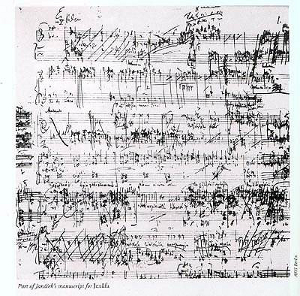
So, who's right? Do we believe the publisher (who often knew the composer at first hand) or the scholar who has dug up original manuscripts and gone back to the composer's initial thoughts?
This has intrigued some great minds. We work a lot with composer/conductors at the BBC Symphony Orchestra and it's always interesting having them conduct their own material and observing the changes they make to it during rehearsals, reminding us perhaps that a piece of music is a living thing. Curiously Pierre Boulez (a composer who is a serial reviser of his own works and with whom we last performed the Glagolitic Mass) prefers original versions of pieces (Stravinsky ballets for example) whereas Oliver Knussen prefers final revisions.
Composers are probably more prone to tinkering with their work post publication than in most other Art forms. Janacek was no exception. In the case of the Glagolitic Mass, which we will be playing tonight to open the 2011 BBC Proms, it may surprise you to learn that there are at least three different performing versions now on the market of a work composed only 84 years ago. We are playing the latest one, published by Barenreiter Prague just this year. Some believe he made changes during rehearsals because it was too difficult for the Brno orchestra playing the 1927 premiere; others claim that the orchestra was in fine shape and that he deliberately altered things for his own artistic reasons. Who knows...
I'll be honest, I didn't know what the differences were until it was too late. At the first rehearsal Jiri Belohlavek said good morning and launched into the beginning of the piece conducting 3 beats to a bar. My part was in 5/8 and the bars had septuplet quavers. This left me reaching for my slide rule... Apparently this was what Janacek (a fan of multiple time signatures) originally intended, rather than the easier sanitised revision in 3/4. Fortunately the BBC SO is pretty good at playing seven notes in the time of five (divided by three) and once we had played it a couple of times the worry lines on our Bohemian conductor's brow relaxed and he uttered his highest words of praise: 'Chapeau', whilst doffing an imaginary cap.
I'm sure even Janacek would have been pleased and wouldn't have changed it for the world. Maybe...

Comment number 1.
At 16:41 16th Jul 2011, Martin Fass wrote:HD Listening in North America. It was available for the last few Proms in 2010, but currently, not offered. May we know the reason? Hopefully, we can have the option again?
Complain about this comment (Comment number 1)