
What's behind the Musicality Test ...
Post categories: Radio 3, The Genius of Mozart
 |15:01 UK Time, Wednesday, 12 January 2011
Michael Orwell is a producer for BBC Lab UK, a BBC website where you can participate in groundbreaking scientific experiments.
When Radio 3 Interactive approached BBC Lab UK about creating an experiment connected to a forthcoming Mozart season I had mixed reactions. The once popular notion that listening to Mozart can increase intelligence, namely the ‘Mozart’ Effect, has been roundly dismissed as fanciful thinking. But I was fascinated by the idea of testing the population’s sense of music, an intangible notion which has rarely been examined on a large scale.
BBC Lab UK create mass-participation experiments that invite the BBC audience to take part, learn something about themselves, but crucially, also contribute to brand new science. Last year we launched The Big Personality Test and Brain Test Britain, both of which were ambitious and bold studies which have never been attempted on such a scale.
Every BBC Lab UK experiment is designed and curated by recognised scientific experts in the field and this test was no different. Although we contacted lots of researchers who were actively involved in the science of music, all roads seemed to lead back to Dr. Lauren Stewart and her team at Goldsmiths. After a brief meeting, it was clear that there was an exciting opportunity to collaborate on a nationwide study. Lauren’s research partner, Dr Daniel Müllensiefen, had already started work on a project to map the musicality that exists within the population.

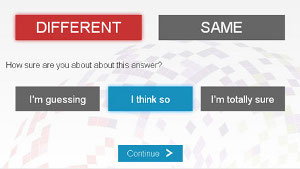
Goldsmiths designed a ‘test of two halves’, to borrow from the lexicon of football managers. The first part tests people’s attitudes to, and consumption of music. A self-report survey asks each participant to estimate their music consumption, perception and listening habits. The second part provides an objective measure of musicality across memory for short melodies, spotting the beat in pieces of music, tapping the beat using the computer spacebar and spotting musical genres from tiny fragments of sound.
Once we had agreed the shape of the study, we realised that we had only 2 months to build and test our experiment, which is a far shorter development period than we have ever attempted!
Not only did we have to quickly dream up a concept that encompassed the abstract and beautiful nature of music but we also had to help Goldsmiths to create the stimuli for the tests .My other career working in recording studios became useful as the beep tracks were compiled and piano ditties were recorded, but it was a fantastic team effort by all involved that finally enabled us to deliver the test in time for ‘The Genius of Mozart’ of season, curated by Radio 3.
Some have asked me what this test has to do with Radio 3 and I have to say I’m surprised by the question! If Radio 3 is not the guardian and exalter of musical excellence and purity, then I don’t know who is! I like to think, had Mozart taken part in the test, his high emotional connection, social creativity and virtuoso ability and perception might explain in part his many prodigious compositions.


Comment number 1.
At 18:47 12th Jan 2011, Fi Nicks wrote:I must say I was far from impressed by the test. Where were the classical music tests? Only rock, pop, hip hop and jazz? Not good enough Im afraid. Moreover, clapping to a beat is not really a good measure of musicality. What about sight reading scores, notation, composition etc? Musical perception and sensitivity seemed to be graded by whether one's mood was affected by music, or whether one selected music to change one's mood. The fact that one can appreciate the emotional range of a piece of music without it impacting on the listeners' own mood does not appear to have been entertained... Another gimmick I'm afraid.
Complain about this comment (Comment number 1)
Comment number 2.
At 09:42 13th Jan 2011, johnny41141 wrote:I thought the initial popular music tests were completely biased towards pop music listeners & that the rest were pretty unimaginative, not requiring much genuine skill - sorry, BBC!
Complain about this comment (Comment number 2)
Comment number 3.
At 14:32 13th Jan 2011, Hello wrote:Most unimpressed - the bias towards popular music (not really explained and I wondered if my computer was working correctly as the clips were so short), the lack of sufficient explanation, probably to avoid being to complex (or perceived as elitist) and the less than satisfactory analysis would not encourage more participation in this type of experiment from me. It might be that my 'lack of musical curiosity' is because I don't like music as background - because I can't concentrate on it - and I am sufficiently knowledgeable to know what I want to explore and don't actually need to be given - 'you liked Poulenc, so you'll like Ibert' help!
Again, sorry BBC.......
Complain about this comment (Comment number 3)
Comment number 4.
At 14:50 13th Jan 2011, watershrew wrote:I strongly agree with Panjandrum, the so called music test was only the noises generated by pop music, and completely alien to my finely tuned ears . I had eagerly anticipated a serious test dealing with actual music. But noooooooooo. I suppose this is yet another nod to being 'unstuffy and hip'
HO HUM. I gave up on the test after a few seconds. Couldnt'bear the racket coming through my speakers.
Complain about this comment (Comment number 4)
Comment number 5.
At 17:54 13th Jan 2011, daveyules wrote:Let me provide some balance to your earlier comments. This is an interesting exercise which may lead to some new insights. I found it fun and engaging and far from being "a nod to being "unstuffy and hip"", it actually recognises a breadth in music and a range in the ways people engage with it. I wonder what scores these people (those that managed to finish it) got?
Complain about this comment (Comment number 5)
Comment number 6.
At 19:13 13th Jan 2011, flosshilde wrote:No, daveyrules, it didn't "recognise a breadth in music" - as others have said the clips one was supposed to recognise came from a very narrow range - mostly what I would call 'pop music'.
The survey would have had much more value if it had been posted on the Radio 1 & 2 sites as well - it would have got a much wider range of people, & some who might have had some familiarity with hip-hop etc! As it is I don't think it has much more value than the trivial quizzes in women's magazines.
& why was it so important to run it while the Mozart fest was on? Because there would be fewer people listening to Radio 3 than usual during that time, & the ones not listening might want something to while away the time?
Complain about this comment (Comment number 6)
Comment number 7.
At 19:24 13th Jan 2011, french frank wrote:The questions were the problem for me. Did it make any difference to the final assessment whether you were a Completely/Strongly Agree/Disagree person, or an Agree/Disagree person? What about if you have lots of Neither agree nor disagrees - how do you know whether this isn't simply a difficulty establishing exactly what the question wants? What if you were always 'completely sure' rather than an 'I think so'? Does it all prove that if you're a wishy-washy personality who doesn't react strongly you are not emotionally capable of appreciating music? And what about self-assessment? Is someone who 'knows' that they sing in tune necessarily correct? Or someone who 'knows' a good singer when they hear one? Then of course there's the kind of person who, when asked whether they've ever been praised for their musical ability, replies, No, on the grounds that, although it isn't literally true, the people doing the praising didn't know much about it ... :o)
I'd be very interested to know whether you were trying to establish personality types and whether you really think musicality is closely allied to personality. That would seem to me to be what you were concluding.
Complain about this comment (Comment number 7)
Comment number 8.
At 14:47 15th Jan 2011, g0mrl wrote:Were the sounds we were supposed to categorise in the first test supposed to be hardly a second in length?? I found it impossible to do this test.
Complain about this comment (Comment number 8)
Comment number 9.
At 14:47 15th Jan 2011, g0mrl wrote:This comment was removed because the moderators found it broke the house rules. Explain.
Complain about this comment (Comment number 9)
Comment number 10.
At 21:00 17th Jan 2011, Leda wrote:I feel that a lot of the people above who are criticising the experiment do not fully understand its purpose. The test was designed to test innate musicality not musical ability. It is meant to be objective so that there is no bias towards musicians or non-musicians. This is a quote from the Lab UK website: ‘A lot of what we know about music comes from comparisons of musicians and non-musicians. It has become increasingly clear that a more sophisticated view of musicality - one which takes into account musical listening and engagement - will yield even greater insights.’ Tests such as sight reading scores, notation, and composition are tests of musical ability acquired through training not a test of innate musicality.
However, being musically trained myself, I do agree that the test needs some improvement.
Complain about this comment (Comment number 10)
Comment number 11.
At 16:57 19th Jan 2011, Graeme Kay wrote:Thanks to everyone for your comments on the Musicality Test
This is just to let you know that Michael Orwell, who produced the test, has posted another Blog responding to you comments.
You can find his blog here: https://www.bbc.co.uk/blogs/radio3/2011/01/answering-your-musicality-test.shtml
Best wishes
Graeme Kay
Interactive Producer, BBC Radio 3
Complain about this comment (Comment number 11)