BBC BLOGS - Radio 3 Blog

Archives for December 2010

Cafe Mozart, Cafe Strauss ...

Blog comments are currently unavailable. Find out more.

Post categories:

Petroc TrelawnyPetroc Trelawny|13:14 UK time, Friday, 31 December 2010

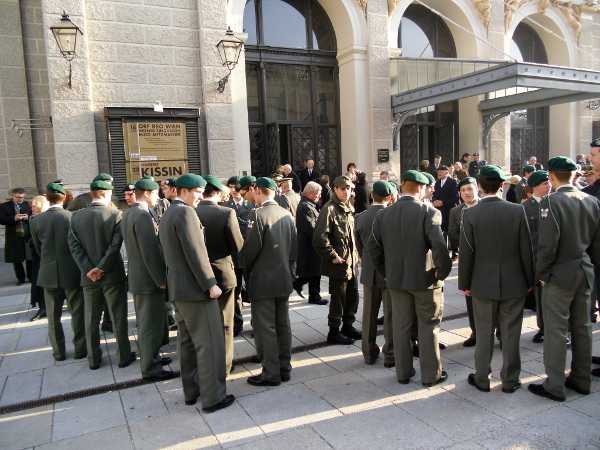
Photo of Austrian servicemen gathering for the Neujahrskonzert

Photo of Austrian servicemen gathering for the Neujahrskonzert

Radio 3's Petroc Trelawny is in Vienna to present the New Year's Day concert and 'Cafe Mozart' - one of the first programmes in Radio 3's Genius of Mozart festival. Here, Petroc describes the scene in Vienna while the Vienna Philharmonic's first and only British player introduces him to a Mozart-era trombone ...
No Blue Danube to greet me on arrival in Vienna. Austrian Airlines serenades its passengers with strains of Strauss’s great waltz as their planes trundle along taxiways; we’d got cheaper tickets for this trip, on an airline lacking such musical good taste.

But I didn’t have to wait too long before getting a burst of this city's de facto anthem. And this time it wasn’t through a crackly speaker, but live in the Musikverein, in the hands of the Vienna Philharmonic and Franz Welser-Möst. The sparkling, thrilling performance came as part of the New Year's Day concert. But hang on, I hear you ask, it’s only December 31st. In fact, the VPO’s tireless players give their salute to the Strauss family three times each year: the famous New Year's morning concert, which I’ll be introducing for Radio 3 and BBC TV, is only the culmination; there's a New Year's Eve performance, when the Sekt flows even more liberally; and another one on the morning of December 30th. Tickets for this first run are not exactly cheap, but they’re a little easier to come by. So, while there were American and Japanese tourists around me yesterday, there were also plenty of Austrian music lovers, thrilled to have secured a seat at their city's annual musical spectacular.

The gallery of the Musikverein was completely Austrian for yesterday’s show - all the tickets are given to members of the Austrian Armed forces. Teenage cadets in their olive green uniforms were lined up on parade immediately beforehand, clutching tickets in their hands; older NCOs popped out during the interval for a quick cigarette, while senior officers, their polished shoes gleaming, gaily clapped along to the Radetzky March, obeying the orders of the musical marshal on the conductor's podium. 

This is rather a personal concert for conductor Franz Welser-Möst. I hope I have this exactly right, but his great, great, great grandfather owned a restaurant and casino in Vienna’s 13th district, where Johann Strauss Junior made his debut. The concert was in the autumn of 1844, and had to happen away from the centre of town so the young man didn’t challenge his father’s musical supremacy. Two works that featured in that first appearance are heard in part one of this year’s concert.

There are already posters advertising the CD of this year's New Year’s Day concert; the liner notes are already printed, and the production teams will work through the night on January 1st to get it edited and ready for release. The recording of the event has become a best seller and a huge revenue earner for the VPO. This year it will be released internationally on January 7th, less than a week after Franz Welser Möst beats his last bar. Quite an achievement. 
Read the rest of this entry

Red Light On ... Once in Royal ...

Blog comments are currently unavailable. Find out more.

Post categories:

Simon VivianSimon Vivian|13:20 UK time, Thursday, 23 December 2010

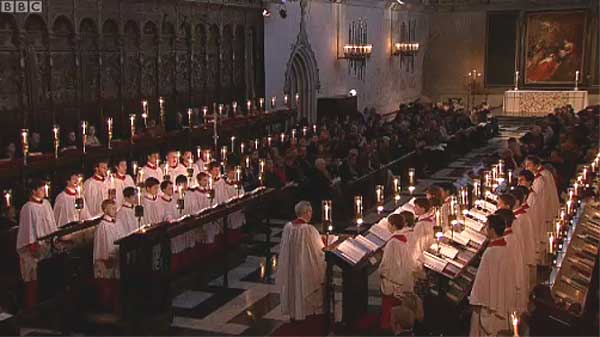
The Choir of King's College Chapel, Cambridge, with conductor, Stephen Cleobury

Simon Vivian is producing the Festival of Nine Lessons and Carols for the first time this year. Here, he describes the big day, and the big day before...

The 'Red Light' moment at the beginning of the Festival of Nine Lessons and Carols has to be the biggest of the year. Many listeners tell us that that moment of stillness on Christmas Eve before the treble soloist steps forward to begin 'Once in Royal David's City' is the moment when their Christmas begins. As broadcasters, it's one of the moments when you know that it's not just the Radio 4 or Radio 3 audience, but a worldwide audience which is tuning in to an act of worship made unique not just by the choir, but by the atmosphere of King's College Chapel in Cambridge, and the choice of music - including new and unfamiliar pieces.

When we broadcast live services on Radio 4, we're used to meeting the 'pips' and The Archers, of course, wait for no-one. Last year's Red Light moment produced its own frisson in a way of which the listening audience would have been quite unaware. The signal to be ready is a flashing red light, at which point the organ scholar knows to wind up his improvisation on the chorister's starting note. Last year, the organist was extra-efficient and brought his voluntary to a swift conclusion when the light began to flash, leaving conductor Stephen Cleobury - and the soloist - a wait while the continuity announcer in Broadcasting House finished the opening announcement. The gap ended up at 45 seconds, which must have been a terrible length of time for the chorister to keep the note in his head. He was spot on, of course!

The TV service is recorded in mid-December - there's some shared repertoire so I compare music notes with the TV team, but the radio service starts a couple of days ahead for the riggers. This is because, with a full candle-lit chapel, the danger of trailing cables and the importance of not allowing technical equipment to intrude on the atmosphere of a religious service, we sling the microphones from the chapel's fan-vaulting rather than using microphone stands, which no-one would pretend are nice to look at. At Choral Evensong broadcasts I remind the congregation that they're in an act of worship, not a recording session, and this is especially important as the King's service is the college's gift not only to the people of Cambridge, but to the world.

It's the day before the broadcast and I've just arrived in Cambridge. Part of tomorrow's schedule is the recent tradition of broadcasting the Radio 4 Daily Service from the Chapel - we have done it in the queue outside, but now we're inside with the Choral Scholars - this year, the college's new Dean, the Rev Dr Jeremy Morris, is presenting for the first time, so today I'll be rehearsing with the clergy and singers; later we're joined by the choristers for a music rehearsal for the big event - now our chief sound engineer Steve Richards can get an idea of the choir blend. After the rehearsal, Stephen Cleobury, the organ scholar, and representatives from the choir will come into the sound van and listen to the rehearsal recording, so that they can have an idea of the sound balance (albeit without congregation) and make adjustments.

We finish at 7pm, then Stephen will do what a lot of choral directors do these days - instead of taking up time at the beginning of a rehearsal with giving individual notes, he will email them to all of the singers so that they can mark up their scores themselves.

Armed with their notes, the choral scholars are back on the morning of Christmas Eve; their first commitment is the Daily Service, then we have the lesson readers in to rehearse - the chaplain, the Rev. Richard Lloyd Morgan (a professional singer) takes a close interest in this, and as there is no Public Address system to help the readers, balance has to be handled carefully. Interestingly, the acoustics really help the wonderful, familiar words of the King James Bible come through in unaccented, fluid speech.

There's a final rehearsal before lunch - we hear the organ voluntaries (there is virtually a whole organ recital to build the atmosphere for the congregation, before the microphones go live). Then the choral scholars go out as 'Collegium Regale' to entertain the people in the queue which snakes all the way round the court at King's.

After that, it's the countdown to the Red Light. I first heard the broadcast live in 1978 when I was 8, and I still feel that same sense of excitement. For all the comfortable familiarity of the event, as a radio producer the question which still intrigues me is, what special moment or atmosphere will be captured this year, and how will the carols which are new contribute to that? This year there's an arrangement of The Holly and the Ivy by June Nixon, long-serving director of music at St Paul's Cathedral, Melbourne, and of course the commission is by the great Finnish composer Einojuhani Rautavaara, who's also written the text - it's about the gifts presented by the Magi, and about the greatest gift of all - the birth of Jesus - given by God to us all. I'm sure that will be quite something!

Take one from Sixteen: inside A Choral History

Blog comments are currently unavailable. Find out more.

Post categories:

Eamonn DouganEamonn Dougan|21:40 UK time, Tuesday, 21 December 2010

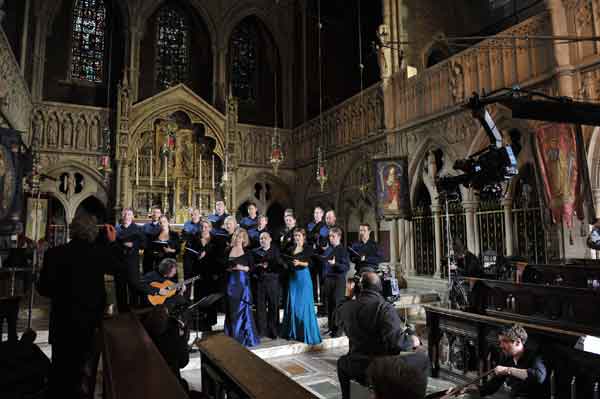
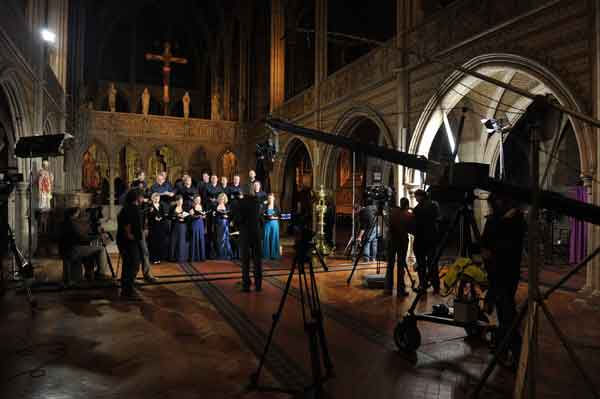
Filming at St Augustine's, Kilburn

Eamonn Dougan, assistant conductor and a bass with The Sixteen, writes about recording Sacred Music's Christmas specials for BBC TV

Wednesday 20th October may seem an unlikely time of year to be singing carols and festive polyphony, but the members of The Sixteen are doing just that today at St. Augustine’s Church, Kilburn, filming and recording two Sacred Music programmes (A Christmas History - documentary and A Choral Christmas - concert), which chart the develpment of of christmas music through the ages.

 We’re all very proud of the previous two series, so are looking forward to adding another instalment, albeit without the company of Simon Russell Beale who is working elsewhere today, although he will be presenting the programme as usual.

The crew and director have been on site for some time. Lighting, preparing shots and the sequence of the pieces all require careful consideration, but under the watchful eye of director Andy King-Dabbs, all will no doubt run smoothly. Andy has repeatedly impressed us by being well read (on sometimes obscure musical subjects), good at time-management (crucial when working within tight schedules and budgets) and good-humoured (a sure way to get the best out of everyone), so we feel in safe hands. Having seen the huge amount of music we have to cover, he’s going to need all these attributes, but he and our conductor Harry Christophers soon make it clear that they know precisely what needs to be done, and we get started very quickly.

The scope of the programme is enormously wide ranging: plainsong, Palestrina and Praetorius through to Howells, Holst, Rutter and Maxwell Davies, via Mozart and Mendelssohn. The Missa Puer Natus Est by Tallis, Victoria’s O Magnum Mysterium and A Spotless Rose by Howells are favourites of mine, but it’s David Miller’s mellifluous guitar accompanying Gruber’s Silent Night that stands out as a gorgeous new colour. Harry does great work in guiding us between styles and centuries, while the crew endeavour to keep the shoot moving as fluently as possible. Despite it being only October, the church is bitterly cold and the sopranos, clad only in concert dresses, cluster around the few heaters between takes.

As ever, there are occasional moments of improvisation: our tours and concerts manager having to relay the beat to organist Robert Quinney when the placing of the choir left him unsighted; and the lottery of who will be handed the tambourines to play in the medieval Make We Joy. It’s a relief when we break for dinner and retire to a nearby pub where a steaming pot of chilli awaits to warm us. It’s interesting to note what sticks in the mind on days like this. With such a wealth of music there are obviously musical highlights, but two things in the pub also stand out.

First is the sign behind the bar - 'Thierry Henry barred for life from this pub'. It transpires that the landlord is an Irishman who will not forgive the Arsenal legend denying the Irish team their place at the World Cup finals with his infamous handball. The second is the lady serving behind the bar who breathlessly informs us that she has taken Viagra 'to see what it’s like'. 'That one doesn’t need Viagra,' mutters the landlord with his eyes raised heavenwards. Initially this might seem somehow incongruous in the context of much of what we have recorded earlier in the day, but when singing William Walton’s Make We Joy, I think it’s the kind of comment that his impish sense of humour would have enjoyed. Call it a touch of festive spice!

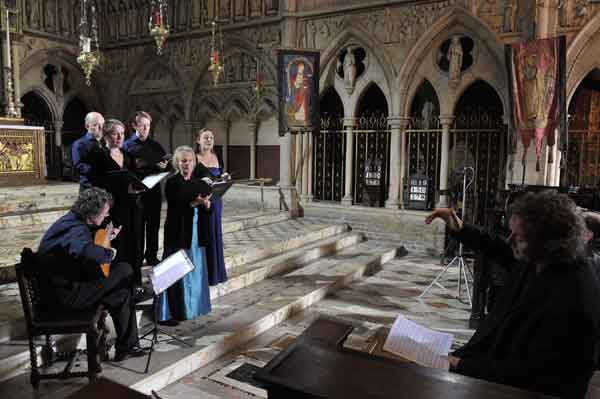
Solo group, with Eamonn Dougan, recording Byrd's Lullaby

Solo group, with Eamonn Dougan, recording Byrd's Lullaby

The Genius of Mozart - Guide to the highlights

Blog comments are currently unavailable. Find out more.

Post categories:

Graeme KayGraeme Kay|15:02 UK time, Tuesday, 21 December 2010

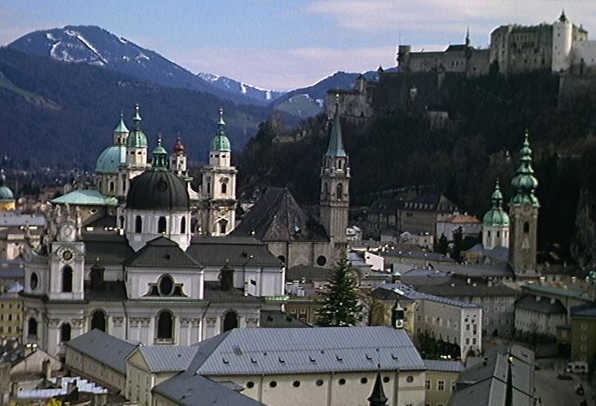
Salzburg - the city of Mozart's birth

Salzburg - the city of Mozart's birth

Radio 3's The Genius of Mozart begins on January 1 - twelve days of Mozart's music and complementary speech programming. If you're wondering how the season will be structured, here's a preview of some of the detailed programming in my own personal collection of highlights. Full details appear on the Radio 3 daily schedule pages. Programme details are, of course, subject to change.

DAY 1: Petroc Trelawny raises the curtain on Radio 3's 12-day celebration, The Genius of Mozart. Today's highlights include the popular Piano Concerto No.21 ('Elvira Madigan') and the exuberant soprano solo work, Exsultate Jubilate, in a live concert from King's Place. You can also hear Mozart's 'Prague' Symphony, then stop off at Petroc's Cafe Mozart (live from Vienna), before settling in to a complete performance of the opera Don Giovanni (premiered in Prague), finishing off the day with a performance of Mozart's 'Musical Joke' (The Genius of Mozart, 915pm).

DAY 2 is 'Wunderkind Day', celebrating Mozart's precocious genius as a composer and performer. His not-even-teenage opera, La Finta Semplice, (written at the age of 12) is perfomed Through the Night, and a highlight of Breakfast with Martin Handley will be a performance of the the beautiful and haunting Clarinet Concerto; speech highlights today include an interview with actor Simon Callow in Sunday Morning, Part 1 of A History of Mozart in a Dozen Objects, and a Drama on 3 performance of Peter Schaffer's play Amadeus, about the composer's fraught relationship with court composer Antonio Salieri - was there really a murder plot?

DAY 3: Meet the Mozarts Day features music associated with the Mozart family and its social circle. Highlights include piano trios live from Wigmore Hall at lunchtime, and the Clarinet Quintet and Concerto for two pianos with former Radio 3 New Generation Artists in Afternoon on 3; nightowls will welcome the first in a series of 'Play Mozart for Me', Sara Mohr-Pietsch's late evening selections, beginning at 10pm.

DAY 4: Grand Tour Day explores Mozart's ten years on the road, performing and composing for cities all across Europe. The day begins early with one of Mozart's opere serie - Mitridate, re di Ponto, in Through the Night; a live lunchtime piano event comes from Studio 7 in Manchester, with a sonata and the Concerto in G; another early opera, Lucio Silla, can be heard in Afternon on 3 and the authentic performance specialist conductor Roger Norrington is Sean Rafferty's guest in In Tune.

DAY 5: Mozart and his sister Nannerl were virtuoso pianists: Piano Day celebrates the breadth and depth of Mozart's piano writing with performances and live studio guests from the cream of the world's pianists, including Steven Osborne, performing the Piano Concerto No.13 live from Studio 7 in Manchester; a packed Afternoon on 3 features performances by Shai Wosner, Jean-Philippe Collard, and Leon McCawley who is live in the studio, appearing again later on In Tune with Mitsuko Uchida. Choral Evensong from Eton College Chapel includes Mozart's Solemn Vespers.

DAY 6: Salzburg Day celebrates Mozart's work in his home town, and explores the mutual disillusion leading to his departure for Vienna. Classical Collection features the Mass in C minor, written in thanksgiving for the recovery from illness of Mozart's wife Constanze, and premiered in Salzburg; former New Generation Artist Ronald van Spaendonck performs the Clarinet Concerto, live form Hoddinott Hall, Cardiff; Sean Rafferty's guests on In Tune are the baritone Thomas Allen and scholar, keyboard player and conductor Ton Koopman; and eminent Mozartian Sir Colin Davis conducts the Aurora Orchestra in some soprano arias, the Violin Concerto No 5 and the Symphony No 36, 'Linz'.

Read the rest of this entry

Sounds fascinating

Blog comments are currently unavailable. Find out more.

Post categories:

Jonny TrunkJonny Trunk|13:41 UK time, Tuesday, 21 December 2010

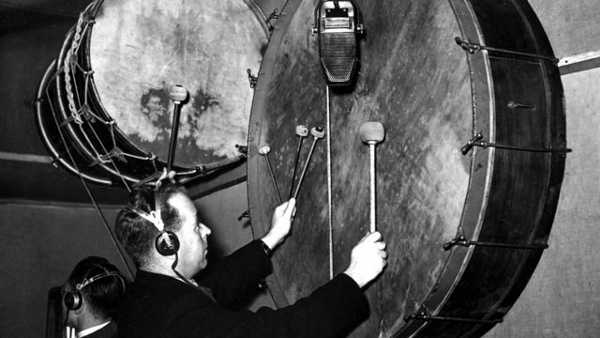
BBC sound effects recording

Record collector and DJ Jonny Trunk has created a new work made up entirely of BBC Sound Effects records. His Sounds of the 70s will be broadcast at 1025pm in Between the Ears on Christmas Day. Here, Jonny explains how he created the programme

The idea of mixing BBC sound effects records developed simply out of seeing them for sale over the years in all sorts of different places. As a record collector I come across these peculiar 7-inch 33rpm colour coded vinyl records every so often (at boot fairs, charity shops, online) and I’ve always found them well worth closer examination. As well as the expected and obvious sounds there will be recordings that only someone at the BBC would deem necessary, for example not one but four different sorts of Geiger counters were recorded for one single B-side. And these Geiger counters all sound the same. Other sonic delights I’ve collected over the years have include 'Big Pigs', 'Shopping At Woolworths' and 'Magical Wind'.

And because there are so many of them, I’ve often wondered (and discussed with fellow collectors) how many were actually pressed, how many full sets of sound effects records were actually made by the BBC, where they all ended up and exactly how many of these effects have been used over the years on The Archers. I’ve got a feeling 'Goats' has been used a few times.

Another important reason for putting the idea to the BBC was the faint whiff of nostalgia created by some of the more period recordings. Most of the singles are dated, so a trip into the 1970s brings stirring Bedford van noises, old parking meters and vintage fire bells to your ears - noises that these days are rarely heard.

And it was the idea of using just sounds recorded in the 1970s that nailed the idea, so the first step in the process was to spend a day at Radio 3 digging out every effect recorded in that period. Once these were in the bag, mixing them together could begin.

Actually putting the recordings together in some sort of order was both fascinating and a little frustrating. My first few runs were quite terrible. I began trying to build a simple story structure to the piece, so I’d start with man walking across sand, the man gets into a boat, the man rows the boat, the man gets out of the boat, the man gets into car and so on. But I soon realised that 1) this was incredibly dull and quite pointless and 2) it was the interplay between incongruous sound effects recordings that started sounding far more interesting – windscreen wipers and footsteps are particularly good. So, I scrapped all the work I’d done and started again from silence. The new piece began with the most musical recording I had found which was a 1970s spinning, humming toy, which has the most marvellous folky drone to it, not too dissimilar to a harmonium. But a harmonium does not begin with the up and down squeaky pushing noise which I really do like. Once this spinning drone was off and running I found it went well with a good few other sounds, especially one of Scalextric cars whizzing round a track. These noises were simple, but strangely unfamiliar when just heard as sound. And adding very slight, shorter sound effects behind or in front of them instantly added some curious dimensions.

I slowly built up both indoor and outdoor narratives, factory interiors, Covent Garden market, inside lifts and phone boxes, and began punctuating sequences with the simple noise of a portcullis rolling shut.

Over the 20-minute mix there are well over 120 recordings used, but some of these involve multiple recordings, so for example a light switch sequence that runs quietly for about 2 minutes involves anything from your standard home light switch to the giant industrial power station on / off lever.

The whole piece has been a joy to create, getting lost in some of the noises of my childhood (possibly the last time I heard a metal detector) and trying to turn them into something altogether more musical. Next year I might get busy with the 1980s SFX catalogue. Let’s hope so.

Inside TV's Christmas classical highlights

Blog comments are currently unavailable. Find out more.

Post categories:

Peter ManiuraPeter Maniura|17:32 UK time, Monday, 20 December 2010

Filming 'Sacred Christmas' with The Sixteen

Filming 'Sacred Christmas' with The Sixteen

Head of BBC Classical Music TV, Peter Maniura, introduces the BBC's Christmas music programmes and looks ahead to a broadcast highlight of the New Year...

For me, Christmas is all about 'raising your voice in song' - celebrating the season together and in community. Because we live in a period where people feel themselves to be 'time poor', it's also about finally being able to have the time to engage with some 'big things', and for broadcasters, that means being able to feed into the Christmas tradition of 'performance'. On Christmas Eve afternoon, BBC 2 has Mozart's Don Giovanni from this year's Glyndebourne Festival. I was lucky enough to direct this magnificent production for television, and it does transfer wonderfully to the small screen - it's a hugely challenging production, technically, but at the heart of the cast is the suave, satanic Gerald Finley: assuming you're at your holiday destination and you're not doing last-minute shopping, Christmas affords the time to sit back and enjoy it. Don Giovanni will also act as a curtain-raiser for Radio 3's The Genius of Mozart- another very 'big thing' which will bring you ten days of uninterrupted Mozart starting on New Year's Day.

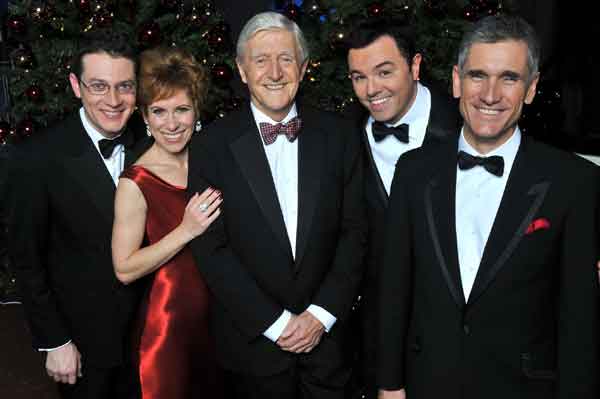
Conductor John Wilson with Sir Michael Parkinson and (l to r) Anna Jane Casey, Seth MacFarlane and Curtis Stigers

The stars of Swingn' Christmas

At the opposite pole to Don Giovanni is Swingin' Christmas - we're bringing Big Band Swing back into the mainstream in a programme conducted by John Wilson with his own orchestra and hosted by Michael Parkinson: we know from the MGM and Rodgers and Hammerstein Proms which we televised is that this music commands enormous affection, and increasingly large audiences - so it's a 'passion' project for us. Together with some soloists familiar from those Proms - Seth MacFarlane, Anna Jane Casey and Curtis Stigers - John Wilson and Parky will be shining some starlight on this wonderful music.

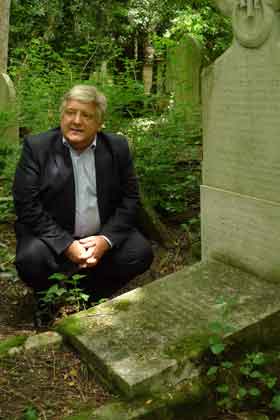
Presenter Simon Russell Beale at the grave of Christina Rossetti

Richard Morrison was writing in The Times last week about our Sacred Music series, which returns for two back-to-back programmes - A Christmas History and A Choral Christmas - on Christmas Eve. Richard quoted Harry Christophers, conductor of The Sixteen (who've been with us throughout the series), that 'being invited to do these Christmas specials makes us feel a bit like Morecambe and Wise'.

Sacred Music has been enormously successful with audiences and in the first of the latest instalments, you'll see Harry and presenter Simon Russell Beale, as they visit Oxford to look at a small scrap of paper - actually, it's part of the Oxyrhynchus Papyri, dating from 2nd century Egypt, and it contains the oldest known music notation and lyrics of a Christian hymn. Harry transcribed this Hymn to the Trinity, and in the programme, he and Simon perform it together. One of the great joys of Sacred Music has been the way in which we've brought scholarship like this into the centre of the journey over ten programmes: I attribute this in no small measure to the combination of talent which Simon and Harry offer - there is no genre of music into which you cannot draw an audience if you have the right mix of presenter and performers. Simon is pictured here at the grave of Christina Rossetti, who wrote the words forming the basis the carol, In the Bleak Midwinter, which features in the programmes.

Sacred Music of course sits happily alongside the traditional Carols from King's broadcast; for decades, Placido Domingo has also been a Christmas favourite on our screens and he's back on New Year's Eve with Rigoletto, his second baritone role this year, after Simon Boccanegra, and filmed 'live' in real time. Originally broadcast in three instalments, the repeat brings the whole opera together. It was a privilege to be part of the production in Mantua - it was my first experience of this great Renaissance centre, linked to the birth of opera through Monteverdi, and it's another opportunity to ttake our audience into the heart of opera as we did with Tony Pappano's Opera Italia series earlier in the year.

There's more - next February you'll be able to see Graham Vick's extraordinary production of Verdi's Othello, created in a disused industrial space with 250 Brummies as chorus, dancers and actors - the cast crowned by Ron Samm's towering performance in the title role. This is the first time a black tenor has performed the role in the UK, and there's an accompanying film, Director's Cut, looking at Graham Vick's approach to the production, and to his brilliantly extreme take on Aida on the floating stage at Bregenz, Lake Constance, which you may have seen on your screens earlier this year.

Programme information for the broadcasts can be found by following these links:

Get ready for a Swingin' Christmas

Blog comments are currently unavailable. Find out more.

Post categories:

John WilsonJohn Wilson|17:31 UK time, Thursday, 16 December 2010

Graphics for Swingin' Christmas

John Wilson and his Orchestra are currently riding a wave of popular acclaim following their televised MGM Musicals and Rodgers & Hammerstein Proms concerts in 2009 and 2010. BBC Classical Music TV cameras went to London's Air Studios to film a special live concert for the festive season: Swingin' Christmas features three singers who made their mark in those concerts – Anna Jane Casey, Seth MacFarlane and Curtis Stigers. Introduced by Sir Michael Parkinson, John Wilson's concert delves deep into theAmerican songbook, with some contributions also from noted British composers of swing music. Here, John describes the journey …

Swingin' Christmas came about as a result of the enormous audience reaction to our Prom concerts, which happily have been repeated several times on TV. The programme illustrates what we do best and I'm fortunate that as well as having crack musicians who love to play this music, and really know how to perform it, the orchestra contains a clutch of gifted arrangers who have pitched in to the programme. Ninety-five percent of my professional life is taken up with conducting – in all genres – butI've also been arranging and re-creating scores (especially film scores) for about ten years: as many people were shocked to find out when we did the MGM Prom, huge quantities of the original scores had been wantonly destroyed and it was a work of painstaking reconstruction to bring them back to life.

Sometimes you are working from a so-called piano-conductor score, and you orchestrate from that; in extremis, you might be doing dictation solely from listening to a recording. People ask, 'How do you know what to do?' and the answer is that over time you get to know the house style of the film studios concerned, and the techniques used by individual composers gets under your skin. And to this mix you bring your technical knowledge - in my own case I spent 10 years working with Robert Farnon, as a copyist, assistant and proofreader and I learned a lot from that experience.

I got to know and love swing because it was coming out of the radio and TV when I was a kid - my parents listened to it, and so did I – I remember Alan Dell's programmes on Radio 2 so it's always been around me. As Sir Thomas Beecham said, it enters the ear with facility and leaves it with difficulty. Swing music has certainly dipped out of fashion in the last 20-30 years; but as time passes it gets re-evaluated, and we've found that peoplewant to listen to it again.

Conductor John Wilson with Sir Michael Parkinson and the soloists

Conductor John Wilson with Sir Michael Parkinson and the soloists

The swing orchestra is like a symphony orchestra with a dance band in the middle of it. It came out of American jazz in the 1930s and by the middle of the decade it had become a distinctive style – Glenn Miller would be a good reference point that most people know. Swing was the pop music of its day: we're 70 years on from that now, but it seems just as relevant to the generation born – as I was – in the 1970s and after. It's timeless and not just a vehicle for nostalgia: I feel that people nowadays are more broad-minded and inclusive in their listening – they will always recognise excellent, well-written, melodic music with the capacity not just to entertain but to thrill. There's nothing old-fashioned about it and, especially with a new generation re-interpreting it, I feel it's here for good – I hope that Swingin' Christmas will help to get the music out there to new ears, as well as delighting people for whom it was 'their' pop music.

The Swingin' Christmas programme is quite a showcase for the music, although there is so much material that I could have put together about 12 evenings of concerts (how about it, BBC?). But to give you just a flavour, I've included a 'Big Band Symphonic Medley' arranged by Andrew Cottee: it's all the signature tunes of all the most important bands; Ihaven't missed any important band out – there are 13 in all, and I think each melody gives you the flavour of the original band – the moods are a mixture of swing and sentiment. Then it's just for the instruments and leaders themselves to play it to you – you'll get an Artie Shaw clarinet solo, a Tommy Dorsey trombone solo, and of course you'll get 'Moonlight Serenade' from Glenn Miller – it's very wide-ranging and colourful.

  • Swingin' Christmas is broadcast at 9.20pm on Christmas Day, on BBC 2 TV
  • Read a biography of John Wilson
  • Visit the John Wilson Orchestra website
  • A big boost for listening quality ...

    Blog comments are currently unavailable. Find out more.

    Post categories:

    Gabriel GilsonGabriel Gilson|11:54 UK time, Wednesday, 15 December 2010

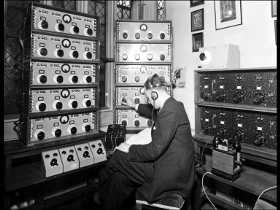
    A BBC outside broadcast sound engineer in 1937

    Interactive Editor Gabriel Gilson writes about the return of the extra high quality audio stream for Radio 3, and the Genius of Mozart season

    Yes, 'HD Sound' is back and it’s back for good. From today, if you click on the link near the top right of the Radio 3 website you’ll get the extra high quality stream. If it doesn’t work for you or you want to make a comparison, you can still get the ‘normal’ stream via the usual listen live links.

    If you’d like to know just how much better it is and why, have a read of our FAQs.

    It's hard to know when new technology will help and when it’ll get in the way. With so many possibilities online, sometimes the hard bit is working out what not to do rather than what to do. But this time, the bits are working harder for all of us and we're all benefiting!

    Read the rest of this entry

    Backstage at Choir of the Year 2010

    Blog comments are currently unavailable. Find out more.

    Post categories:

    Margaret CameronMargaret Cameron|16:53 UK time, Tuesday, 14 December 2010

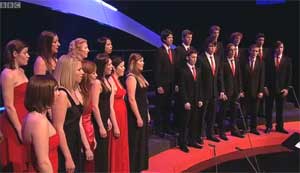
    Choir of the Year 2010 winners, the Wellensian Consort

    The BBC Singers were invited to sing during the judges’ deliberations at the Grand Final of Choir of the Year 2010 in the Royal Festival Hall. Alto Margaret Cameron takes up the story ...

    I arrive at the hall for our stage rehearsal and immediately feel the buzz of anticipation backstage. Someone is rushing a clean and pressed shirt to one of the competitors, others are making their way purposefully to warm-ups, or chatting excitedly on their way back to dressing rooms. We are getting our make up done later as the concert is being televised, so we have been asked to turn up with none on at all. Is that why we look a little pale against our black suits as we walk out onto the brightly lit stage, or is the atmosphere of collective nervous anticipation in the building affecting us too?

    The day must run to a very strict timetable, so the rehearsal is soon finished and we are free to eat some lunch. Some of us sit in the foyer and enjoy the brilliant winter sunshine over the Thames. The place is packed – there is a project happening where people are invited to write on the windows with coloured pens about what makes them happy. Girls with bright coloured rosettes in their hair appear and excitedly greet friends and family – they must be competitors. Time for me to go and get brightened up with some make-up.

    Putting on your make-up is one of the best parts of preparing for a performance. There is something calming and focussing about it all at the same time. The experience is all the better when someone else does it for you, and is enhanced on this occasion by musical accompaniment from Rainbow Connection Singers who are doing their final pre-concert warm up next door. They are impressively slick and I’m looking forward to joining the audience for the main part of the show.

    All six choirs taking part this afternoon have either won or excelled in the group stages of the competition and now they are competing for the overall prize, BBC Choir of the Year 2010. After an introduction by Aled Jones and Josie D’Arby, the first choir onstage is the Holles Singers, from The Lady Eleanor Holles School in Hampton. They sing beautifully together, and show their versatility in different musical styles – classical, traditional Georgian and musical theatre, this last incorporating some pretty cool choreography. Next are the Wellensian Consort, all former singers at Wells Cathedral School who started their choir to maintain friendships forged through shared musical experience while at school. It is interesting to hear the difference that a few more years of vocal development makes to the tone quality, which has added warmth, beauty and colour. I hope this inspires the younger choirs to keep singing into their adulthood. After two pieces in immaculate classical style, they surprise us with a rendition of the spiritual, Didn’t my Lord deliver, which really rocks. Concluding the first half of the concert are the Warwickshire County Boys’ Choir, founded as recently as 2008 by Garry Jones, who was concerned about the shortage of boys coming up into the county youth choir and decided he must do something about it. He has built up a choir that comprises over 100 boys aged from 8 – 13, of whom about 60 now appear on stage. They impress me with their vitality, engagement and sheer enjoyment of singing together. They completely charm the entire audience and panel of judges.

    Read the rest of this entry

    Checkmate: chess ... on the radio?

    Blog comments are currently unavailable. Find out more.

    Post categories:

    Abigail AppletonAbigail Appleton|16:25 UK time, Monday, 13 December 2010

    Chess pieces
    My brother, who lives in Denmark, likes to pretend he will never forgive me for once having given him a large and very heavy mirror for Christmas. At the time he had very young children and the journey back to Denmark after a Christmas in England was hard enough without lugging outsize bags. It’s become a joke between us so that when last year I spent Christmas with him in Denmark (with my own young children) I wasn’t surprised to see a large, unwieldy present with my name on it under the tree. It turned out to be a carved, wooden chess set, as large as a small table, and a thing of beauty. We got it home with difficulty and it’s now greatly loved though it stimulates far more chess stories and observations than it does actual games.

    Chess, it seems, has always attracted craftsmen, artists and conversation as well as players. Whether or not you know the rules of the game, its language and concepts are pervasive and over the next week on Radio 3 we’ve a short season, Checkmate, exploring the game’s extraordinarily rich history and culture through a range of discussions, talks, and drama. Night Waves will be looking at the relationship between chess and intelligencetonight,andtomorrow, the vexed question, for some chess lovers, of the rise of poker.

    There’s also a wide ranging week of chess talks in The Essay, including a fascinating look at the history of chess on the air waves from the radio historian David Hendy (that's Wednesday's Essay). He describes how the forerunner of today’s Radio 3, The Third Programme, launched a dedicated chess series in 1958 which ran for six years. There were dilemmas and debates behind the scenes with one producer instructing his presenter above all to ‘avoid the subjects of women and lunacy’, though this turned out to be impossible. On Tuesday the novelist Anuradha Roy explores the place of chess in Indian culture where the game is said to have originated. Today in India, she says, middle class children are encouraged to play the game in the hope of improving their exam results and landing a plum job. On Friday Ukranian thriller writer Andrey Kurkov narrates the sometimes murderous history of chess in Russia. ‘Ivan the Terrible’, a keen chess player, reportedly died at the chess table. Was he murdered by poisoned chess pieces, Andrey Kurkov speculates?

    Listen out for readings from some of the many literary portrayals of the game in Breakfast and Afternoon on 3 as well as some chess related music, whilst next Sunday (December 19th) there’s an adaptation of Stefan Zweig’s classic chess novel The Royal Game.Paul Rhys gives a totally absorbing performance as the mysterious and broken Dr. Berg. The Sunday Feature that follows includes some of the week’s most striking contributions, from author and chess champion John Healy. ‘It’s a blood sport, it’s a psychic hunt’, he says and powerfully describes the effect on his own life when he learnt to play chess as an inmate in Pentonville prison, finding a path to a different life through the game.

    I wouldn’t claim listening to Checkmate will be life-changing but I hope it will be fascinating. Perhaps, with Christmas on its way, the Checkmate season will prompt a few listeners to evoke the spirit of The Third Programme's chess series and have a game. With my brother visiting us again this year I’m thinking of burying the hatchet and buying him a small and very light, travelling chess set.

    On the Trail of the Snail

    Blog comments are currently unavailable. Find out more.

    Post categories:

    Alan HallAlan Hall|11:40 UK time, Wednesday, 8 December 2010

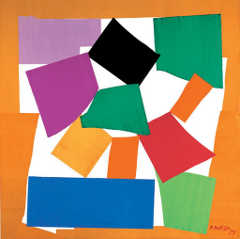
    Matisse's The Snail

    Matisse's The Snail

    Independent producer Alan Hall has curated an unusual broadcast in the Betweenthe Earsseries - five celebrated radio producers from around the world contribute their personal responses in sound to Henri Matisse's The Snail, the paper cut-out collage that hangs in Tate Modern, London. You can hear the programme at 9pm on Saturday 11 December. Here, Alan describes the inspiration for the programme.

    I can’t remember when I first saw Matisse’s Snail – on a school trip, presumably. But then I can’t recall a time when this playful arrangement of coloured cut-outs, spiralling snail-like within a vast canvas hasn’t been familiar. It used to hang in Tate Britain, filling its own wall. For the last ten years it’s been at Tate Modern – on display, as postcards, posters, adorning exhibition catalogues. To my mind, it’s the iconic image in the Tate collection.

    And why it still holds the imagination becomes easier to understand as time passes. My child’s eye was caught by the ‘playschool’ colours and Matisse’s invitation to play a game relating his extraordinary image to the everyday title on the wall – The Snail. This direct statement that what I’m looking at is a snail – and not just coloured paper in a frame - never troubled me. The Snail is a snail, though it isn’t literally a snail. The Snail doesn’t have to look like a snail to be a snail. It represents a snail. It captures snail-ness. Like most viewers, I think, I ‘got’ this early on. Matisse takes us beyond the appearance of a thing to its deeper truth. And this is what has endured and still appeals. 

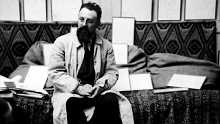
    Henri Matisse

    Henri Matisse (1869-1954)

    With maturity comes a closer understanding of how Matisse was able to make this image when he did. And why. He was old and ill and could no longer paint or sculpt as he had. But he still had to make, to create, to represent - so instructed his assistants to try out different patterns of paper cut-outs, hanging them on his studio wall. And he settled on this image - the spiral with its resonances in so many natural forms, its sense of movement, its spinning-top mischievousness. But more than that, it demonstrates a profound creative inventiveness that confounds the artist’s diminishing faculties and reveals a life-affirming expressive energy in the elderly man who conceived it.

    Read the rest of this entry

    All the news ...

    Blog comments are currently unavailable. Find out more.

    Post categories:

    Roger WrightRoger Wright|16:08 UK time, Thursday, 2 December 2010

    Another busy week for Radio 3 has reminded me of our need to find ways, in our busy time-poor world, of spreading the word about the station's programming.

    Andy Kershaw

    Andy Kershaw

    Last Friday we had a launch event for a special one-off series called Music Planet which will begin on Thursday 13 January. It is an eight part series related to the latest BBC Natural History Unit BBC One spectacular called Human Planet. Andy Kershaw will return to Radio 3 to present the programmes which will feature world music recorded on location around the globe. It promises to be a fascinating opportunity to hear little known music from far-flung cultures.

    Choir of the Year 2010 - The Wellensian Consort

    Choir of the Year 2010 - The Wellensian Consort

    On Sunday I went to the Choir of the Year final at London's Royal Festival Hall. It was a really special occasion, still available to hear on bbc.co.uk/iPlayer after our broadcast on Monday evening. Aled Jones was, as ever, a genial host and the feelgood factor, particularly from hearing what the young choirs have achieved, was enormous - a snapshot of what Aled features every Sunday evening on The Choir.

    That was followed two nights later by the British Composer Awards. These awards are a great reminder of the compositional talent which we are fortunate to have in such abundance at the moment in the UK - from familiar and increasingly established names such as Brian Elias and Ryan Wigglesworth to relative newcomers like Cheryl Frances-Hoad (who won two awards) and Sasha Siem

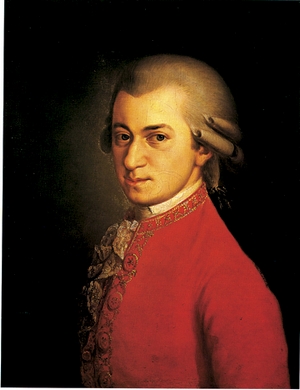
    Mozart

    Mozart

    Following on from the groundbreaking success of our Beethoven Experience and Bach Christmas we have also just announced the latest in our single composer extravaganzas. The Genius of Mozart will run from January 1st - 12th and will feature his complete works, including a lot of live music as well as contextual programming, including Peter Shaffer's play Amadeus.

    What all these programming initiatives have in common is that they are all different ways in which to draw attention to what Radio 3 does on a daily basis. Live music (be it classical, jazz or world), debate, discussion, drama, recommendations, music sequences and music in context - it’s all there regularly on Radio 3 - and so these special series are consistent with the station's output throughout the rest of the year and I hope that they introduce more listeners to R3 and its rich and varied programming.

    With a song in my heart ...

    Blog comments are currently unavailable. Find out more.

    Post categories:

    Fiona TalkingtonFiona Talkington|13:45 UK time, Wednesday, 1 December 2010

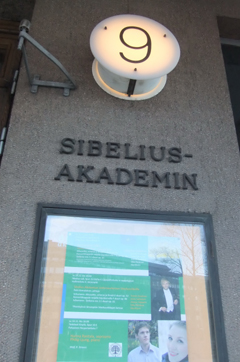
    Helsinki Academy entrance

    Helsinki Academy entrance

    It's always so inspiring to walk through the doors of the Sibelius Academy in Helsinki. That overwhelming sense of history and sense of adventure.

    My visit this time coincided with a symposium hosted by the Academy as part of the project MORE%20-%20Music,%20Orality,%20Roots,%20Europe - funded by the EU Culture Programme, and led by Cite de la Musique in Paris, with co-organising partners The Sage Gateshead, En Chordais in Thassaloniki and the World Music and Dance Centre in Rotterdam. Summer schools in Rotterdam and Gateshead, and symposia in Paris and Thessaloniki as well as Helsinki, will feed into EU research into trans-cultural music practices in educational methods. How does traditional and folk music fit as a tool of intercultural communication in a multi-cultural Europe?

    Two days of speakers and lots of music courtesy of the ever-creative Finnish musicians and coinciding with Finland's world music festival Etnosoi certainly helped us to exchange ideas about what can and is being done. Among the speakers were Sarah Kekus from The Sage Gateshead who talked about their French language music project for children - 'La Chanson du Retour'; Veera Voima helped us to improvise with her Helsinki-based multinational folk choir; Soili Perkio reminded us of the fun and challenges of children's playground games, and we were all mindful of how hand-held technologies seem to be overtaking traditional games. 

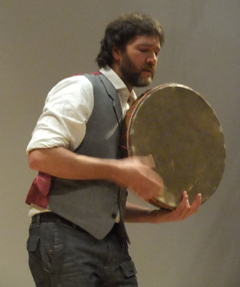
    Nick Hennessy

    Nick Hennessy

    Nick Hennessy enthralled us with his storytelling (he presents the Finnish epic Kalevala to Finnish audiences in English, reviving their own cultural heritage); Vilma Timonen showed us just how far the kantele has come since Vainamoinen fashioned it from the jawbone of a giant fish, so legend has it. And charismatic violinist Mauno Jarvela (whom Late Junction listeners will know from the great Finnish band JPP) brought tears to our eyes with an example of his Nappari project: my first encounter with that was watching him inspire around 150 musicians, from toddlers upwards, to play music as if with one voice. The project has gone from the small Finnish town of Kaustinen already to South Africa.

    The generosity of spirit of many of the Finnish musicians who were around was as evident as always. Accordionist Kimmo Pohjonen went to support a young protege of his in concert, and Timo Alakotila, one of Finland's most in-demand composers, arrangers and performers (with JPP, Karen Tweed and so many more) was there to hear the young students perform.

    Mauno Jarvela

    Mauno Jarvela

    But those knotty issues: how do we use music in a multicultural Europe? What do we share? Can we share a vision for a musical Europe where each country is different in its traditions, in its infrastructure, its funding of the arts, its support of musical education. The debate is ongoing, and the next symposium will be in Greece.

    I came away with a song in my heart and an envy of the way the Finnish educators value music and renewed admiration for the brilliance and humility of the musicians I heard and spoke to from Finland and beyond.

    • Fiona's experiences in Helsinki will be reflected in her forthcoming Radio 3 Late Junction programmes, on 7, 8 and 9 December. 

    More from this blog...

    Categories

    These are some of the popular topics this blog covers.