
The long and the short of the LNOTP
Post categories: Proms, behind the scenes
 |15:08 UK Time, Tuesday, 14 September 2010
Every year, before an international TV and Radio audience of millions, the Last Night of the Proms' conductor singles out the BBC Symphony Orchestra for special praise. But what's like being on the receiving end? Sub-principal viola Phil Hall has the answer ...
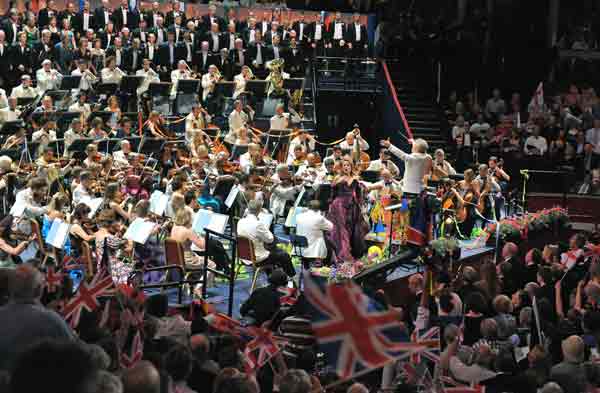
The Last Night of the Proms 2010. Photo: © Chris Christodoulou
It is something of a mixed blessing to be known as 'the orchestra that does the Last Night of the Proms'. For some it's a no uncontentious, flag-waving knees-up, but for others it's a fitting celebratory concert marking the end of the largest classical music festival in the world. For the BBC Symphony Orchestra, it's our longest and most exposed concert of the year. In fact in terms of global coverage, apart from the Vienna Philharmonic's New Year's Day concert, I can think of no bigger regular gig in the world. Put that at the end of a busy summer, and it's not surprising that some of us are feeling more than a little jaded right now. I'll be honest, after 18 Last Nights some of the novelty has gone (I always tell new players that the first one is your best); but, my, when you walk out through the famous 'Bull Run' and on to the stage for the second half, that party atmosphere hits you right between the eyes every time. Sitting at the front of my section, I'm also hit on the head by party poppers, of which the violas seems to have an inexhaustible supply. As fast as I pull the streamers off my viola bow, another arrives. I'm sure they aren't all aiming at me but it's not doing my paranoia any good...I'm lucky if I can get the bow ready in time for the first number!
One thing that makes it interesting for us players (apart from seeing our female colleagues in their pretty and colourful dresses) is the choice of a non-British conductor: not only how they interpret the usual Last Night fare (some rehearse it more than others) but how they control and interact with the spontaneity of the crowd (ok, audience).
This can make or break the event. In the public mind, there seems to be an expectation that a British conductor should do the Last Night, 'though recently, for my money the only Brit who really took to it like a duck to water was Sir Andrew Davis. However, Leonard Slatkin, a natural raconteur and anglophile, didn't bat an eyelid, despite having the unenviably difficult task of dealing with it a few days after 9/11. Similarly, his compatriot David Robertson last year seemed undaunted. Maybe these loquacious Americans are more used to massed social interaction than us reserved Brits. Or perhaps it is just that they aren't saddled with the baggage of Last Night Tradition, having not grown up with it. They also didn't seemed unduly worried by The Speech.
When I got married 19 years ago, the one person more nervous than I was my Czech father-in-law. 'Do I have really to make such speech in English?' he pleaded. 'It's a tradition in this country,' I replied, passing him another (Czech) beer and completely brushing away the fact that the poor chap would have to speak in public in a language foreign to him. However I could tell Jiří Bělohlávek had done his idiomatical homework, since at Friday night's rehearsal he beamed: 'Now we rehearse Parry's Best pair of Nylons!' He muttered some remarks about various versions of You'll never walk alone - I had no idea he was so au fait with Rodgers and Hammerstein arrangements and that set me off on a momentary fantasy: Jiří conducting Carousel with the John Wilson Orchestra at Liverpool's football ground, Anfield... I reeled myself back into reality and asked how his Last Night speech was progressing. He said that he was going to rely on the inspiration of the evening... (I secretly hoped he was half-joking). But, fortunately, as at my wedding, the speech was short, sincere, without notes, and to the point. Who could ask for anything more?
- The Last Night of the Proms on BBC1, BBC2 and Radio 3 is available for three more days on the BBC iPlayer
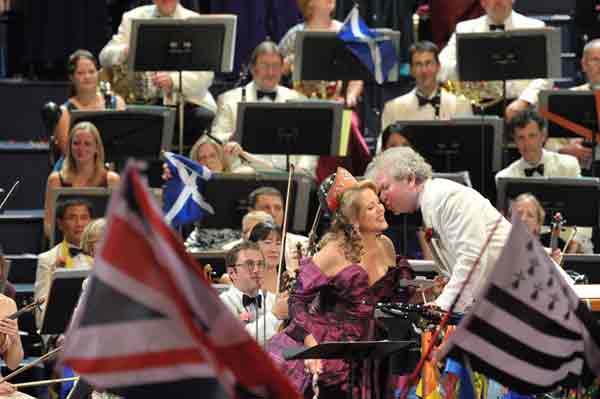
Conductor Jiří Bělohlávek with soprano Renée Fleming. Photo: © Chris Christodoulou

Comment number 1.
At 20:17 13th Oct 2010, bluestateprommer wrote:Unfortunately, I couldn't get in to the LNOP during my recent trip to London, so I had to settle for the last 40 minutes on TV after getting back from another concert. I wonder if you and the orchestra sort of relieved not to play the "Fantasia on British Sea Songs" for several years now, to avoid the year-after-year "here we go again" aspect of it, as opposed to the audiences who keep asking for it with no realization of how mind-numbing it can be to do every year. Of course, then comes the challenge of coming up with a different hornpipe number each year for the audience to clap along to. But anything that breaks the cult of personality of Malcolm Sargent is OK, that I can tell, and if that means pulling back on the FoBSS, so be it. However, at the risk of sounding somewhat self-contradictory, it seems sensible to keep "Rule Britannia", "Land of Hope and Glory" and "Jerusalem" each year. At least those are shorter works. Plus, the Britten arrangement of "God Save the Queen" at the end was a brilliant move.
Complain about this comment (Comment number 1)