
The Proms Archive - how did it get there?
Post categories: Proms, behind the scenes
 |11:21 UK Time, Wednesday, 7 July 2010
Proms Publications Editor
Sound the trumpets! For the first time, the entire history of the Proms is available online ... it's only taken us four years.
The raw data for the Archive - already a media talking point following Monday's launch - was taken from a complete set of Proms Guides and programmes held in the Proms office at Broadcasting House in London. This has always been a working resource for the Proms team, and the condition of some of the older volumes has deteriorated through years of wear-and-tear - thankfully, we won't have to turn to this physical resource so much now that the information is online. The research work was carried out by a small team of part-time freelance researchers - the team consisted of a composer, a music journalist, a practising musician, and a former civil engineer (all with a necessary but rather unnerving obsession with accuracy and attention to detail). Our colleague
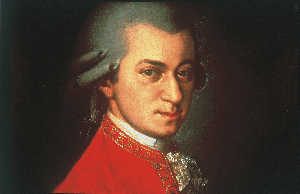 The database is in fact an amalgamation of three existing databases. The largest of these was on a system called 'Cardbox' and was only available to a handful of users within the BBC network. Once the three old databases had been combined, one of the biggest challenges for the researchers was combing multiple versions of the same entry. For example, Wolfgang Amadeus Mozart (left) cropped up 27 times, with 746 works; he's now been reduced to a single composer entry with 185 works.
The Archive is of course a live resource, and with another Proms season about to launch, the plan is to update the database throughout the season, ideally early on the first working day following each performance.
It will come as no surprise that the 'front end' of the Archive, as it appears on the internet, is the tip of a huge iceberg of information - maybe an 'ice-sheet' would be a better description because so much of the detail is cross-linked. On the face of it, the Archive is a simple list of concerts; as such, although we know that some Proms fans take an interest in the history of the music which borders on the obsessive, it's been really encouraging to find so much general interest in the Archive. It has featured on Radio 3's In Tune and Breakfast this week, the Radio 3 messageboarders are talking about it, Radio 4 picked it up on Monday, it took up most of page 4 of the Times and featured in Tom Service's Guardian blog; the BBC Music Magazine and Gramophone websites are also running stories.
We're hoping that the core data we've just released - who played what, when and where - will just be the starting point. There is plenty of potential for the database, both as a social site for our audiences to share their Proms experiences, and as the basis for academic research (we are very excited about further collaboration with the music department at King's College,
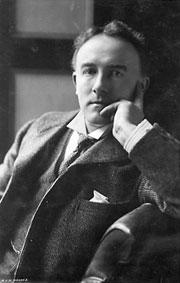 The database has thrown up a huge number of interesting facts. I had no idea that Proms concerts had been held in
We've launched the Proms Archive - could someone now invent a time-machine?

Comment number 1.
At 14:54 7th Jul 2010, french frank wrote:And an excellent piece of work, for which musical anoraks of the world will unite in gratitude.
Complain about this comment (Comment number 1)
Comment number 2.
At 21:58 7th Jul 2010, Petrushka wrote:I bow down in gratitude to all who have worked on, lived and breathed this project for the past 4 years.
From a Prom-goer since 1978 and listener since 1970, many thanks.
Complain about this comment (Comment number 2)
Comment number 3.
At 16:35 8th Jul 2010, Richard van Ginkel wrote:What a magnificent job al concerned have done: I searched for my first proms down in 1983. All those happy memories came back. Thanks to all!!
The BBC can make it heaven - a real time-machine - by combining this data-base with links to all the radio- or tv-recorded concerts. Imagine: One click and we all can listen to the actual concert. Wow, that should be heaven .... and a very large database, I presume.
Complain about this comment (Comment number 3)