BBC BLOGS - Radio 3 Blog

Archives for July 2010

Send for the Doctor!

Blog comments are currently unavailable. Find out more.

Post categories:

Katy AustinKaty Austin|16:46 UK time, Monday, 26 July 2010

Katy Austin is editorial assistant in the team at the BBC Proms. As a member of the London Philharmonic Choir, she took part in the Doctor Who Prom ...
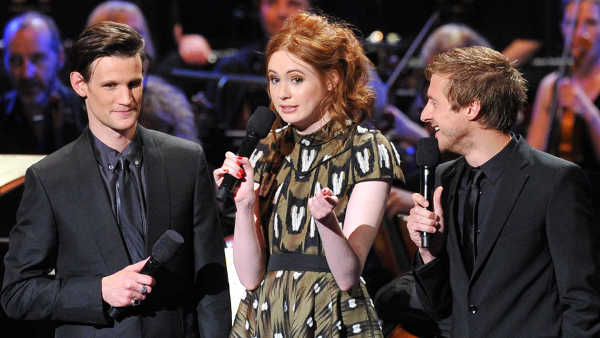
doctor_who_trio_600.jpg

It's a breathtaking experience, performing in, or attending, the Doctor Who Prom. We haven't even got to the concert yet and a week of intensive choral rehearsals has made my throat - to use a drastic understatement - rather less than moist. As singers in the London Philharmonic Choir, however, we're individual members of a cast that is vast in number, age-range - and relentless energy. Everyone at the Royal Albert Hall tonight has worked up a thirst to make this concert an exceptional occasion - it seems to be doing the trick.

This Prom brings out a special kind of energy. Something is in the air at the Hall, and it's not just the clouds of stage smoke from the dry ice. Matt Smith, Karen Gillan and Arthur Darvill, the actor stars of Doctor Who, share the Green Room with the BBC National Orchestra of Wales's conductor Grant Llewellyn, and the charismatic orchestrator and conductor Ben Foster (who bears an alarming resemblance to the previous Doctor, David Tennant).
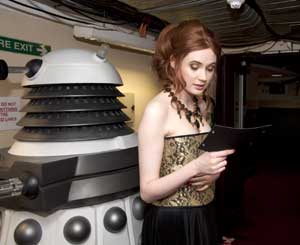
dr_who_backstage2_300.jpgWaiting backstage before the concert amongst a flurry of camera crews, stage managers, performers, and incongruously coffee-drinking semi-costumed monsters, it strikes me that what everyone has in common is an urge to make this concert go with a bang - it needs to excite young and old alike. As Karen Gillan stands outside her dressing room amongst the TV crew, she balances autograph pen and hot dinner in her hands, as excited to be here as the rest of us. She does, however, get mobbed a little more than most of us, and clearly senses the responsibility she carries not just as an actor but as a character in a drama: this hits home when she tells me that introducing 'O Fortuna' from Orff's Carmina Burana and all the other musical items to the audience is a lifetime opportunity. Simply mentioning her love for it onstage will surely help to attract young audiences at an age when they are still devouring new interests.
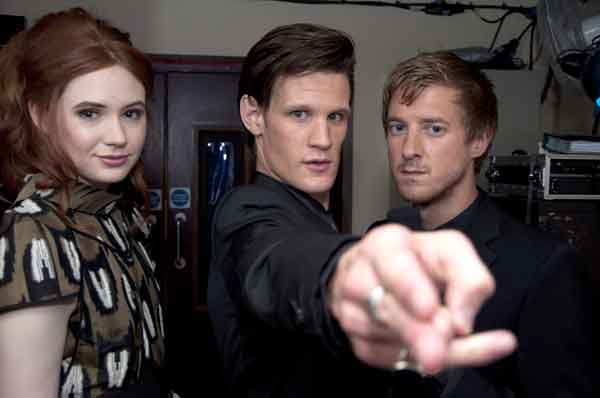
dr_who_backstage1_600.jpgArthur Darvill, aka Karen's husband 'Rory' in Doctor Who, is also a guest host tonight, and is quick to voice his approval. As a lover of musical theatre he admits that he thinks young people are more attracted to it as a genre, but sees the Proms as a vital instrument in introducing them to classical music as well. 'So many people sit in front of the TV all day, but the Proms are exactly what the BBC's for and what I love most about the BBC,' he told me. 'I wanted to do tonight because here, kids are being exposed to something brilliant. The Doctor Who Prom gives children something out of their normal experience, and having that experience can lead them to have an enthusiasm for classical music that they would not otherwise have discovered.'
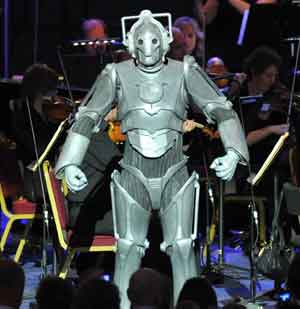
cyberman_prom_300.jpgSo, next to heart-pounding selections from Murray Gold 's Doctor Who music, and Carl Orff, the concert planners have been careful to include John Adams's Short Ride in a Fast Machine, and 'Mars' from Holst's The Planets; in doing so, exposing the audience - which is full of mums, dads and grandparents - to a wide range of classical, contemporary and film music.

Two hours after the start, it's all over, and it seems that the roaming aliens, idolised actors, charismatic conductors, and massed musicians and technical crews have succeeded in introducing the next generation to classical music concerts as events to enjoy rather than endure. When the audience are introduced to the new-look Daleks for the first time, I can see smiles on their faces. It's impossible not to enjoy the spectacle but everyone seems comfortable with both orchestral music of the highest calibre and the glamorous overall effect. As one audience member named Mike, from Northern Ireland, commented to me at the end of the evening: 'It's been a very brave venture ...' 

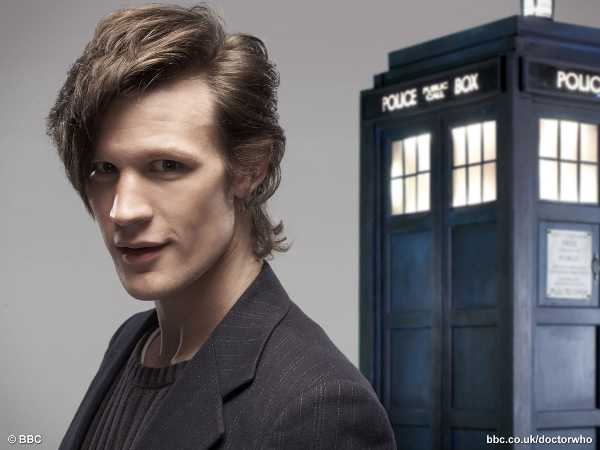
  • The top, bottom and Cyberman photos are © Chris Christodoulou/BBC; backstage photos are © Christopher Frowen /BBC. Pictured are Matt Smith (The Doctor), Karen Gillan (Amy Pond); Arthur Darvill (Rory). Below, a new-style Dalek commands conductor Ben Foster to get a move on, or BE EXTERMINATED!!!
  • Click this link for a Doctor Who Prom Photo Gallery

  • The Doctor Who Prom is available to listen to until Friday 30 July. Click this link for the BBC iPlayer

  • The Doctor Who Prom has been recorded for future broadcast on BBC 3 Television
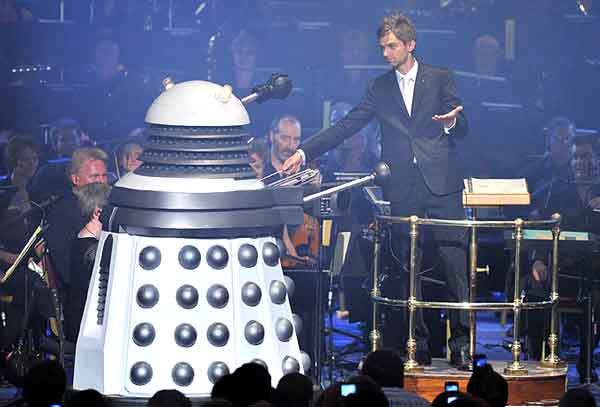
dalek_ben_foster_600.jpg

Doctor Who's in the queue ...

Blog comments are currently unavailable. Find out more.

Post categories:

Petroc TrelawnyPetroc Trelawny|23:59 UK time, Saturday, 24 July 2010

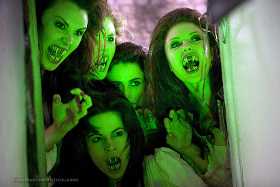
doctor_who_600.jpgdoctor_who_vampires_280.jpgI'm writing this in the Radio 3 Production Office in the basement of the Royal Albert Hall. In the backstage café earlier I stirred my tea watched by a quartet of glamorous vampires, one of them managing to nibble a chocolate bar despite her costume teeth.

cybermen_280.jpgIn the food queue later, I watched two Cybermen, headgear temporarily removed, debate the merits of beef stroganoff verses Thai chicken curry. Meanwhile Matt Smith, one of television's hottest properties, calmly queued with the rest of the production team for his dinner.

It's Dr Who Night at the Proms - the hall sold out for the first of two musical celebrations of the Time Lord and his gang. There will be an interesting mix in the arena: seasoned veterans of dozens of Prom seasons, alongside newcomers visiting for the first time. Let's hope the glorious experience of music making in the Royal Albert Hall soon brings them back again. Maybe the time-travelling Tardis will help sow the seeds for a new generation of Prommers ...

Read the rest of this entry

More from Molde ...

Blog comments are currently unavailable. Find out more.

Post categories:

Fiona TalkingtonFiona Talkington|22:45 UK time, Saturday, 24 July 2010

Fiona Talkington continues her blog from the Molde Jazz Festival

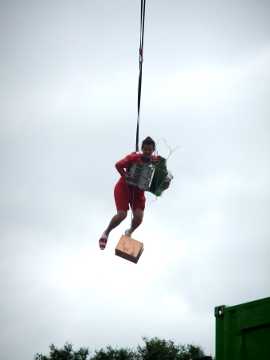
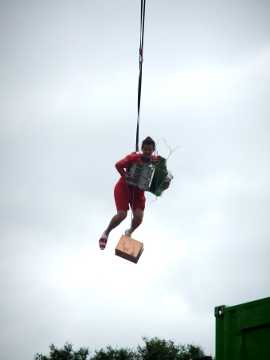
tori_wranes.jpgWatch out Womad! Farmers Market are on their way to you and they are in mischievous mood! If you can't get to Womad in person don't worry, we'll be recording them for next week's Late Junctions. But tonight Farmers entertained the midnight revellers in the park here in Molde with a mixture of brilliant playing and zany humour. A good end to Moldejazz Day 1 and I realise just how much my feet ache. The day began with a ceremony to lay the foundation stone of the new Library, Theatre and Jazz House. The Norwegian Minister of Culture, Anniken Huitfeldt, gave a speech and the Japanese Shibusa Shirazu Orchestra performed some intriguing dance and mime. and I assumed there would be a brick, some concrete and a trowel. But no! The foundation stone arrived carried by Tori Wranes (left), accordion player and singer, who was swung into view by a huge crane and slowly lowered to the ground, singing and playing! Later on Nils Petter Molvaer gave his first concert as artist in residence, teaming up with Ethiopian singer Gigi, and Bill Laswell. Nils Petter has a huge following here and produced some magical sounds. Looking forward to him playing with our own Spin Marvel tomorrow.

My favourite venue here in Molde is the Kulturhuset, a small building on the hill overlooking the town, and this was where In The Country proved yet again not only that they are superb performers but that their music continues to explore emotional and creative depths. Morten Qvenild (piano) (also of Susanna and the Magical Orchestra), Roger Arntzen (also Ballrogg) on bass and Pal Hausken on drums. It certainly goes down in my list of memorable Molde gigs.

It's raining, the mountains are covered in cloud, but it's hard to dampen the spirits of a town steeped in 50 years of jazz and festival fever.

Read the rest of this entry

Creating the Proms Online Quiz

Blog comments are currently unavailable. Find out more.

Post categories:

Philip MattisonPhilip Mattison|17:12 UK time, Monday, 19 July 2010

Radio 3 Interactive producer Philip Mattison brought the Proms Quiz to the website. Here, Philip lifts the lid on what was involved ...

In a spirit of 'they've got one so we want one too' (see Popmaster, Glastonbury Quiz, World Cup Quiz,) this year we've created the first ever BBC Proms Online Quiz!

The Quizmaster 'application' was originally created by an independent company called Kite to give audiences to Ken Bruce's Radio 2 show, Popmaster the chance to have a go themselves. Ken pops up in between questions and at the end gives helpful comments such as (when I was playing it anyway...) 'that must be your specialist subject' after a clip of Tammy Wynette singing 'Stand by your man'... hmmm.

The tone of the quiz needed looking at to make it appeal to audiences for the Proms (who pride themselves in really 'knowing their stuff'), but we were also keen for it not to lose the element of fun which was so appealing in the original ...

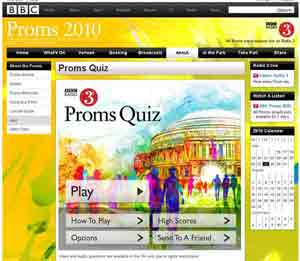
proms_quiz_300.jpgThe design of the quiz went through various drafts before it became apparent that we should just stick with the colourful design already being used on the Proms Guide, website, and posters etc. Other pressing issues like the number of multi-choice options and the appropriate sound effects (harp, triangle, trombone glissando?) were also thrashed out. For quite a while the 'dummy' sound effect given for an incorrect answer remained a Glastonbury cow's moo (it was tempting to leave this in). And for the theme tune? What else but Elgar's Pomp and Circumstance.
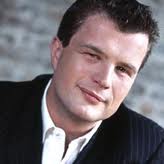
petroc_trelawny.jpgOur voiceover artist became the inimitable Petroc Trelawny who read out probably the most boring script he'd ever been confronted with 'Well done, Correct, Good stuff, Try Harder etc etc) without a word of complaint and even contributed a few suggestions of his own, including a memorable Leslie Phillips-style 'Ding dong' (which was sadly dropped..).
Questions were being furiously compiled by Phil the question-writer (his specialist subject for Mastermind is now the History of the BBC Proms) and checked off, tweaked, rewritten and remarked over ('I didn't know that?!') by myself and Radio 3 Interactive Editor, Gabriel.

A few favourite questions (including about an unmentionably rude cantata by Mozart) were reluctantly let go along the way...

The last couple of years of Prom concerts were raided for audio and video examples through the attractively named BBC system AutoROT ('Recorded On Transmission', for the acronym-busters among you). The Proms team came up with a wonderful archive of photos for image- based questions. Other invaluable sources of information were Nicholas Kenyon's mighty tome The Proms - A New History and of course the Online Proms Archive.

concentration.jpgHave a go - there are 1000 questions in the system from which 10 are randomly chosen for each 'play'. The 10 always consist of seven text questions, one image question, one based on audio and one based on video.

You can play on the Proms website or on Facebook (login required) And for those with a competitive streak, do add your score to the high scores table (you'll need to be signed in with BBC ID to do this on the Proms site; Facebook will recognise your Facebook details).

(And do send any feedback including suggestions for new questions to [email protected])

PlayerCom debuts at the Proms

Blog comments are currently unavailable. Find out more.

Post categories:

Graeme KayGraeme Kay|13:28 UK time, Monday, 19 July 2010

Interactive producer Graeme Kay helped usher in player commentaries at the First Night of the Proms. Here's what happened ...

first_night_of_the_proms.jpgWhen we introduced MaestroCam as a Red Button service on digital platforms during the Proms last year, some sceptics asked, why on earth would you want to have your viewing and listening compromised by someone wittering on during the music?

Well, those 'someones' were three distinguished conductors and teachers - Matthew Rowe, Peter Stark and Jason Lai, who'd come to national attention as the people who, respectively, had mentored Katie Derham, Peter Snow and the eventual winner, Sue Perkins, in BBC 2's televised conducting show, Maestro. And they didn't, of course, witter. I co-produced the first of these experimental Red Button services: and my experience was that hearing Matthew Rowe quietly commentating on the late Sir Charles Mackerras's interpretation of Holst's The Planets brought me whole new levels of interest and understanding of the intricacies of the scoring, and the technical challenges of bringing out an interpretation in music which I thought I knew fairly well. (You can still see the programme by clicking this link.)

MaestroCam wasn't for everyone, of course, but it seemed to us to be exactly the sort of optional service which many music-lovers might appreciate if offered such an extension of choice to their experience of the concert. From a production point of view, it's exactly the kind of service which Red Button is designed to deliver, and which digital platforms make possible; it also costs very little. Choice is the key element - a few years ago, a highly sophisticated and much-appreciated project to produce in-vision programme notes, synchronised to the music, nearly foundered because a roll-out on BBC 1, where a Red Button option wasn't available, meant that viewers who didn't want the notes couldn't turn them off. One disgruntled viewer complained, not about the notes, but about the Prom - it was an unwelcome instrusion into his viewing of a vastly over-running golf game.

Anyway, with the technology sorted, there was nothing to stop us going ahead with the MaestroCam experiment, to see if it would work, and, of course, to gauge public response. The overwhelmingly positive feedback we received vindicated our decision, with many viewers writing or emailing to say how much they'd enjoyed the MaestroCam commentaries. This year we've taken another step forward and added a new service - PlayerCom.

So, last Friday afternoon, in not much more than a cubby-hole in Television Centre, we greeted three distinguished musicians who had responded to a call to commentate on the First Night of the Proms - Mahler 8, the 'Symphony of a Thousand' (actually 650 in our case). Nicole Wilson is a violinist with the English National Opera orchestra; Alistair Mackie plays trumpet in the Philharmonia; and Ron Corp is a conductor with extensive experience of training children's choirs. The trio had attended the final orchestral and general rehearsals in the Royal Albert Hall, and were now together to rehearse their commentary in front of a DVD recording of the general...

On the face of it, you might ask, how can you 'rehearse' spontaneity? The answer is that, of course, you can't: but the rehearsal enabled us to check all the engineering aspects (even something as simple as sound levels has to be got right in advance); it was an opportunity for our three professional colleagues to become totally at ease with each other; and for my Red Button lead producer colleague Rhonagh O'Donnell and I to check that we had the right balance of content in commentaries which were, of course, unscripted.

When it came to the concert, the hours of preparation, in my view, paid off handsomely: Mahler 8 is a very complex work and Mahler's music is notoriously hard to bring off: even seasoned listeners profess to having problems in coming to terms with Mahler; but with my punters' ears on, I thought that the way our experts navigated us through the score, pointing out the challenges to the orchestral players, singers and conductor, and passing the baton, as it were, seamlessly between each other, was revelatory. As well as being a professional musician, Ron is also an ordained priest, and having him on hand to guide us through the metaphysics of the piece (not least the parade of opaque characters who emerge from Goethe's text to appear in Part Two) brought an extra dimension of experience to the commentary. Orchestral players are as much up for a laugh as the rest of us and Nicole has an infectious sense of humour - we were happy for this to come through, even in a solemn work such as Mahler 8, as the three commentators sparked off each other; it helped generate the atmosphere we'd been looking for - an easy, relaxed conversation about the music in which three expert practitioners acted as trusted guides and shared their knowledge with the audience.

Read the rest of this entry

Preparing for BBC Proms 2010 ...

Blog comments are currently unavailable. Find out more.

Post categories:

Roger WrightRoger Wright|11:57 UK time, Monday, 19 July 2010

Proms Director Roger Wright discusses the preparations for the 2010 Proms, and Sir Charles Mackerras, who died last week. Since Roger wrote these words, the BBC has announced that Vassily Sinaisky and Douglas Boyd will now conduct the BBC Proms concerts which were due to be given by Sir Charles on 25 and 29 July. 

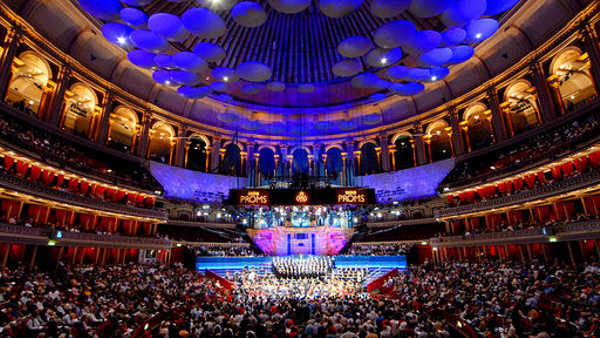
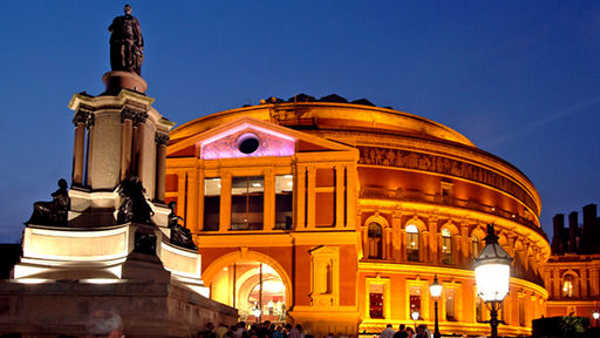
royalalberthall.jpgIn the BBC Proms team we are counting down the hours to go before the 2010 BBC Proms gets underway. For many in our audience the Proms is something that the BBC simply broadcasts, but since 1927 the BBC has run and funded the festival.

The planning for the world's largest music festival begins years ahead and so we have been looking forward to the 2010 programmes for some time!

We live in an odd Doctor Who like time warp in which we are working on urgent things for the start of this festival today and also dealing with pressing matters for future seasons as far ahead as 2014...

The remainder of Roger Wright's Blog is available by clicking on this link.

In another part of the forest ... Norway!

Blog comments are currently unavailable. Find out more.

Post categories:

Fiona TalkingtonFiona Talkington|09:42 UK time, Monday, 19 July 2010

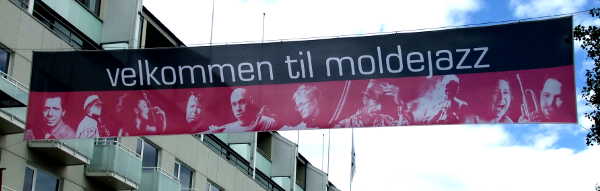
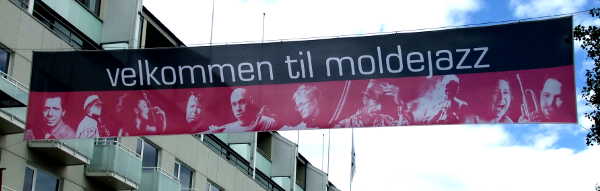
Moldejazz is the largest and oldest jazz festival in Europe. Radio 3's Fiona Talkington is there ...

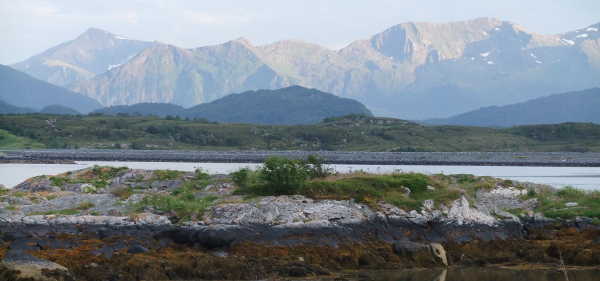
molde3.JPGFor the last couple of hours I've been staring out of my window. I've watched an OB truck pack up after live coverage of the football match between Molde FK and Sandefjord; I've watched the Hurtigruten, the big cruise ship that goes up the west coast of Norway, but most of all I've been watching the ever changing panorama of the blue mountains of this very special town. And I know I'll be watching them again in the early hours of the morning when the sky becomes streaked with pinks and golds as the sun takes a brief break. The town of Molde has a very special place in my heart, not just for the mountains but also for its place in the history of Norwegian music. This year the Molde International Jazz Festival, starting today, celebrates 50 years

I've been in town for a couple of days enjoying the calm before the jazz storm, but this evening jazz became a reality as I bumped into trumpeter Nils Petter Molvaer who's this year's artist in residence and Nils Olav Johansen from Farmers Market (more about them in due course as they're heading to WOMAD after playing in Molde!). It's a paradise for Late Junction listeners: several new projects from Nils Petter, guitarist Stian Westerhus, who's been featured regularly on Late Junction recently and who's here with Puma and with the incomparable Sidsel Endresen, and Ola Kvernberg who played at LJ's 10th birthday party; pianist KjetilBjornstad has a new project, the trio In the Country are here, and there's the promise of the legendary Terje Rypdal at the end of the week.

Between the music and the mountains, there's not going to be a lot of sleep, but I'll keep you posted!

molde2.JPG

Anchor's away!

Blog comments are currently unavailable. Find out more.

Post categories:

Katie DerhamKatie Derham|23:43 UK time, Saturday, 17 July 2010

Katie Derham reflects on presenting the First Night of the Proms for BBC TV

rah2.jpgAnd we're off. After months of preparation, promotion and practice, finally the red light went on, the baton of Jirí Belohlávek came down and we were on air with the First Night of the Proms 2010. Mahler's 'Symphony of a Thousand', his 8th symphony, an epic choral work with a massive orchestra and no fewer than six choirs packed on to the stage, making the

most phenomenal sound. I loved it. I'm sure you have your own view of the work and the performance, but I felt I had the best seat in the house - not only was I in the thick of seeing this piece performed live, but because I had a TV monitor right next to me, I was also able to see the broadcast - the close ups of Jirí
, of the soloists, of the angelic choirboys; of the phenomenally groovy mushrooms in the ceiling lit red .. You know, maybe I'm biased, but you actually get a pretty good deal watching the Proms on the telly if you can't get down to the Royal Albert Hall!


But as I sit here writing this, watching Stephen Fry talking about Wagner's Die Meistersingerand trying to ignore the carnage in the kitchen as my kids and their friends have supper, let me take you back to earlier this week when the first shots were filmed which would eventually be seen by you on the First Night...

The BBC's Maida Vale studios last Tuesday were a hive of activity as the BBC Symphony orchestra began sectional rehearsals of the Mahler. The work requires too many people for everyone to be together at that stage, but nonetheless I couldn't help being slightly stunned to realise that with just three days to go, this was the first time some of the players had tackled the music. But of course, the work is so gargantuan - 600 musicians were involved in last night's performace - that it's pretty tough to organise and stage; even the extremely experienced chief conductor, Jirí, told me later that it was only the second time he'd conducted it. The firstwas 30 years ago in Prague. You'd never guess though. As we snuck into the rehearsal to get some footage, the offstage brass chorus were being rehearsed (they appeared right at the end of the work, up in the Gods of the Albert Hall ... the sound was

unbelievable - and got a cheer from the rest of the orchestra. Talking to some of the

musicians, I really got a sense of excitement about playing not only this piece, but how, even for the most seasoned pros, the First Night of the Proms is a really big deal.

The days before the Proms season kicks off are frankly dizzying. I'm no stranger to the Hall or the festival, but I never cease to be amazed by what can only be described as 'extreme admin' going on: hordes of runners; rigorous security; endless co-ordination between the different parts of the BBC - TV, Radio and Online - to make sure that, frankly, we all know what's happening. And then, as rehearsals move into the Hall... literally hundreds of musicians backstage, who all need looking after: a catering operation which would put the military to shame. Quite extraordinary!

My role in it all is easy, really .. I get to interview interesting people, I'm made glamorous by the magic Christine .. and stand by to fill in any unexpected gaps. It's work I love - but I confess to huge relief when the actual nuts and bolts of the BBC2 broadcast went smoothly. I'll be back in the Hall on Monday for conductor Vasily Petrenko's Prom with his Royal Liverpool Philharmonic Orchestra ... a fabulously romantic programme of Schumann, Rachmaninov and Tchaikovsky*. It will be superb, I'm sure .. I'll let you know how it goes behind the scenes! 

  • *This concert is broadcast live on BBC Radio 3. Katie will present the concert as recorded for broadcast on BBC Two on Saturday 4 July. .


      Mahler 8 - the view from centre stage

      Blog comments are currently unavailable. Find out more.

      Post categories:

      Phil HallPhil Hall|18:14 UK time, Saturday, 17 July 2010

      BBC Symphony Orchestra sub-principal viola Phil Hall reports on the First Night of the Proms

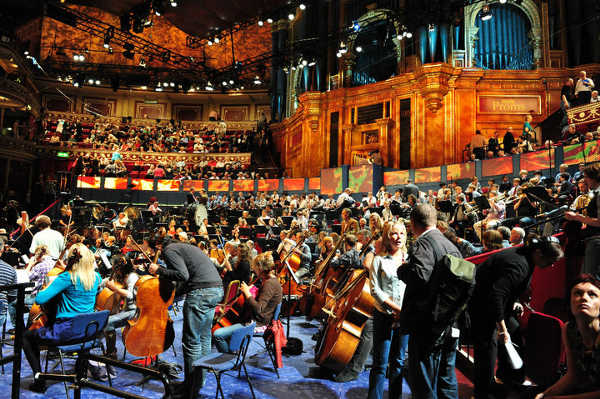
      proms_first_night_rehearsal_600.jpgMy daughter's ex piano teacher once scoffed: 'Surely you can't be satisfied just sitting in the middle of an orchestra day-in, day-out?' Well, yes, there are times when a conductor you don't care for is conducting a piece you don't like very much and your desk partner's perfume is quite literally getting up your nose; or you're jet-lagged, the soloist is murdering the concerto you love and you really wish the person next to you wouldn't play that pizzicato early all the time. But it's rare that all of these unfortunate factors line up. Happily there are also times when you absolutely don't want to be anywhere else.

      Playing Mahler's towering masterpiece in a hall actually big enough to withstand it on the illustrious First Night of the Proms is not just a good day at the office, it's a privilege. Indeed, sitting in the middle of a large orchestra and choir going at full tilt can provide enough of a thrill to rival any adrenal rush. People often ask what it's like to play in the Royal Albert Hall. I guess it's an obvious question given the enormity of the space. Well, actually it's surprisingly easy, in fact it is easier for us to hear each other across the orchestra on stage in this vast mausoleum than in Maida Vale studio 1! I think it is not always so easy for the audience to get a good balance and I wish everyone could get a listen from my seat as the surround sound is little short of awesome, to use that greatly overused import. Admittedly you'd get way too much viola but hey, doesn't that make a change?! You also get a rather pleasant vibration sensation courtesy of 'The Voice of Jupiter', as the mighty organ is known.

      For health and safety reasons (there are over 600 performers) the majority of rehearsals this year have taken place at the RAH. The orchestra hasn't played here since a Monty Python concert in October and it's always a pleasure to be back after some months. It has a special place in music lovers' hearts and for many is synonymous with the Proms. Like a lot of people I heard a great deal of music here for the first time as a lad, much of it with the BBCSO. I'm also fond of the First Night in particular since it was with Elgar's Dream of Gerontius in 1991 that I first played with this orchestra.

      Read the rest of this entry

      The Proms, Mahler and me ...

      Blog comments are currently unavailable. Find out more.

      Post categories:

      Jan YounghusbandJan Younghusband|16:54 UK time, Friday, 16 July 2010

      scooter_100.jpgIt was so cold on the scooter this morning, I wished I had the thermals. Where is summer, I thought? Then I remembered, it's the First Night of the Proms. Summer is in the Royal Albert Hall! Two months of fantastic music, over 80 concerts, and broadcast live on Radio 3 and BBC Television.
      I will let you into a secret: TV commissioners are secretly happy when the weather is bad in early July, because we think it means the viewers will be wrapped up warm on the couch listening to, or watching the First Night of the Proms, and not out in the park enjoying the sunshine!!

      I suppose the great thing about the BBC - still new to it as I pretend I am - is the way you can get to the music on so many different platforms, to fit in with your life. All the Proms are live on Radio 3, then you can see a selection of these on BBC2 and BBC Four; and if you miss the live moment because you're in the park, or the pub, you can catch up with it all on the iPlayer and online. Also this year, all the TV presenters are across Radio, so the discussion of the music will continue throughout the week, from Radio to TV and back to Radio. Through the summer, rain or shine, continuous and glorious music!

      This isn't any ordinary first weekend of the Proms - this is a stonking one! Two first nights: Mahler 8 tonight and Die Meistersinger - complete and uncut, the hit new Welsh National Opera performance starring Bryn Terfel on Saturday night. Two great essential classical masterpieces.

      katie_derham_200.jpgWe also have two fantastic new presenters. Katie Derham who is presenting all the BBC2 Proms this year, and Stephen Fry, who recently made the documentary Fry on Wagner, is presenter on the Meistersinger evening.

      This year at the Proms we have some new gadgets too. The viewers were asking us for closer contact with the music and the musicians, so we have introduced Player Commentary (Player Com) on the red button, so you can hear a commentary from orchestral players about the music (for Mahler 8 we have a string player from English National Opera, a brass player from the Philharmonia, and a choral/orchestral conductor. We are also in a groove this year of getting the musicians to tell us about the music. Antonio Pappano on Italian Opera, Rolando Villazon on how to be a great tenor, Kiri te Kanawa about how to be a great soprano and her brilliant new opera competition for young talent, the winner of which will perform at the last night of the Proms in the Park. So in the Proms on TV this year you will see more of this - testament from the musicians themselves, more backstage.

      Read the rest of this entry

      Out and About with the BBC Symphony Orchestra ...

      Blog comments are currently unavailable. Find out more.

      Post categories:

      Becky DixonBecky Dixon|15:42 UK time, Wednesday, 14 July 2010

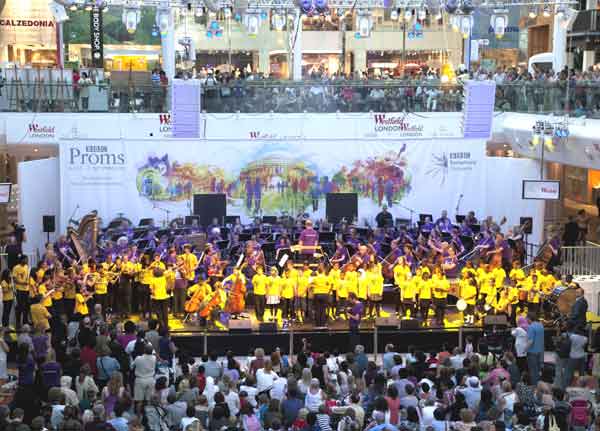
      BBC Symphony Orchestra learning assistant Becky Dixon paints a vivid picture of last Friday's free event at a West London shopping mall

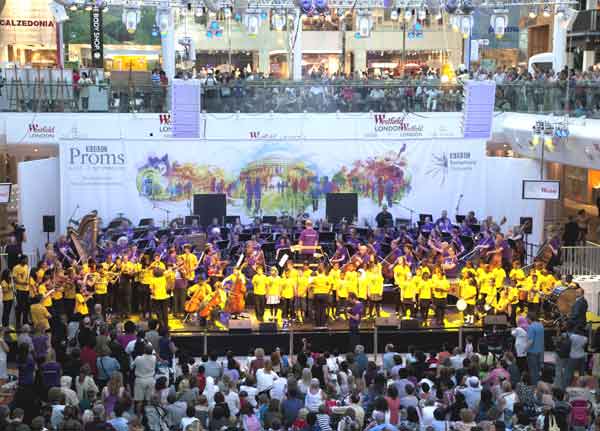
      bbcso_westfield3_edited.jpgWhat do you get if you mix the full complement of players in the BBC Symphony Orchestra, 70 musically minded children, 14 talented teenage musicians, two operatic stars, a liberal handful of BBC Radio 3 helpers, members of the Proms team and the full BBC SO management team, and a huge stage, and plonk them all down in a major shopping centre? Last Friday at Westfield, we proved that this doesn't necessarily result in bulging shopping bags and roaming children (a problem solved by giving all the younger participants bright yellow t-shirts, not an item of clothing you can easily get lost in!), but instead this was a huge free public concert, a free pre-Proms treat, drawing in an estimated audience of 2300 people.

      As learning assistant at the BBC Symphony Orchestra, I've been mainly working on the education projects that were part of the concert. This year, the plan was to get 70 children performing on stage with the full orchestra, and so we spent the past few weeks running workshops in primary schools and the Hammersmith and Fulham Saturday musiccentre, led by project leaders Rachel and Anna.

      To help us on our way, I've been wielding bags of percussion and folders stuffed full of checklists, risk assessments and schedules, lugging all this up and down the Hammersmith and City Line to see our partner schools in the borough of Hammersmith and Fulham. Over the course of six workshops, the children developed short bursts of musical material based on Mark Anthony Turnage's piece Momentum (also performed last Friday). Amongst other memorable moments, this involved a lot of moving percussion up steep staircases (thank you lovely John Lillie, school caretaker!) plenty of shifting chairs and a lot of detailed conversation about how to hold a tambourine without making any unwanted jingling.

      There was also buckets of enthusiasm and creativity from the children involved, and I got the opportunity to play a woodblock and stretch out my vocal cords (never quite hitting the high notes that class 6J reached, sorry Anna and Rachel), so it wasn't all ticking off lists and heavy lifting!

      Read the rest of this entry

      My Night with the Doge

      Blog comments are currently unavailable. Find out more.

      Post categories:

      Jan YounghusbandJan Younghusband|10:59 UK time, Monday, 12 July 2010

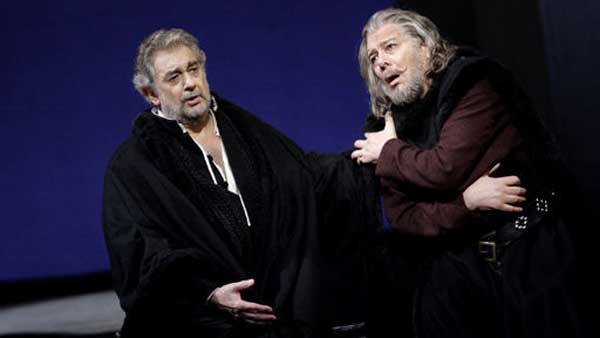
      domingo_boccanegra_bbc.jpgLast Monday night I scrambled into my seat in the stalls at the Royal Opera House, tucked in behind a BBC camera, nervously awaiting the start of the most eagerly anticipated opera event of the year - Plácido Domingo singing the title role in Verdi's great late masterpiece, Simon Boccanegra. As the hubbub settled around me I realised that I had only heard him sing live twice in my life - the other time with my father, right here, almost in the same seat, many years ago. Thank goodness for TV!

      tom_jones_bbc.jpgFor months opera fans have been on the edge of their seats as the celebrated tenor took on the challenge of singing a baritone role. When artists change direction they risk their reputation - look at the tremendous fuss surrounding Tom Jones's (right) return to his gospel roots. The critics wait with knives sharpened, and the fans with baited breath.

      It's a thrill to watch well established artists reinvent themselves - Tom's new album, Praise and Blame, is a blast; David Hockney is setting imaginations on fire creating art on an iPad. And I can say with confidence that Domingo has triumphed.

      In a world obsessed with youth, how wonderful to have so much warmth, reverence and attention for a senior practitioner of his craft.

      As well as recording this important event for posterity, we brought it to the homes of millions who couldn't get to Covent Garden. And we also gave them a peek behind the curtain. Backstage we followed the singers and production team through the evening to see how a great performance is achieved. And brilliant conductor (and my favourite new presenter) Antonio Pappano kindly agreed to present our coverage.

      In the theatre, I was laden with cough sweets, the essential accessory of any opera goer - how many times have I sat rigid in the quiet bits with tears streaming down my face, bursting to cough just in the wrong moment? Last time, my father hummed the whole way through much to the annoyance of the people around us - and me - but I felt I might miss the humming tonight. In Verdi's day the audience would probably be drinking champagne and gossiping throughout ...

      And so it began. Luckily, sitting next to the cameras I could see the pictures - like oil paintings on the monitor. Elijah Moshinsky's production and Michael Yeargan's designs, like Renaissance paintings were a gift for the lens. The most difficult thing about filming opera is to have enough light for the cameras.

      But these technicalities were forgotten as one of the greatest moments I have experienced in an opera house unfolded. When people told director Peter Brook that they loved the show he would demand to know, 'Which night?' - each is different.

      On Monday I felt from the moment the orchestra struck up that the performance was on the top notch - it had the audience barely breathing. It was a night of such great intensity.

      At the end the whole audience was on its feet - we had been present at a moment of history.

      On Saturday night I stayed in to live it all again.

      When will we see Plácido again? Well, next up is the live opera film of Rigoletto in Mantua, on BBC Two in September, with Plácido as the Duke.

      As I left the theatre I popped into the Ladies. In the queue, the woman next to me said 'That was the best tonight wasn't it?' and then all the ladies in line said in chorus 'Yes, it was the best'. I think Verdi would have liked that moment! And in true Verdi tradition, I hummed the tunes in the street all the way home.

      • The picture shows Placido Domingo as Boccanegra and Ferruccio Furlanetto as Fiesco in the BBC 2 TV broadcast
      • Jan Younghusband is Commissioning Editor, Music & Events, BBC Television
      • Simon Boccanegra is available on the BBC iPlayer, until Friday 16 July

      The Verb - Ian says come on down!

      Blog comments are currently unavailable. Find out more.

      Post categories:

      Ian McMillanIan McMillan|12:02 UK time, Wednesday, 7 July 2010

      ian_mcmillan_blogging.jpgThe Verb is live again this Friday! Normally I have a little routine for a typical Verb week. I write my sparkling script on Monday and email it to my producer Laura on Monday evening. She emails me on Tuesday morning to tell me it's not sparkling enough and I rewrite it. We meet up on Wednesday morning in the office and we go through the script and sparkle it up some more and work on the questions we'll be asking the guests before we tumble into the studio at 1301 just after You and Yours have vacated it.

      The week of a Live Verb is different, though; it's got a different rhythm. I still write the script on Monday but there's days and days of sparkling time. I get down to London for about 15.30 and Laura and I go through the script. We nip down to the Radio Theatre to check on preparations; on this week's show we've got the singer/songwriter Ana Silvera and she'll be there at this time setting up and making sure everything sounds right. My other guests, the novelist A L Kennedy, the poet Tim Key and the critic Christopher Ricks will arrive a bit later and we'll sit them in the Green Room (it's green!) and we'll go through the format of the show.

      barnsley_oakwell_stadium_24.jpgI like to stand up for Live Verbs; I can see everybody and it makes it more of an event for the audience. The clock zooms round to 20.15 when the audience comes in; I like to meet and greet them, especially the regulars who rush to the front like I rush to the front when Barnsley score a late goal at Oakwell. I do a few jokes (let's face it, the same few jokes) to warm the audience up: sometimes audiences get a bit nervous at live events because they think they have to be preternaturally quiet, but I encourage people to whoop and holler! Suddenly it's 21.15 and the show starts. I'm standing there and the artists are performing and Laura's talking to me down the headphones and I'm having a fantastic time. And the audience are too...

      Come and join us if you like: there are still a few tickets left! Click this link to book.

      I'll see you there. Or you'll hear me there!

      The Proms Archive - how did it get there?

      Blog comments are currently unavailable. Find out more.

      Post categories:

      John BryantJohn Bryant|11:21 UK time, Wednesday, 7 July 2010

      Proms Publications Editor John Bryant provides the inside track on the Proms Archive, released to a grand press fanfare this week.

      Sound the trumpets! For the first time, the entire history of the Proms is available online ... it's only taken us four years.

      The raw data for the Archive - already a media talking point following Monday's launch - was taken from a complete set of Proms Guides and programmes held in the Proms office at Broadcasting House in London. This has always been a working resource for the Proms team, and the condition of some of the older volumes has deteriorated through years of wear-and-tear - thankfully, we won't have to turn to this physical resource so much now that the information is online. The research work was carried out by a small team of part-time freelance researchers - the team consisted of a composer, a music journalist, a practising musician, and a former civil engineer (all with a necessary but rather unnerving obsession with accuracy and attention to detail). Our colleague Gregory Stevens, senior content producer in Radio 3 Interactive, held the project's hand on the technical side.

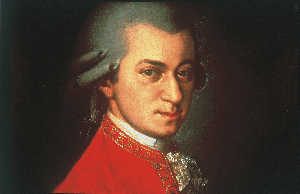
      mozart.jpgThe database is in fact an amalgamation of three existing databases. The largest of these was on a system called 'Cardbox' and was only available to a handful of users within the BBC network. Once the three old databases had been combined, one of the biggest challenges for the researchers was combing multiple versions of the same entry. For example, Wolfgang Amadeus Mozart (left) cropped up 27 times, with 746 works; he's now been reduced to a single composer entry with 185 works.

      The Archive is of course a live resource, and with another Proms season about to launch, the plan is to update the database throughout the season, ideally early on the first working day following each performance.

      It will come as no surprise that the 'front end' of the Archive, as it appears on the internet, is the tip of a huge iceberg of information - maybe an 'ice-sheet' would be a better description because so much of the detail is cross-linked. On the face of it, the Archive is a simple list of concerts; as such, although we know that some Proms fans take an interest in the history of the music which borders on the obsessive, it's been really encouraging to find so much general interest in the Archive. It has featured on Radio 3's In Tune and Breakfast this week, the Radio 3 messageboarders are talking about it, Radio 4 picked it up on Monday, it took up most of page 4 of the Times and featured in Tom Service's Guardian blog; the BBC Music Magazine and Gramophone websites are also running stories.

      We're hoping that the core data we've just released - who played what, when and where - will just be the starting point. There is plenty of potential for the database, both as a social site for our audiences to share their Proms experiences, and as the basis for academic research (we are very excited about further collaboration with the music department at King's College, London).

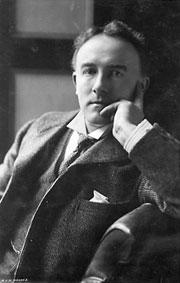
      edward_german.jpgThe database has thrown up a huge number of interesting facts. I had no idea that Proms concerts had been held in Manchester, Leeds and Liverpool. That Richard Wagner was the most-performed composer isn't so much of a surprise, but that he remained so during both World Wars really is astonishing. Also surprising: the most-performed English composer during the years of the Second World War? Jeremiah Clarke. And composers who have fallen out of favour? I'd never have put Edward German (right) as the most performed English composer during the first decade of the last century - none of his music has been performed in the first 10 years of the 21st Century. Sir Thomas Beecham only conducted two Proms concerts - that's a surprise to me. And the list of composers who have appeared as either conductors or instrumentalists at the Proms is a real wonder - from Elgar, Vaughan Williams, Walton and Britten to Copland, Bernstein and Hindemith.

      We've launched the Proms Archive - could someone now invent a time-machine?

      Juanjo named BBC Philharmonic chief conductor

      Blog comments are currently unavailable. Find out more.

      Post categories:

      Richard WigleyRichard Wigley|15:47 UK time, Monday, 5 July 2010

      BBCPhilharmonic general manager Richard Wigley describes the long road he took to making a decision on a vital new episode for the orchestra - the appointment of a new chief conductor.

      The journey was long but the result spectacular; the biggest decision for any orchestra's general manager is the appointment of the next chief conductor.

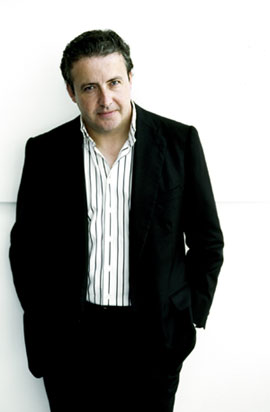
      juanjo_mena_Sussie_Ahlburg.jpgIt began in November 2007 when I was speaking to a well-known tour promoter in Spain (Barcelona ... 1am ... great food, you get the picture...) and asked him who was the pick of Spanish conductors.His unequivocal reply was Juanjo Mena, someone whom I'd not been aware of.Given the exceptional quality of the upcoming generation of conductors in Spain, this was high praise indeed.Juanjo was at that time artistic director and principal conductor of the Bilbao Symphony Orchestra, with its spectacular new theatre a few hundred yards downstream from Frank Gehry's Guggenheim Museum, which allowed him to be mainly at home with his young family in his beloved Basque country.

      I travelled to Bergen to watch him conduct an inspired choice of Luciano Berio's Rendering (a contemporary 'completion' of Schubert's 10th Symphony) and Schubert's 9th (the 'Great C major').The result was impressive and his talent obvious so I immediately approached his agent about conducting the BBC Philharmonic in the following summer.

      During the next couple of years Juanjo conducted the orchestra four times in a range of projects and incrementally built his relationship with the musicians.Juanjo (pronounced with a Basque 'j') conducted a public concert in Huddersfield and recorded a CD for Chandos along with studio broadcasts for Radio 3.

      The moment when everyone sat up and said 'wow' was during rehearsals for Bartok's The Wooden Prince, an exceptionally difficult work that wasn't in the orchestra's repertoire.In only a day-and-a-half he was able to draw a wonderful performance from the musicians by rehearsing with great knowledge and clarity.He became the clear favourite, and we are delighted that he has agreed to join us as chief conductor from 2011/12.

      Our planning of future seasons is very exciting and will build on the platforms built by previous incumbents Ted Downes, Yan Pascal Tortelier and, currently, Gianandrea Noseda.We are privileged, as the audiences will be, in attracting this wonderful musician to the BBC Phil.

      • Juanjo Mena will be conducting the BBC Philharmonic in a live broadcast from Manchester on BBC Radio 3, Afternoon on 3, Friday 9 July at 2pm.

      • The photo of Juanjo Mena is copyright Sussie Ahlburg/BBC Philharmonic

      More from this blog...

      Categories

      These are some of the popular topics this blog covers.