
Khyam Allami in Beirut
Post categories: world music
 |16:50 UK Time, Wednesday, 2 June 2010
When my parents left Iraq in 1979, the first city they arrived in was Beirut. Now here I am over 30 years later and it's impossible to imagine how it must have been.
I arrived a few days ahead of Ilham Al-Madfai and the BBC Radio 3 crew in order to have a little time alone to wander the streets and do some research before our hectic schedule kicked off. It was impossible to sleep on the first night. Anxiety, nerves and excitement kept my brain ticking non-stop and so the 'Ud came out to try and settle my spirits a little and soften the silence in the air.
My friends at the NGO Un Ponte Per... were kind enough to host me and the first few days were spent walking and looking for books and CDs in the Al-Hamra neighbourhood and checking out what was going on in the city. During a short conversation with my father upon his recent return from Baghdad, he told me about a cafe called Cafe Express in Al-Hamra where he passed many days with his friends, fellow writers, journalists, artists and musicians. I tried searching it out but unfortunately there was no trace of it.
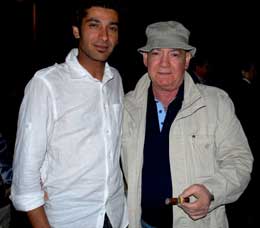 What I did notice was that one of the outside corner seats at the Costa Cafe on Al-Hamra street, was continuously occupied (i.e. every time I walked by throughout the week) by an aged Lebanese man. Dressed in a simple suit he would sit smoking a pipe and drinking espressos whilst chatting to his array of friends, all of whom would come to sit beside him and converse one after the other throughout the day. Nice to see some remnants of tradition.
The next few days were spent getting to know Ilham Al-Madfai (with me, left) and his wonderful wife, whose cooking I can't wait to try once we get to Amman! One evening whilst sitting in the hotel foyer I decided to bring my 'Ud because I was restless and waned to play. Slowly a lovely evening of Lebanese wine and Iraqi took form and many stories were shared.
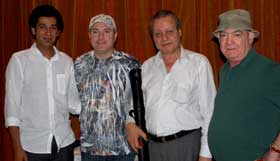
The photo (right) shows me with Lubnan Khalil, Samir Siblini, Ilham al Madfai
Meeting with many musicians throughout the following days was interesting, as were the intense discussions about Arabic music theory and the difference in micro-tonality from Maqām to Maqām. Ilham also arranged for us to attend the rehearsals of the Lebanese Arab Oriental Orchestra, directed by maestro Waleed Gholmiye. Interesting to see such a man at work.
In and around all of this I caught up with Mustafa Said, an excellent 'Ud player and graduate from Naseer Shamma's Beit al-'Ud al-Arabi (Arab Oud House) in Cairo, where I also studied for a few months last year. Mustafa is a library of information about the history of Arabic music and many other things, along side being a composer, singer and teacher at the Antonian University just outside Beirut. Attending rehearsals with his students at the university taught me a lot and his ideas about re-innovating 'from the inside', within the context of what is regarded as traditional music, were nothing short of inspiring.
A few afternoons were spent with Ilham Al-Madfai learning some of his repertoire and going through some of his principles for arrangements. It was a little difficult trying to remember what happens where (Ilham doesn't like to write anything down), but hopefully it will all become easier and clearer once rehearsals start in Amman.
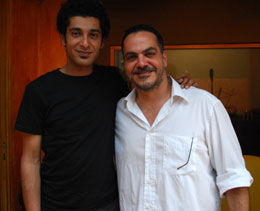 We also managed to find time to interview Ghazi Abdel Baki (left), director of Forward Music and one of its main producers, about the current status of contemporary music in Beirut and how Forward music evolved into what it is today. You will be able to hear some of that in the next episode of World Routes dedicated to the World Routes Academy, which will be broadcast on Saturday 12th June.
Later on that same day, whilst sitting with the 'Ud maker Fadi Matta discussing many topics related to the 'Ud and the differences in styles and construction across the Middle East, we were lucky enough to have a surprise visit from Charbel Rouhana, another of the Middle East's 'Ud maestros and highly respected musicians. It was great to meet such personalities and be able to spend some informal and relaxed time with them, just talking.
Wandering the streets of Beirut and seeing the scars of its tumultuous past, each being slowly replaced with the new and the boutique really makes you think. Not just about how things must have been, but where things are going. Obviously for many it's all steps forward, but judging by the number of Save Beirut Heritage posters across the walls of the Gemmayzeh neighbourhood, it seems that nostalgia is important not only for the old man sitting in the Al-Hamra Costa Cafe every day, but that for some of the young people in today's Beirut, their past is just as important as their future.
In the meantime, emails fly back and forth trying to keep on top of the events I am planning in London, mostly concentrating on the afternoon of Iraqi culture I have curated as part of the Celebrating Sanctuary Festival. More information coming soon, but for now, be sure to set aside the afternoon of Sunday 13th June so you can join us!
Next stop Damascus...

Comment number 1.
At 13:15 8th Feb 2011, U14779592 wrote:This comment was removed because the moderators found it broke the house rules. Explain.
Complain about this comment (Comment number 1)