
A good listen
Post categories: Radio 3
 |11:27 UK Time, Tuesday, 15 June 2010
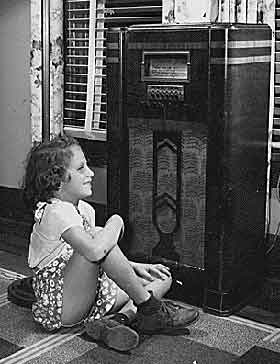 There's something about the radio at night isn't there - a special intensity? Earlier today I was part of a discussion with members of our Through the Night team who are passionate about the programmes they compile for the small hours of the morning. They showcase recordings of live music from across Europe and, as well as to the UK, their sequences are relayed to thirteen other European countries whose broadcasters add their own announcements in the relevant languages.
Like many listeners I usually hear their work through the BBC iPlayer, in daylight, yet to listen to the same sequence at night feels to me more adventurous - a journey into uncharted territory where works by composers I've never heard of tuck in between the classics.
I'm writing this now on Monday night and the house is quiet - quiet, that is, except for the clicks and creaks of any ageing building, the odd shout from the street outside, the tap of my laptop keys and the inquiring tones of historian of broadcasting David Hendy at the start of the first of his series of talks in The Essaythis week. 'Do you remember listening to the radio for the first time?' he asks, and I'm not surprised that he describes his own earliest, intense listening to the radio as a night time experience - listening as a boy to voices from across the world through an old Bakelite radio installed by the bed.
This memory is a way, for Hendy, of conjuring the magic of the very early days of the medium when not just children but writers, artists and scientists became fascinated by the distances covered and the invisibility the waves. For some, radio presented a threat of thought control, for others a chance to bring back the dead. I'm fascinated by this Essay and it's not just the late hour as I read the whole week in advance and have been enthusing to friends and colleagues to catch the series. Throughout the week David Hendy is looking at different ways in which a century of electronic media may have shaped the way we think. He digs out an old BBC pamphlet on 'Wireless Discussion Groups: What They Are and How to Run Them', aimed at enlightening the 'plain man'. The paternalism is obviously dated but the endeavour to nurture a continuous coming-into-contact with different points of view doesn't seem to me that far removed from that of a lively week of Night Waves.
Broadcasting isn't, Hendy argues, about rewiring the mind in an instant but it has had a more complicated impact and has worked, as he puts it, a 'cognitive magic' more subtly, its effects building up over time. By Friday's Essay he'll have got to the impact of the internet.
It's a hot topic of course, and his reflections are divided between acknowledging the richness it has brought our lives and the dangers of too much noise. I've become something of a fan of David Hendy's writing recently, having also enjoyed reading his thoughtful Life on Air: a History of Radio Four (Oxford University Press, 2007), and a drama script he's developing for Radio 3 with playwright Adrian Bean. I love his evident passion for radio, his appreciation of it as a stimulus to the imagination as well as the intellect, and his sensitivity to the place it can take in our lives.
But I also respond to his suggestion that despite the pleasures of radio, television and internet, just sometimes we need to disconnect and find some quiet. This for me is part of the pleasure of radio at night, first the listening and then the silence...

Comment number 1.
At 20:57 17th Jun 2010, sigolene euphemia wrote:Ms Appleton,
The NYT did a multi part series, "Hooked on Gadgets and Paying a Price" Monday June 7, 2010. My thoughts expressed are No 338 in the Highligts.
https://community.nytimes.com/comments/www.nytimes.com/2010/06/07/technology/07brain.html?scp=2&sq=hooked%20on%20gadgets%20and%20paying%20a%20mental%20price&st=cse
Yet, I want to reminisce of the longing I sometimes have of radio in the car, traveling late into the night, my Dad would easily drive until two in the morning to a destination nearly each weekend.
Often we would head north from New Mexico to Colorado and the sixteeners' the 16,000 foot high Rockies. Their dramatic shadowing especially on a moon lit night, the stars as a dome and the small green light on the dash, that we had radio reception. We always seemed to find the "Mystery" show that intensified since we were in the dark, seldom another vehicle passing, but the distance of the red tail lights still lodged in my memory along with the static of the in and out of radio reception. Then arriving to where we would camp for the night, and settling to the stillness and the roar of the silence.
All you say here is what we grapple with and I have decided that we, the adults, must learn to navigate this in order to teach our children. This is the frontier.
with joy, imagination and inspiration,
Sigolene
Complain about this comment (Comment number 1)
Comment number 2.
At 20:52 20th Jun 2010, Felix d e Villiers wrote:The Schumann Week
As a Schumann lover form the age of 14 who has read all the letters and diaries of Robert and Clara - apart from biographies - I listened to your programme on 8 June, and was taken aback by the comments of the person who was presented as the biographer which were often innacurate.
The biographer (BBC) said Robert and Clara had blazing rows, before marriage -'see letters' - and after. Not true. In the letters there were a few moments of misunderstanding and hurt feelings which last for about three letters. Without now remembering the details, I can remember an accusation of R's where I felt he was right. Clara replied tetchily and R dropped the subject.
I have double-checked this and I was right. Clara lapsed for a moment into her father’s language and told Schumann he would have to be a rich man to provide a comfortable life for her as an artist. Schumann replied with indignation, and Clara, instead of acknowledging her mistake, was indignant in turn (How could you doubt my love’ etc.). The subject faded out. It was not a blazing row and there weren’t any. One has to remember that R and C were kept apart for months years and there were bound to be rumours and misunderstandings, hurt feelings, explanations, but no rows.
There were no blazing rows and after the marriage. Clara's attitude to Robert was much like mine to my mother. She only had to get ever so slightly cross and my tears flowed. It only happened once.
When Robert was becoming mentally unstable he was very occasionally cruel. After Clara had played his concerto in Duesseldorff and the audience applauded her jubilantly, R, backstage, said she had played badly. On another occasion, when she played the Quintet to an invited audience at home, R beat the time on her shoulders with his hands. There were no rows and Clara conveyed her grief to the diary.
The biogr. said they had only kept their joint diary for a short while. They continued with it until R went to Endenich - understandably the entries in the last year or so before Endenich were somewhat sparse - after which Clara took it over and kept up with it until the end of her life.
The person she did have blazing rows with was Brahms. The story of their relationship is, as far as I know, still an unwritten chapter.
Then biographer and others talks about the huge influence of Clara's music on R's, in which there are only thematic references to her compositions.I think - perhaps they came closer to one another in the Ruekert cycle they composed together. Otherwise there was no influence of Clara’s music on Robert's whatever.
Then biographer and others talks about the huge influence of Clara's music on R's, in which there are only thematic references to her compositions.I think - perhaps they came closer to one another in the Ruekert cycle they composed together. Otherwise there was no influence of Clara’s music on Roberts whatever.
It has now become the fashion to say that Wieck was right to disapprove the marriage. How unspeakably low can one sink when their marriage was one of the starry hours of mankind. Wieck simply wanted a rich husband and for Clara's concert career to continue, which it did anyway. Wieck was in an hysterical screaming rage at the trial and would have pulled out all the stops, but he didn't bring up the subject of mental instability – I still have to double check this - but that of Schumann having gotten drunk as a student.
I have nearly reread the Robert and Clara letters up to the end of 1838. I'm still waiting for the 'blazing rows.' I'm now proceeding to the letters between 1838 and am not expecting any rude shocks.
Wieck did not permit Clara to play Robert's compositions, the biographer says. Firstly she practised them every day at home under Wieck's nose; he admired them; he encouraged her to play them at gatherings, he wanted to find a poet who might illuminate the sense of Carnival; he wanted her to and let her play them in public concerts - a few at a time, because of their novelty and 'difficulty'; Schumann was much more averse to having them played to a public that wouldn't make head or tail of them.
To end up with something positive, the resident pianist played Clara Wieck's Romance in F major really beautifully; it was the best rendering I have heard and she gave the middle sectiona bit of impetous which gave more sense to the return of the F major theme.
I would like to propose purely hypothetically, my idea of a Schumann week another time, after all, one doesn't have to celebrate composers only at their anniversaries.
Yours, Felix de Villiers
(My user name came out with a gap btween the d & e in the middle. Does it have to remain that way forever?)
Complain about this comment (Comment number 2)
Comment number 3.
At 08:08 21st Jun 2010, Felix d e Villiers wrote:P.S. to my comments on the poor biographer who discussed Schumann on 8 June. Perhaps he was just carried away by gossipy enthusiasm and didn't put those errors in his book. I expect a stinging reply. I left out these two paragraphs. Omit them if you think I have gone too far.
"Schumann had no money" - When? - The diaries are full of the infinite pains he took with his inheritance, earnings from his journal and etc. to make sure they would have enough to live on and this they did, though Clara was eager to add to the coffers with concerts. The only time they felt a pinch of something like poverty was on a tour of Vienna when both Clara and Robert failed, she because she was playing his music.(Great success afterwards in Prague). But one never has the impression that they didn't have their roast beefs and etc. Clara later scolded the pianist-composer Kirchner for not being a good businessman like her husband as well as being an artistic soul.
I couldn’t believe my ears when the biographer said, not without glee in his voice (See your archives) that Schumann lied to Clara about his economic situation. No, he did quite the opposite, he told her the truth. He wrote to Clara immediately when he discussed the inheritance with his brothers and found to his dismay that they were giving him 200 Talers less than he expected, but he managed to establish that they nevertheless owed him 1800 Talers a year (I don’t know for how long), and threatened to take them to court if they didn’t produce this, because his future with Clara went above brotherly love.
Yours,
Felix
Complain about this comment (Comment number 3)
Comment number 4.
At 02:23 29th Jun 2010, Christopher Hobe Morrison wrote:At the risk of changing the subject I will discuss Late Night Radio rather than the marriage and career of Robert Schumann which seems to be the subject of the discussion.
I don't have the impression of Through the Night at all, that there seems to be something misasing from it that is there in other Radio 3 programmes. I do get the impression that all late-night radio programmes are alike, especially in classical radio. In the 1970's I used to listen to a radio station in New York, WNCN, which had a programme called of all things Through the Night. It wasn't that they played quiet music. The format was low-key but open. There was also a late-night programme on WQXR, with Nimette Hovashi (I always forget how to spell this). In the early days, WQXR had an am signal as well as an fm signal, and she got a lot of mail and requests from long-haul truck drivers all across America. Eventually, WQXR gave up its am transmissions, and WNCN came to be owned by a William F. Buckley who shall remain anonymous who changed the format from classical to pop in order to show that the true conservative's value is money rather than any sort of cultural values. But there were other forms. There was Pacifica WBAI, rock stations such as WNEW, free-form WFMU in New Jersey. They all sort of let their hair down at night, and you could hear all sorts of stuff you never heard any other time. In particular I remember Glenn Gould calling in and talking about music.
One particular idea he talked about was music on computers. He thought that eventually listeners would have complete control over music, they would be able to change the key and the tempo and even the instrumentation. This was really strange, and far away from anything that anyone would have recognized in the days of reel-to-reel tape machines. It is strange, I always thought he might talk about, say, politics, but music was the only thing he was interested in. But there was always Paul Krassner or Abbie Hoffman or somebody like that who would call into WBAI and they would talk for hours at a time. I was generally listening from an empty factory someplace where I was a night watchman.
Oh, but I can remember like Segolene, driving north except in my case it was from Rockland County, NY, and in my case it was the Canadian stations CBL in Toronto and CBM in Montreal on the am radio that I listened to. Canada for me represented a civilized country unlike the barbarous country I grew up in (my grandfather grew up in Frederickton, NB, but my father's family all hated each other so I never got there). I even picked up Cuba sometimes, although I couldn't understand a word of it there was Fidel Castro. My father hated him, and so of course I thought he was the future of the world. Later on, I got a shortwave set, and started listening to Radio Moscow, the Voice of America, and the BBC. The BBC General Overseas Service gradually changed to the World Service, and I became more and more sympathetic to it as the Empire faded into history. Gradually the internet came in, and with it all the radio networks available in ultra-high quality all the time.
I generally like to keep Radio 3 on all night on my computer. It helps me relax and sleep. Through the Night comes on at 8 pm New York Time, and goes on until 2 am. Even after this, it is relaxing to hear the time pips and the news summaries when I wake up at night, and when I have to get up to walk the dog I pause afterwards (of course afterwards!) to check e-mails and the news from the BBC News Online and the AP, maybe check out The Daily Kos. Sometimes there is a break in the feed, and it is sort of a crack in my world which disrupts my sense of reality in some vague way. Truth is, when the announcer talks about storms I look out the window, having somehow forgotten where I am. Truth is, I prefer to forget about where I am, and to live in some sort of a country without countries where things are endlessly interesting and people wave books instead of flags, and people listen to all sorts of interesting music and have all sorts of ideas which they share with each other. Sort of the geek combined with the beat. Geeknick?
So the past few days I have been having problems with my iPlayer! Just after I subscribed to Rhapsody. I actually listened to the Firesign Theatre just like the old days, and Nina Simon singing Mississippi Goddamm just like the old days. Then I tried to get Through the Night or the Midnight News from Radio 4, and couldn't! Bummer!
Christopher
Christopher Hobe Morrison
Pine Bush, Ulster County, NY, USA
cmorrison5_at_hvc.rr.com
Complain about this comment (Comment number 4)
Comment number 5.
At 14:50 28th Feb 2011, Christopher Hobe Morrison wrote:I was listening to Radio 3 this morning via iPlayer, and it stopped. I tried to restart it and got a message telling me I needed to install Flashplayer. I tried to install it, and first thing happened was I was told I had to shut down IE as conflicting software. I did this and then it seemed to install, but then I got an error message that really didn't tell me anything. So I uninstalled the Flashplayer through the uninstall software window, and then tried to install it again by going to the iPlayer and trying to restart Radio 3 via the Radio 3 Programmes Page, in the Listen Live link. I again got the message telling me I needed to install Flashplayer. This is all I get now, and I can't even get the Listein Again programmes as they all bring me the Install message. Is this yet another one of the infamous iPlayer/Flashplayer snafus or did the government cutbacks just hit the BBC iPlayer?
I need someone to get back to me via e-mail at cmorrison5 at hvc.rr.com, because of course I tried to file a complaint but don't know if it went through or not.
Christopher
Complain about this comment (Comment number 5)