
Graeme Kay's Free Thinking Blog
Post categories: Free Thinking, Radio 3, behind the scenes
 |16:43 UK Time, Saturday, 24 October 2009
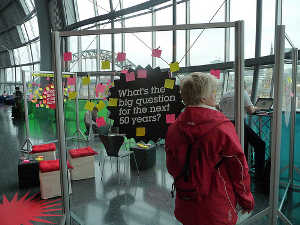 I'm writing this in the 'Interactive Hub' at The Sage Gateshead - 'hub' is an aspirational word used to describe a fenced off bit of the wonderfully curvy foyer spaces. After a false start because we reckoned the feng shui wasn't right, we set up our screens into an 'open hands' configuration which worked a treat - people were immediately drawn in. We have some cube seats, three computer work stations and a big screen on which we can throw up our Twitter feed, or display the Radio 3 website and blog entries. But what draws most people into our hub is the opportunity for people to use stickers to post their own thoughts and responses to the key questions:
 What's the future for men?
- Extinction - women will be able to reproduce for themselves
- Sperm donors for our mother-in-law's grandchildren
- Hopefully they may be slightly more intelligent than they are at the moment
- As long as there are spiders, and food in tight jars - we're safe!
What makes a happy family?
- Love and understanding
- Earplugs
- Love
- Having a few quid at the end of the month would help
The greatest moment in Sport or the Arts is ...?
- The very existence of J S Bach ...
- Jesse Owens 1936 Olympics wins
- Shakespeare
- Morris dancing
What's the big question for the next 50 years?
- Will I be a granny?
- Will there ever not be a war going on somewhere?
- Will China and India let us in?
You can join in the thinking, and the fun, by commenting on this or any of the Free Thinking posts here on the Blog.
There's been a huge buzz around The Sage, and it's growing all the time as more people come in to attend the events on their weekends.
You can see the hub and get a flavour of Free Thinking at our picture gallery - and you can see what our video blogger Jon Jacob has been up to on the Radio 3 YouTube channel.
For now, I'm just off to a talk by former England cricket captain and psychologist Mike Brearley, about leadership and narcissism ...
More as at happens ...
Sunday morning
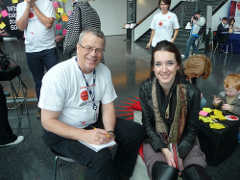 Got in early with our editor Roland Taylor to transcribe the public's thoughts on our post-it note screens, so that we can add them to the blog, and pass them on to the producers of today's talks and Night Waves recordings. Over 350 posts have been made by the public since we opened for business on Friday night.
It's great to see so many young people around The Sage. Because the building is open all day in an area which makes riverside walking a real pleasure (there are the Millennium Bridge, the Baltic Mills building and great views of Newcastle on the opposite bank of the Tyne to enjoy) families are constantly passing through - not least because there is an excellent cafe bar. MA students from Newcastle University School of Journalism are volunteering as runners at the Festival, and a more enthusiastic group of people it would be hard to meet. Among yesterday's visitors was Beatrice Pickup, news editor of the University's student radio station, who told me all about the internet station's work (they also broadcast live to the Student Union and tie in closely with the student newspaper); Beatrice is studying English Literature, with a focus on feminism and sexual theory; she was particularly interested in Gwen Adshead's session entitled, 'The Woman's Right to be Evil.' You can read Ros Porter's post on the talk here, and the talk will be broadcast on BBC R3 Night Waves on Tuesday 27th October at 21.15. Newcastle Student Radio's lively website is at www.unionsociety.co.uk/nsr.
Sunday afternoon
You can see all the comments written on the post-it notes as the public responded to the four propositions we put to them by clicking on these links:
What was the greatest moment in sport or the arts for you?
What is the biggest question for the next 50 years?
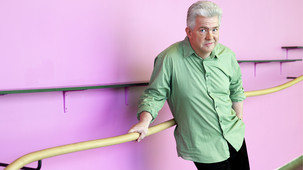
The picture below show Ian McMillan blogging in the hub, surrounded by post-it notes ...

Comment number 1.
At 18:06 24th Oct 2009, RolandTaylor wrote:It is brilliant here, watching people looking at the boards, laughing, looking confused, interested. Few pass by without stopping. Some of the comments are amusing, some scary, some full of mystery. It's also great to share Radio 3 with people. I'm hoping to see a few more answers to some of the big questions pop up. There are hundreds here at the Sage Gateshead. Why not add yours?
Roland (Editor, Radio 3 Interactive)
Complain about this comment (Comment number 1)
Comment number 2.
At 15:02 26th Oct 2009, kleines c wrote:I hope that Beatrice did not get up to too much evil with you over the weekend, Graeme.
;)
If I may also take the opportunity to respond to Krompetz40 on the Arts & Ideas messageboard, as the BBC Radio 3 messageboards are undoubtedly better for my absence:
"Following Tony's comment, will Wittgenstein, Nietzsche & Aristotle be speaking - or will kleines do the talking for them?"
https://www.bbc.co.uk/dna/mbradio3/F7497570?thread=7022349&skip=0&show=20#p87529646
I suspect that they speak through you, Krompetz40, although to the best of my knowledge, they did not turn up at 'The Sage' over the Free Thinking weekend, although maestrolover clearly did. Nor could I talk for this year's Free Thinkers, as I am elsewhere (Strasbourg).
https://www.au-crocodile.com/
Nevertheless, in all humility, it was probably a better Free Thinking Festival for my, and the great philosophers', absence. Very briefly, Ludwig Wittgenstein, arguably the greatest of twentieth century philosophers, thought that by becoming conscious of the real character in our personal use of language, we can remove the intellectual cramps that have come from our failure to understand how language actually functions.
https://www.open2.net/historyandthearts/philosophy_ethics/wittgensteinbiography.html
Friedrich Nietzsche was also something of a Free Thinker, in the sense that he was interested in finding out what human beings can do, what human possibility is, what humanity is capable of understanding and creating from within.
https://www.open2.net/historyandthearts/philosophy_ethics/nietzsche_bio.html
In terms of morality, Aristotle uses this image: he says that just as an architect is not going to try to measure a complex fluted column with a straight ruler, so too the ethical judge is not going to take a simple and inflexible set of rules into the complexities of a practical situation, for example, the Interactive Hub of BBC Radio 3's Free Thinking Festival at 'The Sage' last weekend.
Instead, just as the architect measures 'The Sage' with a flexible strip of metal, when we address the complexities of the human condition, we have to have our faculties open and responsive, ready to shape ourselves to the complex, perhaps unique and non-repeatable, demands of a particular situation. We don't ultimately control our moral environment, and we cannot therefore be self-contained moral entities. We sometimes therefore need to adjust rules to meet new challenges.
This is certainly applicable to Free Thinking. In philosophical terms, I suspect that Aristotle has found the right balance between the oversimplifying theorising that takes philosophy too far from the messiness of ordinary life and the house of cards approach which suggests that there is no point in asking for and giving explanations, because the assumptions on which they are based are fundamentally flawed:
"I count us braver who overcome our desires than those who conquer their enemies; for the hardest victory is over self."
Aristotle
https://www.bbc.co.uk/radio4/history/inourtime/greatest_philosopher_aristotle.shtml
The key point to remember about Ludwig Wittgenstein, arguably the greatest philosopher of the twentieth century, is that he was ultimately resistant to theory.
"We just act."
Ludwig Wittgenstein
So we do, Graeme?
Complain about this comment (Comment number 2)
Comment number 3.
At 15:51 27th Oct 2009, rustedknight wrote:So, I've just had the good old BBC trying to sell me the idea that T Dan Smith was not a crook, who helped create the poverty that still blights the region, but indeed, a courageous, visionary, giant of a man, even a poetic and brilliant savant who had a plan for the North, that still resonates today! Of course it does, what he did and what all the other great spell blinding charlatans do from Maxwell to Madoff, ( to name but two) isto betray the trust they assume. Smith , despite his heroic working-class background, and oh how many of this ilk are able to boast equally impressive roots, betrayed the trust created by the myriad of equally heroic but far less well rewarded foot soldiers of the North's search for a decent way of life against the grain of indifference and neglect. He and his gang of cronies, such as Alderman Cunningham, yes dear Jack's dad, used the Labour Party as little more than their private club sharing out parliamentary seats like liquorice allsorts to one toady after another, who without exception, did their best to help kill, the little bit of genuine inspiration that flourishes in the North. No, I don't buy the T Dan Smith was a great man let down by a few misjudged relationships fairy tale, the real price of men like him is too high for any such sentimental revisionism!!
Complain about this comment (Comment number 3)
Comment number 4.
At 19:22 29th Oct 2009, newlach wrote:Tuesday night's talk on women and evil was compelling. It seems that women have the same capacity as men to commit evil acts, although no society exists where men do not account for at least 80 per cent of violence. The discussion on Franz Stangl who oversaw the deaths of around 900,000 Jews in Treblinka, and the ordinariness of the guards who volunteered to work in the place, was chilling. How could they slaughter Jews day after day yet live a seemingly normal family life? The point was made that it is the normality of evil that ought to intrigue us.
Complain about this comment (Comment number 4)