
Tim Davie on DAB's 'ambitious target'
Post categories: DAB, advertising, digital
 |13:55 PM, Friday, 26 November 2010
Editor's note: Tim Davie was interviewed on today's Feedback, Radio 4's weekly accountability programme - SB.
"The BBC should be ashamed of themselves for running this ad. They are telling their listeners to buy something they know isn't ready for us yet."
That was William Rogers, Chief Executive of the commercial radio station UKRD.
He was talking about the Digital Radio UK Christmas campaign featuring David Mitchell and Arthur Smith, launched this week (November 22) and running until Christmas Eve.
BBC TV and Radio is running its own companion advertisments but some commercial radio stations are holding off.
Mr Rogers isn't finished.
He says it was "fundamentally immoral and dishonest" to run the campaign "knowing that the DAB (Digital Audio Broadcasting) infrastructure is not good enough and knowing full well that when people buy a DAB radio it may not work when they get it home".
This week on Feedback I talked about these claims with the BBC's head of radio Tim Davie.
Fifteen per cent of listening is currently on DAB radio and that figure rises to nearly 25 per cent for listening on all digital platforms - online etc. Many of us have lots of analogue radios which we have no desire to see become redundant.
The Government"s target date for digital switchover (which means analogue switch-off) is still 2015, though it is now called an "aspiration" by the Coalition, "ambitious" by tactful radio executives, and "impossible" by some others.
Hear what Tim Davie has to say about Britain's digital future:
In order to see this content you need to have both Javascript enabled and Flash installed. Visit BBC Webwise for full instructions
PS On a personal note it is difficult to talk to the whippet thin Tim Davie without wondering about his obsession with running marathons, and the fact that this year he ran the 48 miles from home to work nonstop for charity.
I really must go to the gym again.
Roger Bolton is presenter of Feedback on BBC Radio 4
- Listen again to this week's Feedback, produced by Karen Pirie, get in touch with Feedback, find out how to join the listener panel or subscribe to the podcast on the Feedback web page.
- Ford Ennals, Chief Executive of DRUK (Digital Radio UK) was interviewed by Evan Davis on Today and the programme followed up on his numbers a few days later.
- Former BBC Radio executive James Cridland took on the issue of listener numbers on his blog.
- Feedback is now on Twitter. Follow @BBCFeedback.
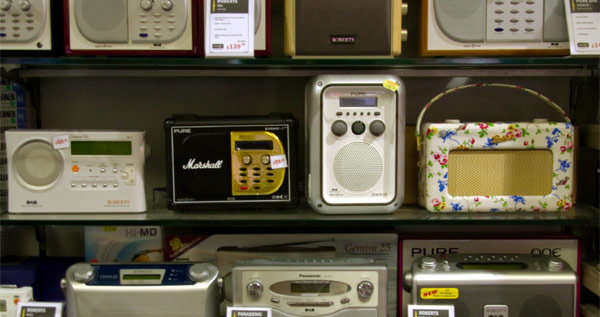
- The picture shows DAB radios in a shop. It's by Salim Fadhley. Some rights reserved.




Comment number 1.
At 16:46 26th Nov 2010, Trev wrote:Why is the BBC still waisting licence payers on DAB. DAB has been roundly rejected throughout europe.
There are 3 main problems with DAB. The low bits rates used on DAB give a sound quality greatly inferior to FM. The second problem is that DAB radio was designed with insufficient error correction making susceptable to interference. The third problem is that it is spectrally very inefficient and therefor very expensive.
Because DAB uses a higher frequency than FM the DAB signal does not penetrate walls as well as FM.
The BBC has also been guilty of missleading the public about DAB. For those interested in what is going on in the radio industry see Grant Godards blog:
https://grantgoddardradioblog.blogspot.com/
There is absolutly no chance of a digital switch over to DAB. The BBC will never be able to switch off FM until they move to a radio system that works!.
DAB is dead. Long live FM.
Complain about this comment (Comment number 1)
Comment number 2.
At 20:15 26th Nov 2010, l6m wrote:I would say this wouldn't I but currently the only reason to own a DAB radio happens to be the BBC's finest contemporary music station, BBC 6 Music, a station saved from closure by protests displaying a love for the station which nearly doubled the listenership.
If music is truly important to you, then listen to the station for a month and you'll find tuning back to Radio 1 or 2 will have you cringing. Really. It is THAT good.
So, saving 6 Music may have saved DAB because it's nothing without it.
Future platforms will IMHO be over home and future G4 mobile broadband - your car radio will have a sim card slot for this.
I have DAB in 2 cars. It's getting better in the car but still doesn't have the musicality of FM through a decent hifi.
So, support DAB for now. Everything will become obsolete eventually. It's the content that's important and not the platform. There will in future be many platforms Mac/PC, iPad/Webtablet, iPhone/Win7Phone/Android, WiFi radios and it's important that the BBC doesn't restrict HD radio to the iPlayer web browser and the forthcoming Radio Player. Steaming devices that deliver better quality and greater ease of use than computers need support - Sonos, Linn DS, Sooloos, etc. need HD support.
At least 6 Music has been re-appraised as the gem that it is. No one would dare propose its closure again. Fewer would shed tears if Radio 1 wend Web and DAB only to fit 6 on FM.
love6music.com
Complain about this comment (Comment number 2)
Comment number 3.
At 20:53 26th Nov 2010, Trev wrote:@16m
I do agree that many people like 6 music but why should people have to endure listening on an obsolete system such as DAB. The BBC wants to move the main national radio stations off of FM. As far as I can see the UK is the only country in Europe who are still supporting DAB. Most commercial radio stations are finding DAB to be too expensive. The only reason the BBC can afford such extravigence is that we are all forced to pay the licence tax.
One of my main concerns is that people may be mislead into buying DAB radios thinking that FM is going to be switched off. Commercial stations have refused to join in the current BBC advertising campaign because too many people will not be able to get a signal.
I am interested to know how good your DAB car radio reception is. When the "Working Lunch" program tested a very expensive DAB car radio in London it was useless. Signal dropouts was the main problem.
Complain about this comment (Comment number 3)
Comment number 4.
At 16:59 27th Nov 2010, LondonMark wrote:@ trevorjharris
The BBC are building out 60 new DAB transmitters within the next year, and four of these are high-power transmitters to bring reception within the M25 up to 99%, so the signal dropout problem revealed on Working Lunch should only be temporary.
In general people who have DAB in the car report that reception on the national multiplexes is very robust as they drive up and down the country with few dropouts.
If you don't like DAB that's fine - there are several other ways to listen to digital radio, and you will have the option of internet radio on the move by the time any FM switch-off happens (alongside DAB).
The last time I checked the iPhone subscription was at least £30 per month, whereas DAB is free once you have purchased the equipment.
Complain about this comment (Comment number 4)
Comment number 5.
At 01:28 28th Nov 2010, l6m wrote:@trevorjharris
To clarify, I am totally against the proposed FM switch off. It cannot, and indeed, won't happen.
However, pushing for the abandonment of DAB at this stage will see the withdrawal of valuable BBC services which better represent what the BBC should be doing than do many of it's mainstream services on FM.
My argument is that the BBC needs to focus on content and offer it's content on as many platforms as possible.
For example, most BBC podcasts are delivered via iTunes. Why then is is not possible to listen to live BBC content via iTunes as it is for thousands of other radio services?
On trains I listen to 6 Music on an iPhone on 3G, in the car on DAB, at home via a multiroom system which delivers it in better than DAB quality via broadband. Right now as it happens I'm listening to Tom Robinson on 6 Music on Freesat (also capable of better than DAB quality). The many options need to be stressed.
Also, I'd make a controversial argument for the BBC reducing it's local radio output massively except for GLR, Manchester, Wales, Cymru, Scotland, Alba.
Do we really need BBC local radio in Hereford? Berkshire? etc. etc. If you've dumbed down to local radio, then you've probably dumbed down to commercial radio.
Using the bandwidth on FM currently occupied by BBC local stations for 6 Music and 7 on FM would be welcomed.
www.love6music.com
Complain about this comment (Comment number 5)
Comment number 6.
At 09:36 28th Nov 2010, JamesH wrote:This comment was removed because the moderators found it broke the house rules. Explain.
Complain about this comment (Comment number 6)
Comment number 7.
At 10:43 29th Nov 2010, Trev wrote:@LondonMark
DAB will never be robust enough for car radios. Not a single manufacturer installs DAB as standard because nobody wants it. DAB has only one level of error correction which is one of its major flaws. As any radio engineer will tell you it is not just a case of building more powerful transmitters. To get the same sort of coverage as FM would require massive number of fill in stations which would cost a fortune. This is where the crunch comes. Commercial stations cannot afford DAB and this is were the BBC has an unfair advantage. The BBC gets its money from the Licence Tax and so is able to spend alot more money on Radio than the commercial stations. The number of Commercial DAB stations has actually decreased and many others want to leave DAB as it is uneconomic. The new Commercial DAB multiplex seems to have been abandoned completely. So DAB will give us more radio stations but only BBC state sponsored ones. This is why the BBC is trying to impose DAB on us as it will not allow the commercial stations to compete on a level playing field.
DAB+ does use a better codec and has an extra level of error correction which does improve things. But it is still too expensive. DAB is also not suitable for local radio because you would have to have a local mutltiplex which could not be filled. The current BBC answer is to use national DAB sites which greatly limits what can be done with local stations. There are other technologies available now such as Digital Radio Mondial Plus which would be cheaper to run.
One point is there are no plans to switch off FM and the band will still be need for local stations. The plan is just to switch off the national stations but the BBC will never be able to do this as not enough people will ever convert to DAB.
Complain about this comment (Comment number 7)
Comment number 8.
At 10:50 29th Nov 2010, Trev wrote:I forget to mention that anyone considering a DAB radio should insist they try it first at home. DAB uses a higher frequency than FM and does not penetrait walls well. This means you will need an oudside aerial which will add to your costs. For indoor use you will be better off with an internet radio connected to your wifi. The sound quaility is better too.
Complain about this comment (Comment number 8)
Comment number 9.
At 19:10 29th Nov 2010, LondonMark wrote:@ trevorjharris
All new Mini models (except basic entry model) have DAB as standard, as do the Ford C-Max & Grand C-Max. the Seat Leon E and various Audi and BMW models.
Do these not qualify as cars?
How can you comment on the in-car DAB reception when you haven't tried it? I have driven from London to Swansea with a properly-fitted in-car DAB and the signal did not drop out once on the national multiplexes.
I'm not convinced that the number of commercial DAB stations has decreased - do you have any stats to back up this comment? In the last year Absolute 80s, Extra & 90s have joined Digital One, Amazing Radio joined a couple of years back. Smooth Radio is a new station for many now that it's gone national and a French station has just launched in London. In addition to this Jazz FM has launched in several areas.
Complain about this comment (Comment number 9)
Comment number 10.
At 12:53 1st Dec 2010, Trev wrote:Actually you are right I was a bit out of date on car radios. You are right I do not have a DAB car radio. I just cannot stand the poor sound quality. The BBC "Working Lunch Program" fitted an expensive DAB car radio and drove round central London are the reception was apawling but FM was fine. I have seen lots of reports of people with portable DAB recievers trying to use them on thier train journey. They all report an unusable service. I know of friends who bought DAB radios and had to return them because of interference problems although they were in a strong signal area. DAB+ has added an extra layer of error correction and uses the AAC codec but the BBC refuses to upgrade. I am suprised that you did not have any problems looking at the coverage maps most of Wales is not covered.
The number of DAB stations is rather difficult to keep track of as there seem to be stations moving on and off the national multiplexes every few days. What I said was based on an annual report so I will have to wait for the next report. It does seem that one multiplex operator has reduce thier national multiplex price from 1 million to 650 thousand so this might have had some effect. Some commercial stations were bribed into going on DAB with the promise of an FM licence.
Complain about this comment (Comment number 10)
Comment number 11.
At 23:58 9th Dec 2010, Trev wrote:My wife asked for a radio for Christmas so I bought an internet radio which has wifi, DAB and FM.
Trying DAB I did get all the channels I should be able to get probably due to improved coverage in our area. I have not done any extended tests yet but the sound quality can only be described as horrible. My ears cannot stand the irritations such low bitrates produced. MP2 is just about the worst codec in use today.
I then tried the internet radio only to find that the BBC AAC streams are not available to digital radios. The BBC only makes WMA streams available at low bit rates although it is better than DAB. My radio does support AAC streams but the BBC uses proprietry Flash streams which can only be used with a Flash Player which is not available on Digital Radios. The crazy thing is that I can recieve the BBC AAC streams on my Mobile phone and I can plug this into the auxillary socket to listen on my digital radio. So the way to listen to the BBC stations with a reasonable quality is using FM.
On the one hand we have the BBC spending large amounts of money on promoting Digital Radio and at the same time discouraging digital radio by not making high quality streams available on Digital Radios via wifi. The BBC is trying to decieve people into thinking that Digital means DAB. Until the BBC starts to provide open quality streams the BBC will not be able to switch off the FM transmitters.
As many might have gathered my view is that DAB is dead. Even returning to the 256k bit rate or adopting DAB+ is not enough to bring it back to life. The public and commercial broadcasters are now in opposition to it throughout the world.
The DAB mantra has been the provision of choice but what people want more is quality both technically and in terms of content. The BBC has begun to realize this in the provision of 320kb/s AAC streams on the internet. The BBC has also shown an interest in surround sound radio. DAB+ does use AAC and I think could support 5.1 channels but it would be very expensive to run such a service.
Complain about this comment (Comment number 11)
Comment number 12.
At 20:14 10th Dec 2010, LondonMark wrote:@ trevorjharris
Even if the BBC only had five national networks or could afford to build another national DAB multiplex they wouldn't be able to use 256kbps - the vast majority of DAB sets on sale will not decode this bit rate (even the DAB+/DAB models).
Have a look at the specs in the manual for your new radio - it almost certainly only handles bit rates up to 192kbps.
Complain about this comment (Comment number 12)