BBC BLOGS - Paul Hudson's Weather & Climate Blog

Archives for November 2009

Can coal continue in a low carbon world?

Paul Hudson |19:40 UK time, Sunday, 29 November 2009

Comments

Did you know that Yorkshire has the biggest carbon footprint of any region in Britain - and the second highest in all of Europe?

It's not because we drive our cars more than anyone else; or because we use more electricity. It's because of one of the most recognisable landmarks in Yorkshire, which is also one of the most controversial. We've all seen the famous cooling towers of Drax power station near Selby, and its neighbours at Ferrybridge and Eggborough.

Drax is the biggest coal-fired power station in Western Europe. In burning coal, it emits 21 million tonnes of carbon dioxide, the same as a quarter of all the cars on the UK's roads in a year, and around 3% of the UK's total carbon dioxide output, making it the countries biggest single producer of C02. But without it, there would be a real danger the lights would go out. It generates 7% of all the UK's power, or enough electricity for all of Yorkshire

But are coal-fired power stations compatible with a low-carbon world? I've been inside Drax; they are taking steps to cut its greenhouse gas emissions. By next year over a million tonnes of Coal will be replaced by biomass materials such as straw and willow. Drax is also upgrading its turbines; once these upgrades are completed, the efficiency of the power station will rise from 38% to 40%, reducing fuel burn by ½ a million tonnes a year, and reducing C02 emissions by another 1 million tonnes. They also say that they will look closely at carbon capture if the technology is shown to work on a large scale.

But climate campaigners say it's not enough, and coal-fired power stations are simply incompatible with government targets and a greener future. By 2050, the UK government wants an 80% cut in emissions. They say that must mean an end to coal-fired facilities.

Coal is though a vital part of power generation, and along with gas is the only way to react to demand rises on a large scale. This is because nuclear power output is constant, whereas renewables such as wind only work when the wind blows. But if demand for electricity rockets, for example during bad weather, coal and gas fired stations can ramp up supply at short notice - something that other stations can't do.

It's a real dilemma; at the moment, Britain can't live without coal if we're to meet our current energy demands. But if we're to meet our targets to cut carbon emissions, we can't live with current emission levels from big coal-fired power stations like Drax, either.
'Climategate' - What next?

Paul Hudson |20:02 UK time, Tuesday, 24 November 2009

Comments

Like many of you I've been watching the story at the University of East Anglia develop with interest. I first became aware of the news late last week, but because of my weather and filming commitments couldn't deal with it myself and so passed the news on to some of my colleagues in the BBC's environment and science team, including our environment analyst Roger Harrabin who wrote about it on saturday morning, and Newsnight, who covered the story last night.

As you may know, some of the e-mails that were released last week directly involved me and one of my previous blogs, 'Whatever happened to global warming ?'

These took the form of complaints about its content, and I was copied in to them at the time. Complaints and criticisms of output are an every day part of life, and as such were nothing out of the ordinary. However I felt that seeing there was an ongoing debate as to the authenticity of the hacked e-mails, I was duty bound to point out that as I had read the original e-mails, then at least these were authentic, although of course I cannot vouch for the authenticity of the others.

There are clearly some very serious issues that arise from the information that has been released. Some people are suggesting that spin has infiltrated science. Others worry that there are suggestions that the peer review process has been compromised and those with contrary views are being frozen out. There are issues regarding data; how has it been used? But those scientists that are convinced that man is responsible for global warming are troubled that all this takes attention away from the real issue here: that action is needed to be taken from the world's biggest polluters to cut carbon dioxide emissions. This was certainly the message that came across the morning, in this story on our science website.

How will this all be resolved? Momentum does seem to be growing, from people on both sides of the argument, behind calls for a full independent enquiry that can once and for all get to the bottom of the many issues that have been raised. A recent survey showed that climate scepticism in this country is growing, and this episode may increase it further. Some would say that an enquiry is the only way to bring clarity to the science of global warming and climate change that has enormous implications for all of us.

'Climategate' - CRU hacked into and its implications

Paul Hudson |13:07 UK time, Monday, 23 November 2009

Comments


Very busy with forecast duties right now, but I do intend to write a blog regarding the UK Climate research centre (CRU) being hacked into, and the possible implications of this very serious affair.

I will add comment on this page as soon as I can free up some time. But I will in the meantime answer the question regarding the chain of e-mails which you have been commenting about on my blog, which can be seen here, and whether they are genuine or part of an elaborate hoax.

I was forwarded the chain of e-mails on the 12th October, which are comments from some of the worlds leading climate scientists written as a direct result of my article 'whatever happened to global warming'. The e-mails released on the internet as a result of CRU being hacked into are identical to the ones I was forwarded and read at the time and so, as far as l can see, they are authentic.

More later.

Hatfield gets green light from EU

Paul Hudson |13:11 UK time, Thursday, 19 November 2009

Comments

The BBC has learned that on Saturday the European Union will officially endorse the proposed carbon capture power station at Hatfield near Doncaster, to be built alongside the existing colliery, with a grant of 180 million Euros.

If all goes to plan, construction could begin next Spring, with a completion date in the middle of 2012. But this doesn't mean that coal will be used to generate electricity straight away.

The power station will in fact be gas fired, connected to the natural gas grid and capable of generating 900MW of electricity. The power station will have a 'carbon capture' kit fitted to it, and be able to switch from natural gas to hydrogen, captured from coal, provided by the Hatfield colliery next door, when the issue of carbon dioxide storage is resolved. The plant will also be able to produce excess hydrogen gas over and above what would be needed to produce electricity, to be used as green fuel for a new generation of cars, buses and lorries.

The science of carbon capture on the face of it seems simple. The idea is to split the hydrogen from coal, use it as the fuel, and capture the carbon dioxide at the same time. The carbon dioxide would be liquefied under high pressure, pumped down a pipeline through the Humber and into disused gas fields to be stored.

The long term plan would to connect all heavy carbon polluters to this pipeline, such as Ferrybridge and High Eggborough power stations, and the Corus steel works in Scunthorpe. But the pipeline itself will cost billions, if it gets the go ahead. And green activists worry that storing carbon dioxide underground is not safe or proven. They also argue there are other pollutants that are released into the atmosphere from burning coal that the new plant won't capture, damaging the environment.

The Hatfield announcement comes hot off the heels of a trial proposed by Scottish and Southern energy last week to fit carbon capture technology to Ferrybridge power station near Castleford. The reasoning behind this is simple.

All existing coal fired power stations are coming under increasing pressure to lower their carbon emissions because of the UK government's legally binding targets. This can be done in a number of ways. Firstly more efficient turbines can be fitted which would produce more electricity by burning less coal. Secondly sustainable bio-mass such as willow or straw can be used alongside coal as the fuel. Thirdly, emissions can be captured and stored. Alternatively, the power station would have to buy the right to pollute by way of carbon credits. The idea is that this would hit the profitability of the power plant, forcing them to invest in cleaner power generation. But all new coal fired power stations would have to have Carbon capture technology fitted as standard.

There are benefits to be had from carbon capture technology, not only from a reduction in greenhouse gases, but for energy security. There are still massive coal deposits under our region, and carbon capture technology opens up the prospect of utilising our own natural energy supplies, and not being reliant on foreign gas. It would also create hundreds of jobs in Yorkshire.

But there is a catch. In order to reach the government's plan to cut Carbon dioxide emissions by 80% by 2050, most of our electricity will have to come from carbon capture, renewables and nuclear power in the future. And that means much more expensive electricity in the years to come

Cloud forecasting and Cosmic rays

Paul Hudson |14:26 UK time, Friday, 13 November 2009

Comments

Despite the extent of our knowledge on clouds, and how powerful the computer is that helps us formulate our forecasts, we still do not seem to be able to forecast cloud amounts with any reasonable consistency.

Sometimes the computer models are wrong only six hours ahead! And there can be no doubt about it, cloud has an enormous role to play in calculating temperature levels, and forecasting its extent correctly is at times a major challenge.


Most scientists believe that greenhouse gases are largely responsible for temperature rises particularly during the second half of the last century. But if cloud is so important in predicting global temperature levels, how can we have confidence in projections fifty years ahead when cloud detail for short term forecasts can often prove elusive?

Thinking about clouds reminded me of a seperate, relatively poorly understood and controversial branch of climate change science; cosmic rays.

It's thought by some that cosmic rays can cause changes in cloud cover, by creating condensation nucleii, the very seeds of clouds around which water molecules are attracted to form clouds.

When the sun is active, so the theory goes, its magnetic field is stronger and so better at shielding us against the cosmic rays coming from outer space, before they reach our planet. High solar activity means fewer condensation nucleii and so fewer clouds and, if the theory is correct, a warmer world. Low solar activity and poorer shielding against cosmic rays result in increased cloud cover and hence a cooling. By regulating the Earth's cloud cover, it's thought the sun may turn the temperature up and down.

As the sun's magnetism increased in strength (higher sunspot activity) during the twentieth century, its thought that this natural mechanism may be responsible for at least some of global warming seen during the last century, as a result of decreased cloud cover.

But successive pieces of research has failed to find any link between cosmic rays and cloud. Mike Lockwood, from the UK's Rutherford-Appleton Laboratory, found no link in the last forty years.

More recently a University of Lancaster team found no significant link between cosmic rays and cloudiness in the last twenty years.

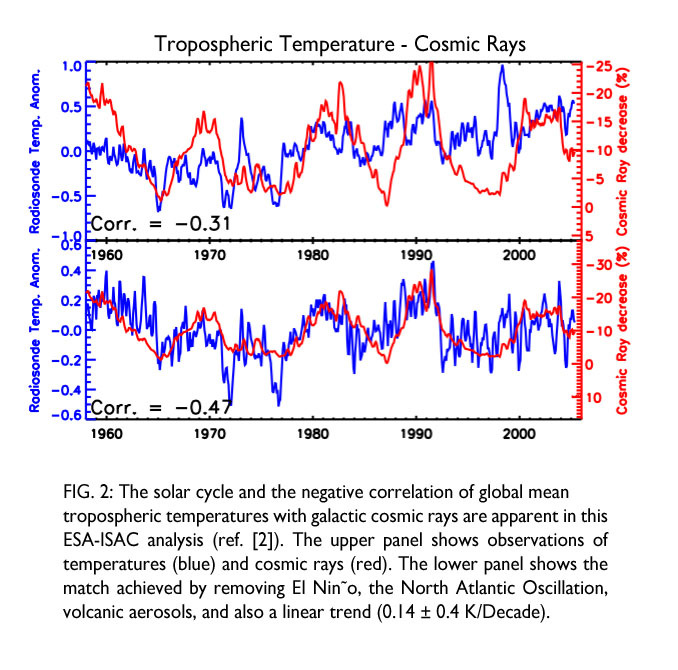
But in a paper by Henrik Svensmark and Eigil Friis-Christensen, at the Danish National Space centre, they claim that there is a link between cosmic rays and global temperatures. See diagram below.

PHgraph121109.jpg

So the arguments go on as to what effects cosmic rays have on temperature levels. There is very little in the IPCC report on the subject, but its difficult not to conclude looking at the above graph that there is an obvious link between temperatures and cosmic rays - even if the mechanism is poorly understood.

The idea that cosmic rays do impact us on earth by affecting our climate has been recently given a boost by research conducted last month into tree growth. The researchers tried to correlate tree growth to solar activity (hence cosmic rays) - and found a link.

According to them, an increase in cloud cover and haze would diffuse the amount of solar radiation reaching the trees. As diffuse radiation penetrates forest canopies better than direct light, it would increase the amount of radiation that plants capture, and increase photosynthesis by trees, boosting growth.

It would seem that it may well be in everyone's best interests to conduct more research into this intriguing branch of solar and climate science.

(Please note: Text highlighted in blue links to relevent research)

Global temperatures - and the future

Paul Hudson |14:08 UK time, Friday, 6 November 2009

Comments

And so to the ongoing issue of global temperatures, whether they have gone up down or flat lined and in what time period. I stated in my original article 'Whatever happened to global warming' that temperatures peaked in 1998, and have levelled out since then. I argued that it was not appropriate to take out the El Nino event from 1998 as some had suggested; for a level playing field other ocean oscillations would have to be taken out too.

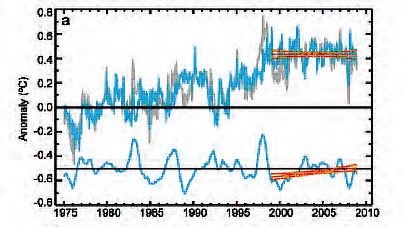
However, for those that still insist that I should have not have picked on the hottest year on record, lets for argument's sake say I was wrong. With that in mind, I draw your attention to some research that is readily available on the Met Office website, in which they not only start with 1999, the year following the hottest year on record, but also strip the data of all El Nino/Southern Oscillation ocean effects to see what's happening to underlying global temperatures. (Note: Nasa GISS data is warmer; satellite data though seems on the face of it cooler than GISS so I'm sticking to the data set I know).


Take a look at the diagram below.

PHGRAPH.jpg

According to the Met Office, the least squares trend from Jan 1999 to Dec 2008 is 0.07 +/- 0.07C per decade, much lower than the 0.18C per decade from 1979 to 2005, despite steady increases in Greenhouse gases. (note the small rise is only the same as the error/noise level)

The trend in the ENSO related component (1999-2008) is 0.08 +/- 0.07C - virtually the same as the observed trend (again note clearly very close to noise levels)

Hence the trend once El Nino/SO type events are removed is 0C +/- 0.05C per decade - i.e no rise at all in underlying global temperatures.

So either from 1998, or looking at underlying temperatures 1999 onwards, then at the very least temperatures have flat lined - global warming has, at least for the time being, faltered - despite a relentless rise in C02 emissions.

Now some of you will say that the period of time is too short to draw any conclusions. But I am only trying to highlight the fact that global warming has, at least for the time being, levelled off.

The full article can be found on the Met Office website ; it explains why the Met Office believes levelling off of global temperatures is to be expected at times.

There's another element of the research which illustrates how interesting the debate is becoming.

The authors say that they have been able to simulate near zero or even negative temperature trends for intervals of a decade or less, due to the model's internal climate variability. But importantly, the simulation's rule out zero trends for intervals of 15 years or more.

And it seems that this is where the Met Office's forecast for the next five years originates from. (They say from 2010 to 2015 at least half the years will be hotter than the hottest year on record). The authors continue 'given the likelihood that internal variability contributed to the slowing of global temperature rise in the last decade, we expect that warming will resume in the next few years consistent with predictions from near term climate forecasts (source Smith et al. 2007 - note the date - we are nearly 3 years on from when this statement was made).

So, one could reasonably argue that in the next five years, we will have a far better idea about the extent to which man is warming the planet, and how much is perhaps from naturally driven mechanisms. If the Met Office is right, and temperatures rise to record levels in the next 5 five years, then the sceptics will have no-where to hide. If the Met Office is wrong, and in the next few years we have not exceeded 1998 temperature levels, then this would cause big questions to be asked - remember their simulations rule out zero trends for 15 years or more.

And talking of long term predictions, while I was away last week, Piers Corbyn from Weatheraction, held his much awaited conference. You remember I talked in my article about his theory that solar particles and their interaction with our atmosphere is the main driver of global temperature levels? My colleagues Richard Black and Roger Harribin went along. You can read Richard's account on his blog

Note once again Piers' assertion that there will be no further warming for decades, if his theory is correct.

And finally, I have also been asked to clarify Dr Latif's comments at the Geneva climate conference in September, when he talked about the possibility of no more warming for the next decade or so. Can I point you in the direction of another article from Richard , which covered the subject last year, when the research was released by Kiel University, plus an article from Tom Fielden's Radio 4 blog written following Dr Latif's comments in September of this year.