


- 8 May 08, 06:00 AM
No prizes for guessing that today's instalment is related to the Games of the XXVth Olympiad, hosted by Barcelona.
The world was undergoing many changes through the late 1980s and early 1990s and this was reflected at the 1992 Olympics.
South Africa returned to the Olympic family after their apartheid regime led to them being suspended after the 1960 Games.
German reunification in 1990 meant that they participated as a single team for the first time since 1960.
The dissolution of the Soviet Union in 1991 meant the Baltic nations of Estonia, Latvia and Lithuania participated with their own teams for the first time since 1936 while other Soviet republics took part as the "Unified Team".
The break-up of Yugoslavia led to the debuts of Croatia, Slovenia and Bosnia and Herzegovina.
Yugoslav athletes were only allowed to compete under the Olympic flag as Independent Olympic Participants due to United Nations sanctions.
And they say sport and politics don't mix.
Fittingly, one of the stories of the Barcelona Games involved two African athletes.
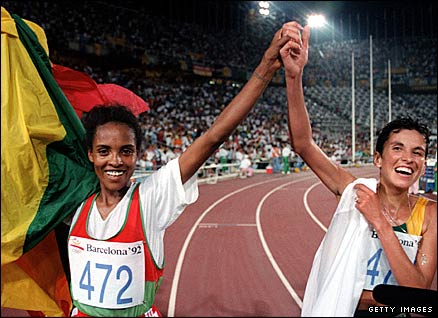
Ethiopia's Derartu Tulu won the 10,000m to become the first black African woman to earn an Olympic medal.
Tulu waited for second-placed Elana Meyer, a white South African, to finish before the two set off hand-in-hand for a symbolic victory lap.
What are your favourite memories from 16 years ago?
BBC Sport The Olympic Broadcaster
React to comment, analysis and opinion from BBC Sport experts at Beijing's Olympics and Paralympics.
Our bloggers in Beijing

Interactive Beijing map
Meet Monkey
Latest Photos
Clicking on any of these photos will take you to an external site.
Topics
Podcast
Download or subscribe to this programme's podcast


Fun and Games
Olympic standard
Do you have what it takes to excel at Denise Lewis' heptathlon?

The BBC is not responsible for the content of external internet sites

Comments
Sign in or register to comment.